These playbooks are your concise, actionable guides to navigating this turbulent period. They are designed specifically for Canadian SME leaders who need immediate, low-cost strategies to mitigate the impact of these tariffs and emerge stronger.
Part 1 offers practical tactics for cash flow protection, cost control, supplier management, and payment term optimization.
Part 2 expands on these concepts with deeper strategies regarding customer communications, market diversification, business model adaptation, warehousing, competitive intelligence, corporate structuring, and accessing government relief.
Weathering the Storm, Part 1


Weathering the Storm, Part 2
Update (August 2026): Following the collapse of trade talks and the introduction of new 50% U.S. tariffs on August 22, we're preparing an addendum to the Tariff Playbook addressing the latest round of measures and Canada's September 8 retaliatory response. Check back here or follow World Trade Centre Toronto on LinkedIn for the update.
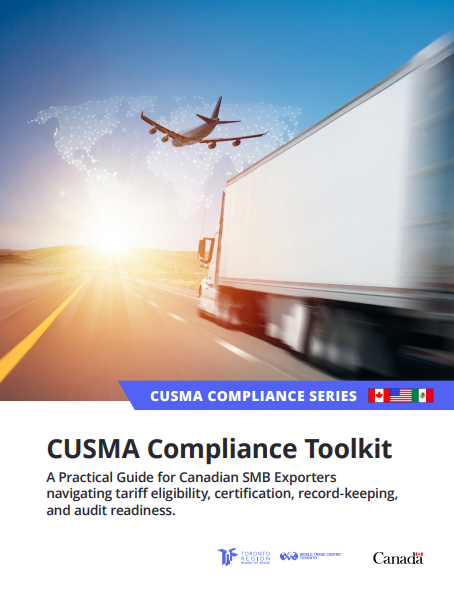
If your products qualify under CUSMA, you shouldn't be paying tariffs — but paperwork errors mean many Canadian businesses do. Our free toolkit helps you classify goods correctly, certify origin, and stay audit-ready.



- This page lists the specific U.S. products subject to Canada's counter-tariffs of 15%, 25%, and 50%, effective September 8, 2026, in response to the U.S. 50% tariff on Canadian goods. Organized by Harmonized System (HS) code, it reflects the current, in-force retaliatory tariff schedule.
- A free tool that allows businesses to quickly look up tariff rates for specific products and countries where Canada has a Free Trade Agreement. Users can access tariff information even without an HS code, making it easier to estimate costs for international trade.
- A searchable database that helps businesses find trade data by product using the Harmonized System (HS) code. It provides insights into import/export trends, key markets, and trade flows to support informed decision-making.
Regional Tariff Response Initiative in Southern Ontario — FedDev Ontario
- FedDev Ontario's Regional Tariff Response Initiative (RTRI) supports southern Ontario SMEs affected by tariffs, with non-repayable contributions of $125,000–$3 million and repayable contributions up to $10 million. As of September 2026, the program has been bolstered by an additional $1.5 billion, raising the non-repayable cap from $1 million to $3 million and introducing up to $2 million in new liquidity support for businesses facing cash-flow pressure.
Process for requesting remission of tariffs that apply on certain goods from the U.S. — Canada.ca
Outlines the federal process for businesses to request remission (relief) from tariffs applied to certain goods imported from the U.S., including eligibility considerations and how to submit a request.
Government of Canada: Navigating U.S. Tariff Challenges
- This webpage offers insights on trade and investment with the U.S., including market trends, key policy updates, and opportunities to support cross-border business growth to help businesses navigate the Canada-U.S. economic landscape.
RBC Trade Hub: Building a Resilient Economy
- Explore RBC's Trade Hub for in-depth research and strategic analysis on Canada-U.S. trade relations. The hub now features Trade Zone, a weekly briefing series covering the latest tariff developments, CUSMA negotiations, energy and pipeline economics, and cross-border sector impacts; giving businesses a current, ongoing read on trade risks and opportunities alongside RBC's flagship reports.
Tariff support for Canadian exporters — EDC Trade Impact Program
- EDC's Trade Impact Program (TIP) provides financing, insurance, and advisory support specifically for Canadian exporters affected by tariffs, helping businesses manage cash flow and mitigate trade-related risk.
BDC: Resources for Canadian businesses facing U.S. tariffs
- Access valuable guidance for businesses affected by U.S. tariffs, including a cash flow calculator to assess financial impacts.