Hitachi Rail in Canada
Hitachi Rail is a global leader in rail and digital mobility, committed to accelerating the transition to more connected, smooth and sustainable transportation. With more than 24,000 employees in over 50 countries and annual revenues exceeding C$11 billion. Its expertise spans the full rail ecosystem, from high quality rolling stock and maintenance to digital signalling, payment systems and smart operations, drawing on the advanced digital and artificial intelligence capabilities of the wider Hitachi Group.
In Canada, Hitachi Rail employs more than 1,300 people, with its global centre for Communications Based Train Control engineering based in Toronto, and additional locations in Vancouver, Montreal, and Ottawa. The company develops and exports world leading digital signalling technology for metro systems worldwide, and delivers major transit projects across the country, including the Ontario Line and the Hazel McCallion Line.

Arnaud Besse, COO, Hitachi Rail Canada
Arnaud Besse shares how Toronto has become a world leading hub for rail technology and talent. With deep experience delivering complex transit projects globally, Arnaud oversees major investments in next generation signalling, workforce development and the delivery of transformative projects such as the Ontario Line. Under his leadership, Hitachi Rail is strengthening Canada’s role as a global exporter of signalling solutions while helping shape the future of urban transit in the GTA.
Urban rail systems around the world face a common challenge: how to carry more passengers without the cost and disruption of building new tunnels and tracks. Toronto is no exception. Thankfully, Toronto-made innovations are solving that very problem both here and globally.
Hitachi Rail addresses this through Communications Based Train Control (CBTC), the digital brain of a modern transit system. CBTC precisely controls train movements, speed and spacing by continuously knowing where each train is in real time. Developed in Toronto, Hitachi Rail’s SelTrac™ signalling system allows trains to safely run up to every 60 to 90 seconds, increasing capacity by 20 to 40 per cent without expanding physical infrastructure. For cities facing congestion and funding constraints, that is transformational.
The impact is global. In London, UK, Hitachi Rail is delivering the 4 Lines Modernisation programme, one of the most complex rail signalling upgrades ever undertaken. The project replaces signalling systems within a infrastructure that is up to 150 years old across nearly half of the London Underground network. When complete, it will boost peak passenger capacity by 33%, with an increase from 24 to 32 trains per hour. All this will occur while minimizing disruption for riders with a specific focus on keeping line closures to an absolute minimum.
The benefits go beyond capacity. Digital signalling also delivers smoother journeys, reduces wear on trains and track, and cuts energy use. Energy can account for as much as 40% of subway operating costs. In Dubai, CBTC technology developed in Toronto helped reduce metro energy consumption by around 15 percent.

A Global Industry, Built in Toronto
Toronto is both a major customer and a global exporter in this space. The region is investing heavily to expand and modernize transit, while also serving as a world leading hub for rail technology. From Hitachi Rail’s new state of the art facility in Scarborough, more than 1,100 highly skilled engineers are developing solutions that are deployed in over 100 lines in 40 countries worldwide, including Vancouver, Ottawa, Montreal and Toronto.
It is little known but Toronto’s leadership in this space comes from its invention of the first CBTC system back in the 1970s. Support from the then provincial government put the city at forefront urban rail technology and saw Toronto developed signalling enabled Vancouver’s SkyTrain to become the world’s first fully automated metro.
This legacy continues today. In 2024, Hitachi Rail announced a $100 million investment to develop the ninth generation of this signalling technology – SeltracTM CBTC. From its HQ in Toronto, its engineers are developing a next generation that integrates artificial intelligence, cloud computing, and 5G connectivity. These features aim to further enhance an already hugely successful technology and continue to improve the performance, resilience and customer experience it delivers.
Innovation at this level depends on talent. Hitachi Rail is investing $30 million in a new global competence centre in Scarborough as the new modern home for its employees. Toronto’s deep pool of engineering and technology expertise is a major competitive advantage. To strengthen the pipeline further, Hitachi Rail has partnered with Ontario Tech University to support Canada’s first dedicated Railway Engineering program, helping build the next generation of rail specialists and keeping critical skills in the region.
Being part of the Hitachi Group allows Toronto based teams to leverage this investment from a leading global company. It also means that local leaders and customers have greater access to technologies from Hitachi business across the world, including pioneering high speed rail, battery trains, advanced energy systems and digital platforms.
Transforming Mobility at Home
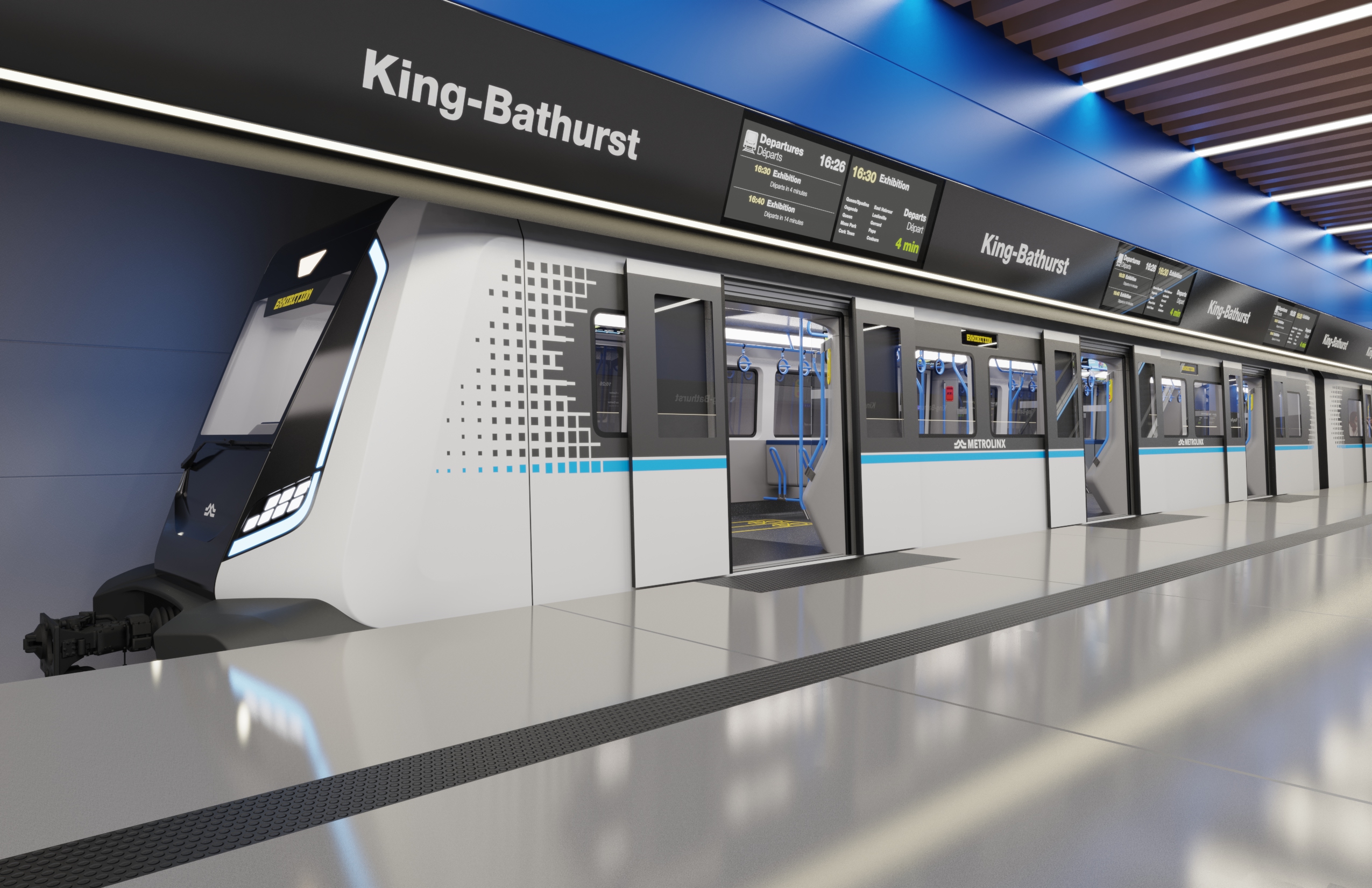
Hitachi Rail’s technology is also being applied to one of Canada’s most important transit projects. The company is the lead in the consortium delivering trains, signalling, systems, operations and maintenance for the Ontario Line, the largest subway project currently underway in North America. The new line is essential for a region that has grown by nearly 1.5 million people over the past decade and is expected to add another 1.2 million in the next.
The Ontario Line will be fully automated, with driverless trains running as frequently as every 90 seconds through the most congested area of Canada. Platform screen doors, digital passenger information systems and regenerative braking will improve safety, reliability and energy efficiency. The project will also serve as a test bed for advanced digital asset management, setting the foundation for smarter operations across Toronto’s wider transit network.

Looking Ahead
Rail is entering a new era. Growing cities in Canada and around the world are demanding more from their infrastructure. Digital rail technology will play an increasingly central role.
The recent investments in Toronto reflect decades of world leading signalling expertise and confidence in the region’s future. For Hitachi Rail, Toronto is not just a place where technology is delivered. It is where the future of urban mobility is being designed, built and is transforming cities in Canada and around the world.