In innovation-driven sectors, progress is rarely limited by a lack of talent. More often, it stalls when expertise is fragmented and disciplines operate in parallel rather than in partnership. For Shamini Ayyadhury, Founder and CEO of Panoramics – A Vision, recognizing that pattern became the starting point for building something Canada did not yet have.
“In my role, I’ve focused on building community and advancing innovation where biology, computation and AI come together,” Shamini says.

Panoramics – A Vision is a Canadian organization focused on building community and advancing innovation in emerging areas of life sciences where biology, computation and artificial intelligence intersect. Through events, learning programs and applied research, the organization brings people together across disciplines and helps turn new ideas into real-world impact.

Why Life Sciences Need More Than Breakthroughs to Scale
Life sciences play an increasingly important role in the Toronto region’s economy. The sector supports high-value jobs, attracts global investment and underpins growth across healthcare, advanced manufacturing, data and AI. As the sector becomes more complex and technology-driven, its success depends not only on scientific excellence, but on how well people, institutions and businesses work together.
At the centre of Panoramics - A Vision's work is biological topography, an emerging field that studies biological systems in three-dimensional space using spatial and single-cell technologies. While technically complex, its relevance is clear. “Since a 3D organism’s structure and function depends on its spatial organization, understanding biological architecture has a high impact on the life sciences and healthcare,” she explains.
Over the course of her career as a spatial and single-cell biologist, Shamini has worked across academia, industry and clinical environments. That experience gave her a clear view of how innovation ecosystems function in practice.
“I had the privilege and opportunity to engage with diverse personas from academia, industry and clinic,” she says, “and to understand the complexities behind the science, engineering, economics and the business of spatial and single-cell biology.”
What she observed will feel familiar to leaders across many sectors. “I slowly recognized gaps that were real: siloed conversations, limited cross-disciplinary exchange, technical bottlenecks and a lack of pedagogy frameworks to support knowledge and skills acquisition,” Shamini says.
Breakthrough work was happening, but too often without the connections needed to scale it.
From Insight to Action
That realization led to the launch of True North Spatial, Panoramics – A Vision’s flagship initiative and Canada’s first national summit dedicated to spatial and single-cell biology.
“Canada has extraordinary talent in this space,” Shamini says. “But it needed a unified national platform to connect, amplify and project that talent onto the global stage.”
True North Spatial was designed to move beyond the traditional conference model. Rather than focusing solely on presentations, it brings together computational scientists, wet-lab biologists, clinicians, AI developers and business leaders to learn from one another and identify opportunities to collaborate.
“It was founded as a space where discovery, learning, innovation and critical dialogue come together,” Shamini explains. The goal is shared understanding and practical collaboration, not parallel conversations.
For business leaders, the lesson is straightforward. Ecosystems grow faster when people are given the structure to collaborate and the language to work across disciplines.
Why Toronto Is Central to the Vision
For the Toronto region, True North Spatial reinforces a broader economic opportunity. “Canada is trusted globally. Reliable, safe, liberal and accepting,” Shamini says. “It is the ideal choice for the creation of a North American hub for spatial discovery.”
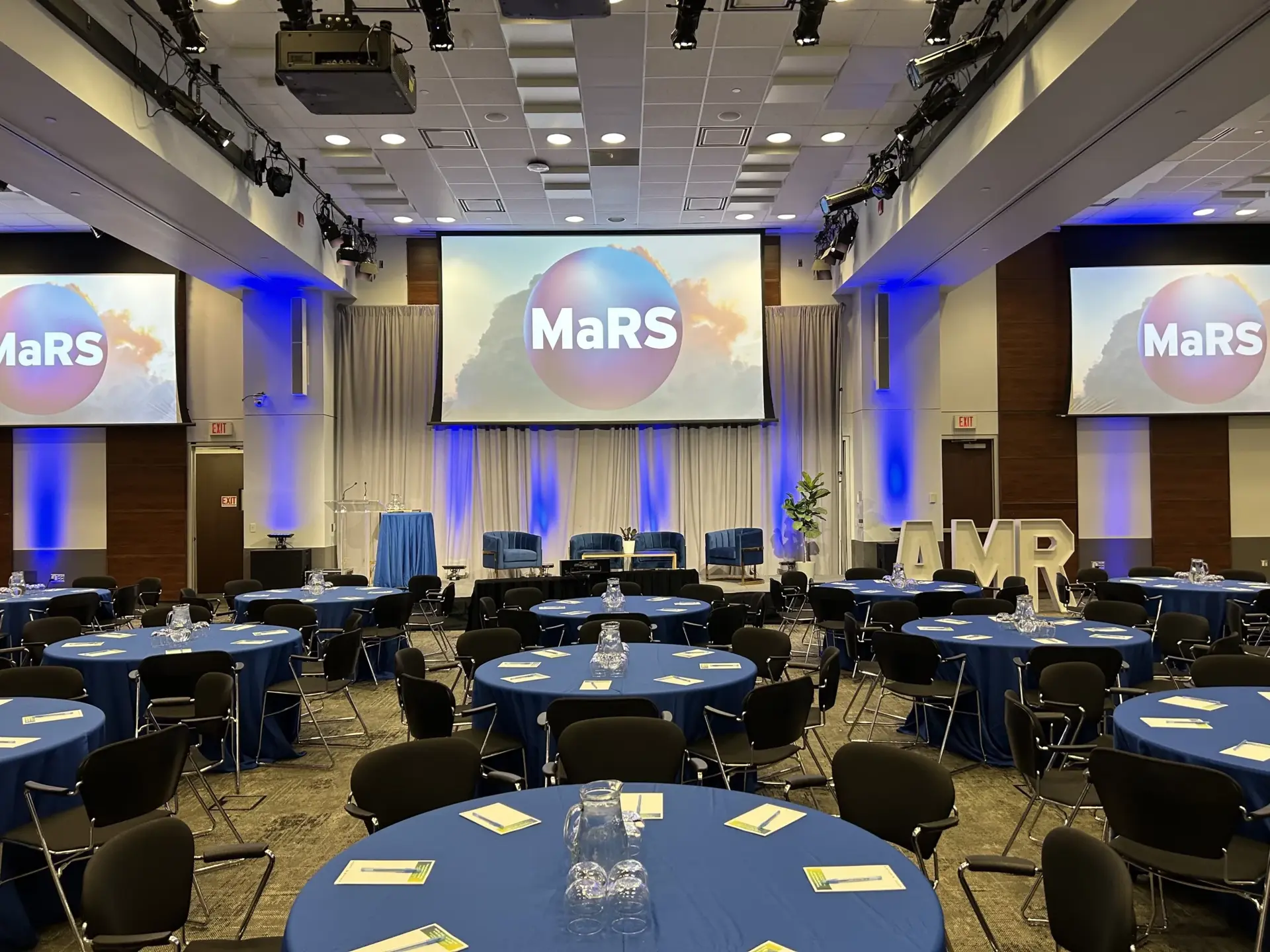
Hosting the summit at the MaRS Discovery District places it at the centre of Toronto’s life sciences ecosystem, surrounded by hospitals, academic institutions and research hubs. It is an environment where connections made in one room can translate into partnerships, investment and applied innovation.
“Our participants are convening at a strategic epicentre where science, healthcare and business converge,” Shamini says. Attendees gain access to high-quality scientific discourse, exposure to cutting-edge technologies, visibility for Canadian-led innovation and opportunities to build collaborations that extend beyond the event itself.
At its core, True North Spatial lowers barriers. “It creates space for cross-sector fluency,” she explains. “Where people learn to speak a shared language despite very different backgrounds.” That principle is as relevant to growing businesses as it is to emerging sciences.
Building Without a Template
Launching a first-of-its-kind national platform came with challenges. “Being a pioneer means every build had to be intentional. We had no legacy template to fall back on,” Shamini says.
As a young organization operating in a rapidly evolving field, Panoramics – A Vision also had to build trust while navigating limited resources and broader economic uncertainty. The response was clarity and focus.
“True North Spatial is a reminder to stay oriented toward what truly matters: discovery, collaboration and the courage to move science forward,” Shamini says.
Looking Ahead
True North Spatial represents just one part of Panoramics – A Vision’s longer-term strategy. “Any aspirational pedagogy or futuristic innovation must be grounded in community engagement and real-world impact,” Shamini explains.
The summit serves as a community anchor, a learning environment that informs research and development priorities and a platform designed to evolve alongside Canada’s spatial ecosystem.
For leaders considering similarly ambitious initiatives, Shamini offers practical advice. “The first is always the hardest. Trust does not scale automatically,” she says.
Progress comes from discipline, focus and consistency. “Set milestones, take each day for what it is and prioritize project management. And above all, believe in yourself. Know that this is happening because of you.”