The Toronto region has grown by two million residents over the last two decades. Its transportation infrastructure has not kept pace. Those two facts set the tone for the Board's 11th Annual Transportation Symposium. The day was built around the question: what will it take to build a fully integrated, multimodal transportation network across the region?
Canada's Minister of Transport Steven MacKinnon, speaking in a video address, framed the economic case: "Transportation policy is economic policy. For this sole reason, we need to build the trade infrastructure of the future. This is about making sure our entire transportation network runs smoothly as one effective unit from end to end."
It is exactly that kind of thinking that drove the Board to release Faster Commutes: Advancing Regional Fare and Service Integration the day before the symposium. Building on the success of the OneFare program, the report calls for harmonized timetables across all regional agencies, buses that can cross municipal boundaries freely, a 10-minute base service standard across the region, common wayfinding, and full integration of GO fares into a single regional system.
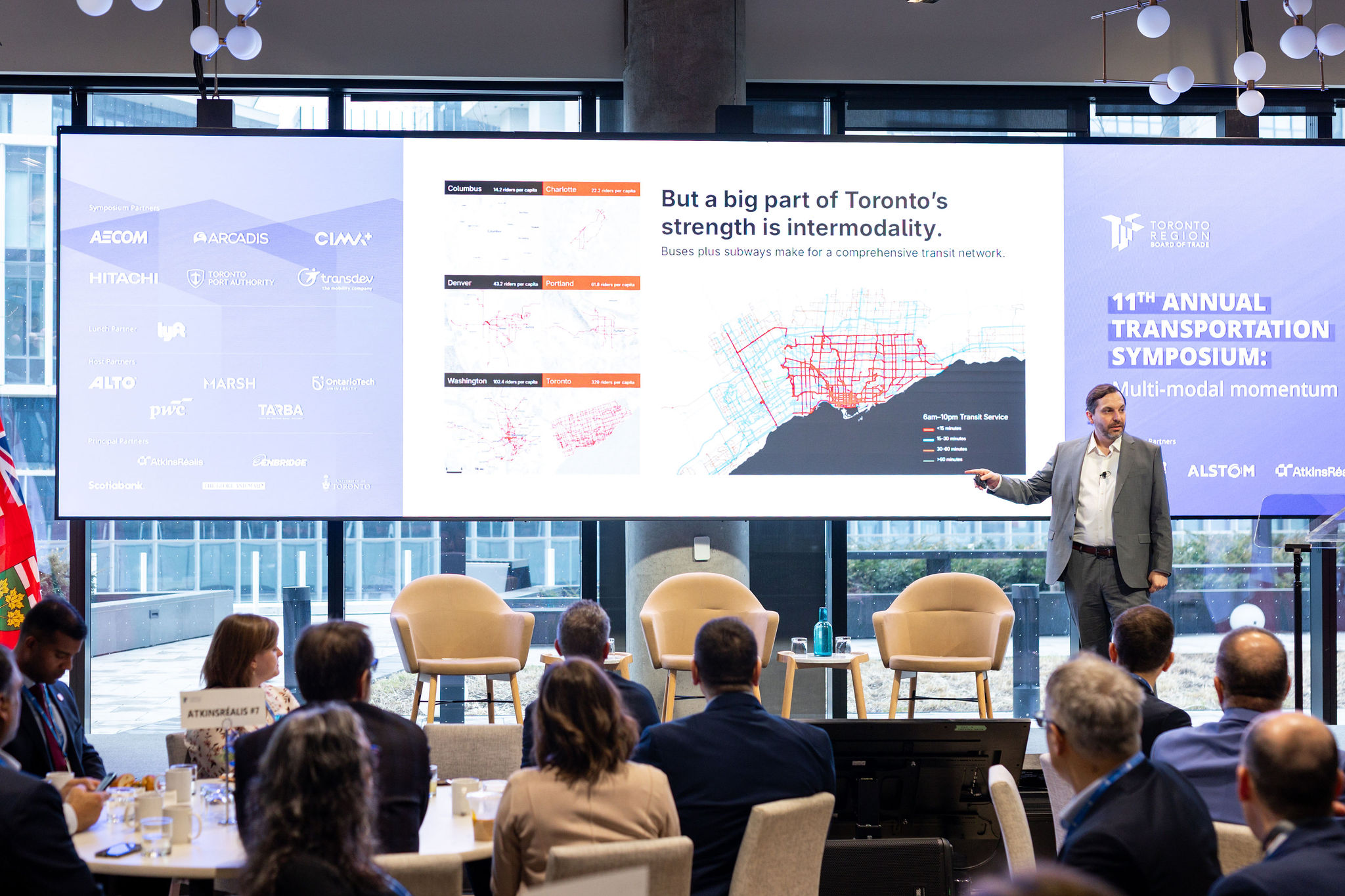
Jonathan English of Infrastory Insights put the rider experience at the centre of the day's discussion: "However somebody wants to travel from A to B, it should be a seamless journey. They shouldn't have to think about who's operating it. What map do I have to check? What website do I have to check? We need something that integrates everything from bus to train to airport to even boats."
Our President and CEO Giles Gherson was equally direct. The goal, he said, is "for riders to be able to move across transit agencies in the region as if it was a single, seamless network. Railways across Europe already coordinate around a single continental rail timetable. Doing the same across the GTA is surely achievable."
Toronto's strength is intermodality, and it needs to be unlocked
The region cannot catch up to Paris or London by building subway lines alone. When all modes are counted, transit, rail, road, and active transportation, the region performs better than it appears. North America’s busiest subway per kilometre runs in Toronto not in spite of its bus network but because of it. The priority now is building on that foundation through fare integration, all-day service, and seamless transfers that make the whole network feel like one system.
Nobody cares what colour the bus is
Transit leaders argued that planning has too long been preoccupied with form over function. The region needs to put a customer lens on integration and start knocking off the practical barriers. As TTC Chief Strategy Officer Josh Colle put it: "If someone wants to get to work or get home, they don't care what the colour of the bus is. They should just be able to get on the first bus that comes to help them complete their journey as expeditiously as possible." Forty per cent of riders are already using digital payment forms, a strong foundation for the deeper fare integration that comes next.
Canada's first high-speed rail is moving
Alto's plan to build Canada's first high-speed rail corridor, a roughly 1,000-kilometre line, would reduce travel time between Toronto and Montreal to under three hours. Construction is targeted to begin between 2029 and 2030, starting with the Ottawa-Montreal segment before extending west. Speakers acknowledged Canada is late to high-speed rail, but argued the window has not closed. The Toronto segment, the most constrained on the corridor, will benefit from every lesson learned building east.
Delivering major projects requires collaboration built in from the start
Collaboration fails when risk is allocated before it is properly understood. The foundation of any successful delivery model is due diligence and early engagement with contractors and engineers, before costs are locked and pressure mounts. One speaker offered a vivid measure of Toronto's progress on this front — when he arrived from Paris a decade ago, the city had two metro lines. Today it has four.
Infrastructure is only as strong as its integration
Ports, airports, and transit cannot be treated as separate utilities. They are integrated systems that move people, goods, and economic opportunity. Billy Bishop Airport's new U.S. preclearance facility, 15 years in the making, is already creating opportunity for new destinations. Hoverlink's plans to connect downtown Toronto to the Niagara Peninsula in 30 minutes continue to move forward. The question is not whether to build, but how to make smarter use of the assets already in place.

Getting FIFA is proof the region is doing more right than it thinks
Nashville had the stadiums, the hotels, and the tourism infrastructure to host a FIFA World Cup. FIFA said no because of transit. Steve Townsend of Cintra, who worked on Nashville's unsuccessful bid, brought that lesson to the room: "The fact that you have matches coming here means you're doing something very right. You all are very hard on yourselves, but as a neighbour, you're doing things good and pretty well. Take stock of the fact that the largest sporting event in the world is coming here."
The Detroit-Toronto rail corridor could return by 2029
Detroit Riverfront Conservancy CEO Ryan Sullivan presented a vision for reconnecting Detroit and Toronto via passenger rail for the first time since the 1970s. A future multimodal hub anchored by the restored Michigan Central Station is already under development. A CP-KCS rail merger concession has reopened the Windsor-Detroit tunnel to potential passenger service. The link is described as the one missing piece connecting Toronto, Detroit, and Chicago, three of North America's most important economic hubs, at an estimated cost of just $40 to $50 million.
100 km + 33 km
Toronto currently has 100 kilometres of rapid transit, with 33 kilometres more under construction. While this still falls well short of peer global cities, the region's full multimodal picture is more competitive than the subway numbers alone suggest.
76 million
Riders on GO Transit and UP Express last year, a more than 10 per cent year-over-year increase. Minister Sarkaria cited the figure as evidence that GO Expansion is already delivering, even as electrification timelines evolve.
$1,600
The estimated annual savings per full-time commuter from the OneFare program, which eliminates double fares for riders transferring between the TTC and regional transit agencies. Approximately 72 million transfers have been taken under the program, translating to roughly $220 million in rider savings.
$200 billion
Ontario's total infrastructure budget, with approximately $100 billion allocated to current and planned transit and highways projects.
$40 to $50 million
The estimated investment required to restore passenger rail service between Detroit and Toronto via the Windsor-Detroit tunnel, described as a comparatively modest price for reconnecting three major North American economic hubs.
"Tackling congestion in the Toronto region will take a full toolbox and a coordinated approach. We need to manage demand, protect reliability, and make the most of the assets we already have so the entire network performs better for everyone."
— Christina Basil, Vice President, Communications & Government Relations, 407 ETR
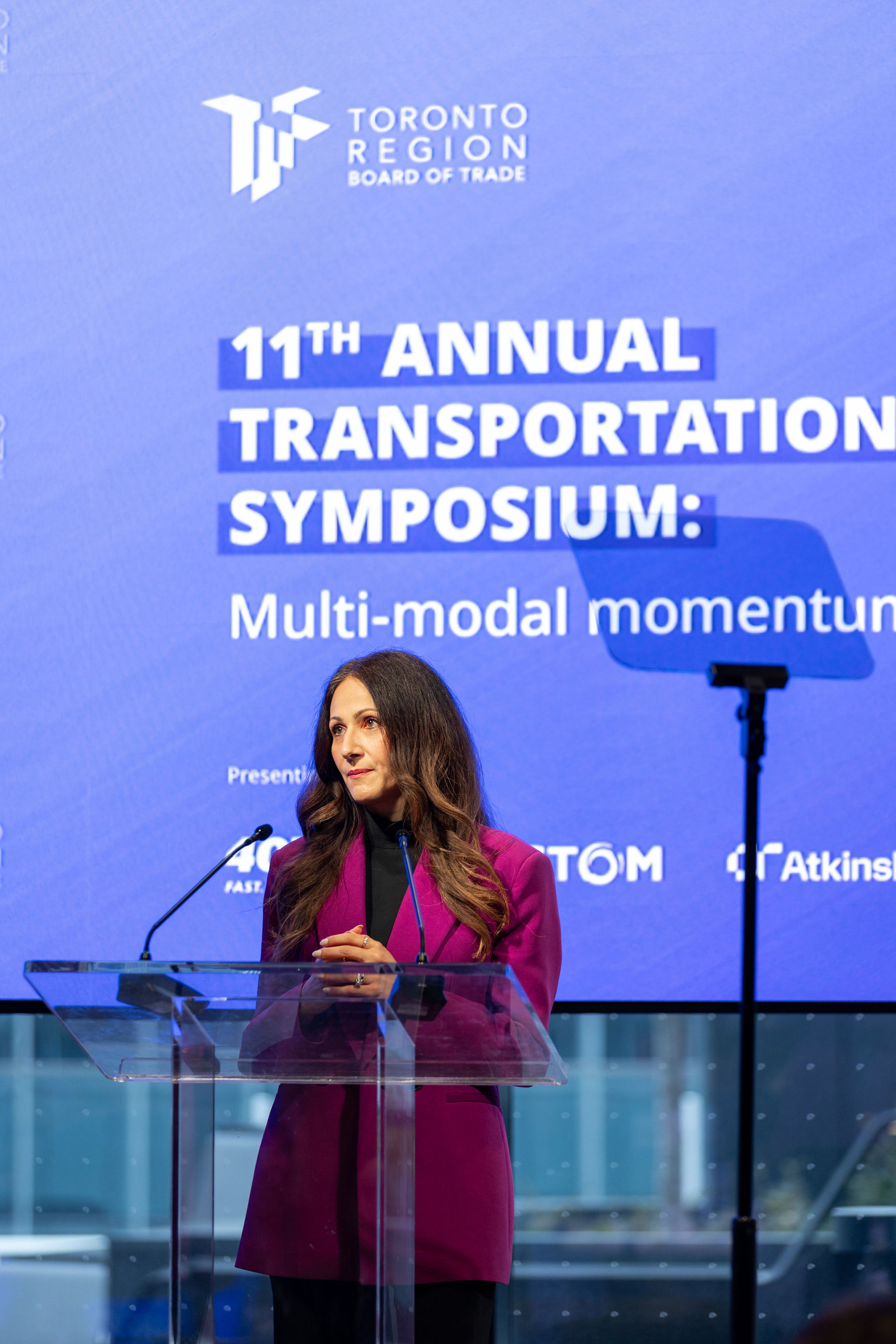
"We've attracted some of the best talent, but more importantly, we've been able to train a lot of people here in this province to work on these big projects that we didn't have. I think you now actually have an ecosystem — whether it's from a talent perspective or the world looking at Ontario and saying, 'wow.'"
— Hon. Prabmeet Sarkaria, Minister of Transportation, Government of Ontario, on what Ontario has built through its major transit program

"This has to be a partnership. Government doesn't build these things. The private sector builds these things and does it best. So it's not that government needs to get out of the way, but government needs to be a partner. And a partner that creates those conditions that make it possible and to make it faster."
— Hon. Todd J. McCarthy, Minister of the Environment, Conservation and Parks, Government of Ontario
"I actually am quite excited about what transit will feel and look like in 20 years. I think it will be a generational change in the experience and in the integration and the service."
— Maya Kolaczynski, Chief Strategy and Planning Officer, Metrolinx
"Most of the beneficiaries of high-speed rail in Canada, they're not even born yet. A lot of the other beneficiaries are in school. And a whole bunch of other people who are beneficiaries are hard-working families. None of those people have any opportunity, really, or time — or they don't even exist — to engage with the stakeholder process."
— Russell Jackson, Chief Executive Interim, Global Transportation, AECOM, on the challenge of building public support for long-horizon infrastructure
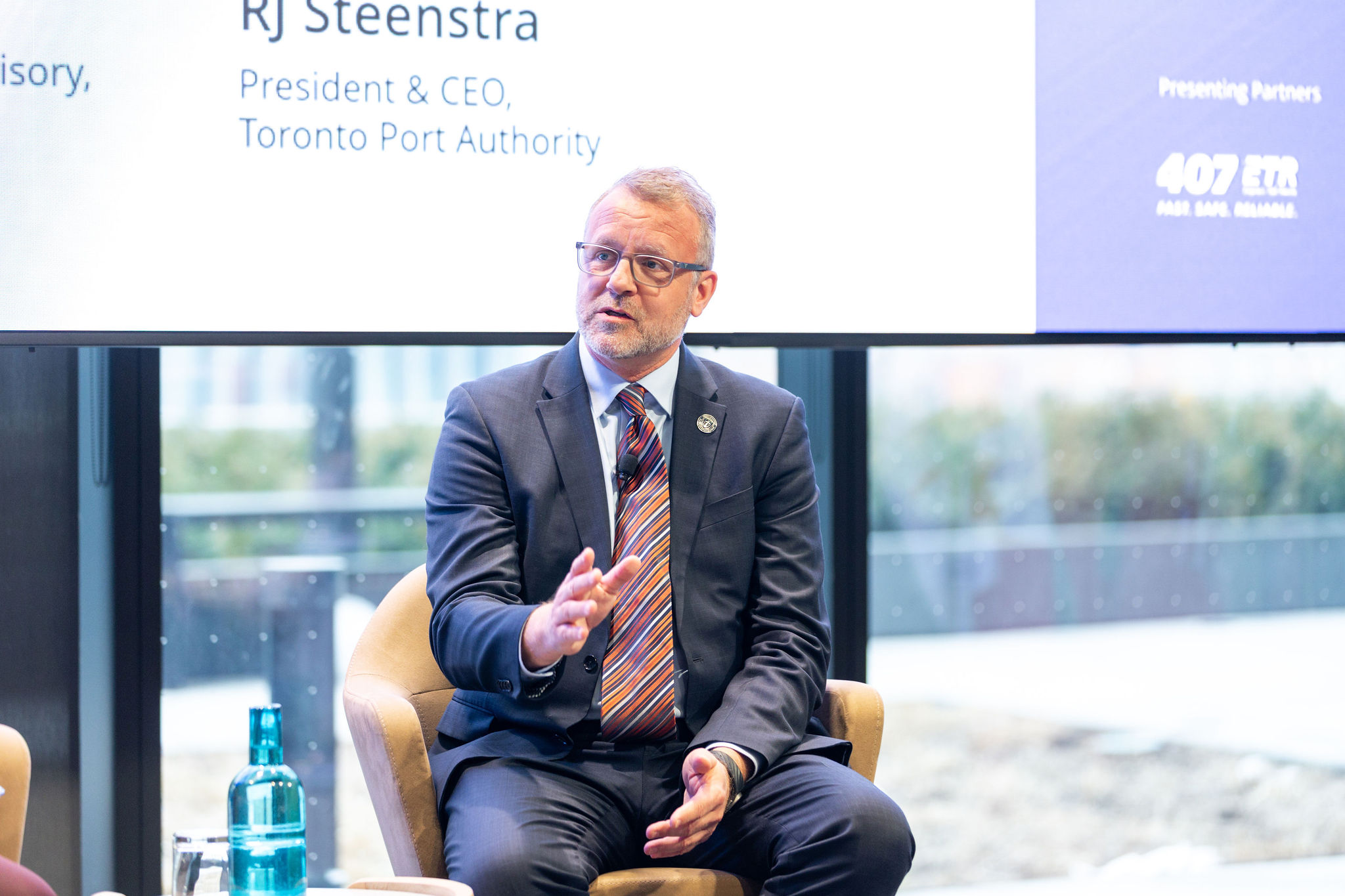
"Port infrastructure, airport infrastructure, transit infrastructure, we work at a very different rhythm than the political rhythms that are taking place today. And what I mean by that is we are a stabilizing force in all of this conversation."
— RJ Steenstra, President & CEO, Toronto Port Authority
"This connection is the one missing piece that connects Toronto to Detroit to Chicago, three of North America's most promising, most growing, most important economic hubs. The beneficiaries of this vision are alive today. This could be up and running as soon as 2029, so all of us here in this room could benefit from this, as well as our children and future generations. Let's be the ancestors we want to be proud of."
— Ryan Sullivan, CEO, Detroit Riverfront Conservancy, on a proposed multimodal hub in Detroit that would reconnect Detroit and Toronto via passenger rail for the first time since the 1970s
Thank you to our sponsors: