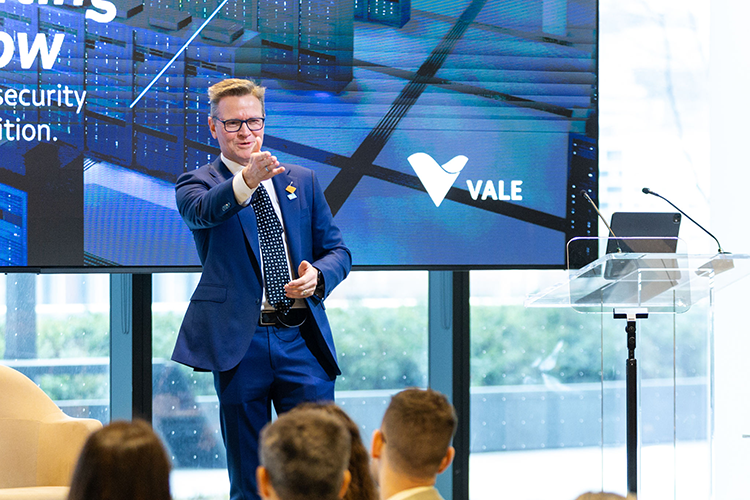
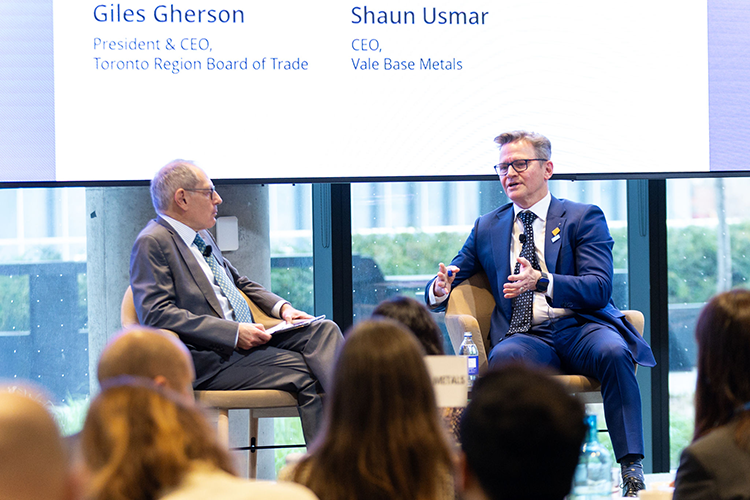
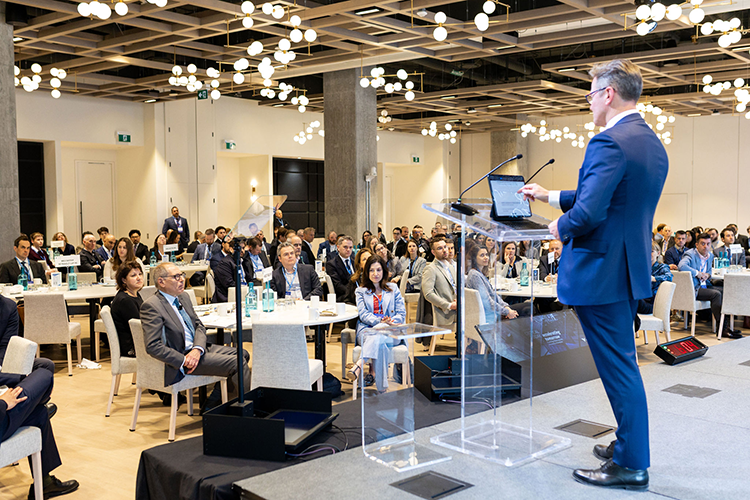
Vale Base Metals is at the centre of Ontario's mining comeback story. The Board recently hosted CEO Shaun Usmar for a keynote address and fireside chat to discuss the company's transformation and what it will take for Ontario to reclaim its place as a global mining powerhouse.
Vale Base Metals (VBM), one of the world's largest producers of copper and nickel, has transformed its business over the past 18 months, becoming a more lean, agile, resilient, and cost competitive organization. Its transformation is occurring at a pivotal moment for mining, with rising competition to secure reliable supply of critical minerals that increasingly underpin modern economies.
"I think this is perhaps one of the most consequential moments that I've seen in my 35 years in this sector. I think it's extremely exciting and I think this ecosystem is more rare than we appreciate, but we have to make things happen," Usmar said.
For most of the 20th century, Ontario was a global mining powerhouse; home to Inco, Falconbridge, and Noranda. That dominance didn't disappear overnight; it was worn down by higher costs, regulatory drag, and a global supply chain that rewarded looking elsewhere. Usmar believes it is best positioned to rebuild what was lost.
Echoing Usmar’s enthusiasm for the future of the sector, our President & CEO Giles Gherson said: The minerals and metals that enable electrification, digital infrastructure, advanced manufacturing, and defense industries can be found in abundance right here in Ontario. In the race for critical minerals, that five-year difference is the ballgame. Incremental acceleration won't be good enough. Today's conversation is ultimately about one question. Are we truly moving from ambition to execution? And is that movement fast enough to matter?"
The best mining opportunity in Canada is already in the ground.
Greenfield mines matter, but they typically take 15 to 20 years or more to reach production. The faster, higher-return opportunity is in expanding what already exists, not solely focusing on building new. VBM and Glencore Canada are evaluating a project that would involve co-investing billions in a brownfield copper development in the Sudbury Basin. The capital is available. The people are there. The infrastructure already exists. And, as this project shows, the Sudbury Basin's mineral endowment is far from exhausted.
VBM is on the comeback trail.
When new leadership arrived, VBM was spending more than it was bringing in – about $2 billion in 2024 alone. Projects were routinely running over budget. A key part of the transformation was getting back to basics, simplifying processes and focusing on what matters: safety, continuous improvement, and working more efficiently. Thousands of unnecessary internal standards were stripped out, costs were cut, and projects were restructured from the ground up. Returns on individual copper projects have risen from the low-to-mid teens to above 50 percent. The business has hit its production and financial targets for five consecutive quarters, exceeding production guidance for both copper and nickel last year—a first for VBM.
Ottawa and Queen's Park are saying the right things. Now they need to deliver.
The policy signals from Ottawa and Queen's Park are the most encouraging in years. The federal Major Projects Office, special economic zones, and a commitment to streamline 150 permitting regulations are all meaningful steps. But what is still missing matters. Promised investment tax credits and mine development expense deductions for brownfield operations have not yet materialized. Canada's average timeline from mine discovery to production remains 18 years, compared to 13 in the United States. Closing that gap requires more than incremental reform.
The biggest threat to Canada's mining revival is a shortage of talent.
Engineering faculties have been graduating fewer students for decades. Trades are scarce. Risk capital for exploration has dried up. As Usmar put it, the answer is to think like Silicon Valley. We need an ecosystem where talent, capital, and know-how concentrate in one place and compound over time. The Toronto region has the foundation. The TSX and TSXV already host roughly 40 percent of the world's listed mining companies. What is missing is the urgency to act before the moment passes.
18 years
How long it takes on average for a mine in Canada to go from discovery to production — versus 14 in Australia and Mexico and 13 years in the United States.
$1.3B → $3.3B
Growth in VBM’s EBITDA since new leadership took the helm in 2024.
Nearly ~$2B USD
VBM and Glencore Canada's projected co-investment for a copper development project currently under evaluation in the Sudbury Basin.
270,000 metres
Exploration drilling VBM has planned in Ontario and Newfoundland and Labrador this year alone.
40%
Share of the world's listed mining companies on the TSX and TSXV.
7,200
Canadians employed by VBM, with interior miners earning double the provincial average wage.
"It's so easy to find reasons why not to do stuff. But if we actually forget what divides us and come together to remove our obstacles, that's what creates the opportunity. We have to do things differently, because the rest of the world is indeed doing that... If we're going to create more of these global champions and unlock this mineral wealth, we need to think of ourselves more like a Silicon Valley in mining — an ecosystem that's been able to attract the best and brightest and the capital that has driven innovation and the technologies of the future." — Shaun Usmar, CEO, Vale Base Metals
"We supplied 95% of all the nickel in World War II. We supply about 60% to US aerospace and defense. It is an underappreciated asset. We have billions of dollars of sunk capital in these facilities. We have smelters, refineries. We don't produce an intermediate product. It's a rare asset — and at a time where supply chains are fracturing, the capability which we actually have in our technology centre in Mississauga is beyond rare." — Shaun Usmar, CEO, Vale Base Metals