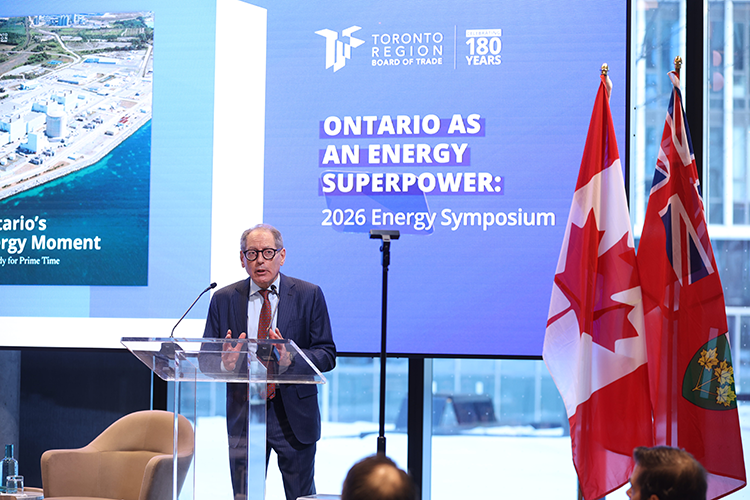
At the Board’s Ontario as an Energy Superpower symposium, Ontario’s Minister of Energy and Mines Stephen Lecce said the province is currently the second slowest jurisdiction in Canada when it comes to delivering major projects. Regulatory timelines and approvals, he argued, are no longer aligned with rising demand or global competition. “We have to radically change how fast we build.”
The symposium built on the Board’s new report, Ontario’s Energy Moment: Get Ready for Prime Time, which outlines a practical energy pathway for the province. In the report, the Board asserts that Ontario’s opportunity now depends on pivoting from planning to execution across the full system, aligning policy, capital, talent, and infrastructure to move at the pace global markets demand. That challenge is becoming more urgent as the province enters a period of sustained energy growth driven by electrification, data centres, advanced manufacturing, and population growth.
As the Board’s President and CEO Giles Gherson put it, the issue is no longer abstract. “We’re not just cogitating about the future. We’re planning for it,” he said. “Energy strategy shapes how we access capital, how we manage risk, how we attract talent, and how we compete across global markets. We need to remember the linkages between oil and gas and nuclear. There’s been a sense that it’s either-or, but our sales of hydrocarbons abroad and domestically bring capital to this country. That capital lowers the cost of capital here, which enables us to speed up the transition and expand nuclear.”
VIDEO | Why energy sits at the centre of Canada–U.S. trade
Speed has become a competitive advantage
Across panels and speakers, timelines emerged as the central constraint. Regulatory approvals, permitting, and project sequencing increasingly determine where investment goes. Minister Lecce’s call for faster delivery was echoed by industry leaders who argued that capital follows jurisdictions that can build on schedule and at scale.
Integrated energy planning reflects how the system actually operates
Electricity, natural gas, nuclear, and emerging technologies already work together, especially during peak demand and extreme weather. Speakers stressed that planning these systems in isolation increases risk and slows response. Ontario’s integrated energy plan was described as a practical move away from fragmented decision making toward planning that reflects how the system actually operates.
Natural gas and nuclear play complementary roles in reliability and growth
Speakers rejected the idea of choosing between energy sources. Natural gas was described as the system’s shock absorber, providing flexibility when demand spikes or other sources are unavailable. Nuclear was positioned as long-term baseload, delivering scale, stability, and emissions-free power. Together, participants argued, they support affordability, reliability, and system resilience.

Canada’s resource base supports energy security and investment
Several speakers argued that oil and gas revenues still help pay for the transition to cleaner energy, rather than standing in the way of it. As Enbridge’s Devin Iversen put it, oil remains Canada’s largest export “by a country mile.” Participants noted that the United States has limited alternatives to Canadian supply, underscoring the strategic importance of energy trade in sustaining capital flows and broader economic stability.
Execution at home creates credibility abroad
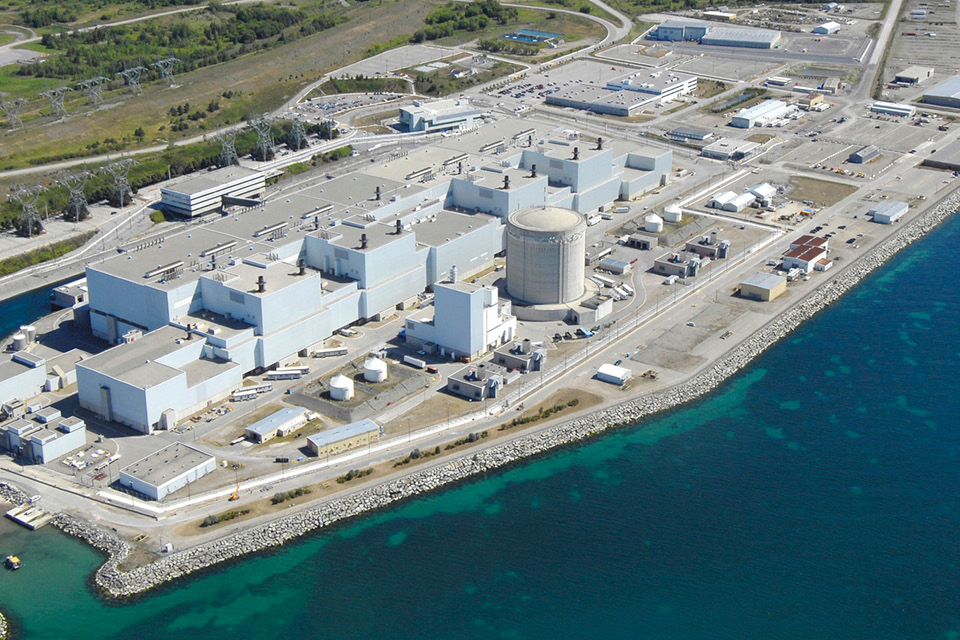
Ontario’s nuclear track record featured prominently in discussions about exports. Speakers emphasized that global markets are watching whether projects are delivered on time, on budget, and at scale. Standardization, repeatability, and cost discipline were described as essential to building trust, with domestic delivery forming the foundation for international growth.
Talent is a core part of the energy supply chain
Speakers emphasized that large energy projects cannot move forward without enough trained workers. With multiple projects advancing at the same time, competition for skilled labour is increasing across sectors and jurisdictions. The consensus was that training pipelines, mid-career transitions, and institutional capacity must expand at the same pace as physical infrastructure.
Demand can be shaped, not only supplied
Beyond new generation, speakers highlighted ways to reduce pressure on the system. District energy, operational efficiency, advanced analytics, and emerging computing technologies were discussed as tools to flatten demand curves and make better use of existing infrastructure, buying time while new capacity is built.
From 4,500 to 7,000 megawatts by 2044
Projected growth in Toronto’s peak electricity demand. A megawatt is a unit of power used to describe large systems, and peak demand refers to the highest level of use on the busiest days of the year. The increase illustrates the scale of new capacity the city will need within the next two decades.
From 23,000 to more than 42,000 megawatts by 2050
The corresponding increase in provincial peak demand. Speakers used this figure to show that the challenge is not isolated to Toronto, but extends across Ontario’s entire energy system.
75 percent
The share of Ontario homes heated with natural gas. The figure was cited to explain why gas remains central to winter reliability and why changes to that system have broad consequences for households.
18,000 football fields
The scale Enbridge used to describe underground natural gas storage at the Dawn Hub in southwestern Ontario. The facility stores gas during lower-demand summer months and releases it during winter peaks, helping keep supply steady and prices more stable when demand is highest across Ontario and the U.S. Midwest.
$30 billion over five years
OPG’s planned capital investment across nuclear and hydro assets in its next five-year rate period.
60,000 jobs in two years
Ontario Tech University suggested there will be a need of nearly 60,000 new nuclear-related jobs over a two-year period, spanning engineers, skilled trades, technicians, and project managers. The figure was used to show that workforce availability, not just funding or materials, could become a limiting factor as multiple nuclear projects move ahead at the same time.
Seven million years and two minutes
Xanadu’s comparison to explain the potential impact of quantum computing. A problem that would take seven million years on a classical supercomputer was solved in two minutes on Borealis, offering a concrete example of how future technologies could reduce energy use for certain tasks.

“There is an enormous global appetite for nuclear right now, and it’s not theoretical. Countries are looking for proven technology, proven operators, and proven delivery models. What Ontario has, through CANDU and through our supply chain, is a track record that shows we can build, operate, and maintain these systems safely and reliably. That credibility matters when countries are deciding who they want to partner with for the next several decades.”
— Todd Smith, Vice President, Marketing and Business Development, Candu Energy, an AtkinsRéalis company
“The conversation has shifted from whether we should build to how we build faster and with less risk. That means standardization, repeatability, and aligning policy, capital, and delivery models. Jurisdictions that can reduce uncertainty and move projects forward quickly will attract investment. Ontario has the opportunity to do that if it treats energy as an integrated system rather than a series of one-off decisions.”
— Alex Bettencourt, Managing Director, Strategy & Consulting Lead for Utilities, Accenture
“Oil is Canada’s largest export by a country mile. When you look at the United States, there really aren’t a lot of options if they decide they don’t want Canadian oil. That reality matters when we talk about energy security, affordability, and investment. These systems are deeply connected, whether we like it or not.”
— Devin Iversen, Head of External Affairs Canada, Enbridge
“We want to be reliable because at the end of the day, as Imperial, we want to be that provider of choice to all of our customers. Disruptions don’t take weeks. You start to feel them in days. When the system is stressed, the timelines are very short, and that’s why resilience and redundancy matter as much as capacity.”
— Angel Chacon, Eastern Canada Operations Manager, Fuel Operations, Imperial

“When we think about bankability, it comes down to standardization, cost, schedule, and managing risk. Fundamentally, it has to do with what we’ve already proven in this province. Ontario doesn’t miss when it comes to nuclear infrastructure projects. The refurbishments we’ve seen show that we can deliver, and that track record matters when you’re trying to attract capital and compete globally.”
— Lisa McBride, Vice President, Country Leader, GE Vernova Hitachi
“At a quick glance, we’re looking at almost 60,000 new nuclear-related jobs in a two-year timeline. The workforce is the supply chain. If we don’t have the people, projects slow down regardless of how much capital is available. That means education and training have to scale at the same pace as infrastructure.”
— Jennifer Alsop, CEO, EDGE at Ontario Tech University