Skip to content

Member Spotlight

Strengthening Workplace Resilience: How Circle Point Wellness Is Helping Leaders Prevent Crisis Before It Escalates

discussion on desk with laptop

In high-pressure workplaces, crises rarely arrive all at once. More often, they build quietly, through small warning signs that accumulate over time such as minor disagreements, fatigue, overwork, and unresolved conflict.  

After working with diverse companies and seeing the same concerns pop up, Snjezana Pruginic, founder of Circle Point Wellness Inc., took those early signals and built a foundation of a new methodology and framework designed to help organizations respond to internal and external shocks.

Over the past year, Snjezana has been formalizing the Organizational Crisis Curve™, an evidence-based framework informed by her 25+ year career, and which helps leaders and teams identify the early indicators of strain inside teams so they take practical action before challenges grow into full-scale crises. 

When Crisis Starts Quietly 

For Snjezana, the idea behind the Organizational Crisis Curve™ grew out of decades spent supporting workplaces through conflict and critical incidents. 

“Most organizations only call something a ‘crisis’ once it’s already loud: a major incident, a public issue, a safety event, a resignation that shakes the team,” she says. “But in the work we do at Circle Point Wellness, we see that crises often start quietly: rising conflict, creeping absenteeism, near-misses, fractured trust, decision fatigue, and managers spending more time putting out fires than leading.” 

Across more than 25 years of working with organizations navigating pressure and change, she noticed a consistent pattern. Companies mostly acted once issues had already reached a breaking point.  

“The Organizational Crisis Curve™ teaches how to recognize the early symptoms so that internal structures, skills and strategies can be tailored and sustainable, building overall company resiliency. This allows the company to move from merely reacting to an incident, to building a culture and workplace that responds to incidences with confidence.” 

Snjezana

A Full-Cycle Framework for Workplace Resilience 

The framework provides what Snjezana describes as a full-cycle playbook for organizations navigating workplace pressure. 

Organizations that have begun applying the approach are already seeing meaningful results. 

“We’ve seen it reduce burnout and friction and strengthen team cohesion, and we’re excited to share it across many high stress sectors so people can do great work without burning out.”

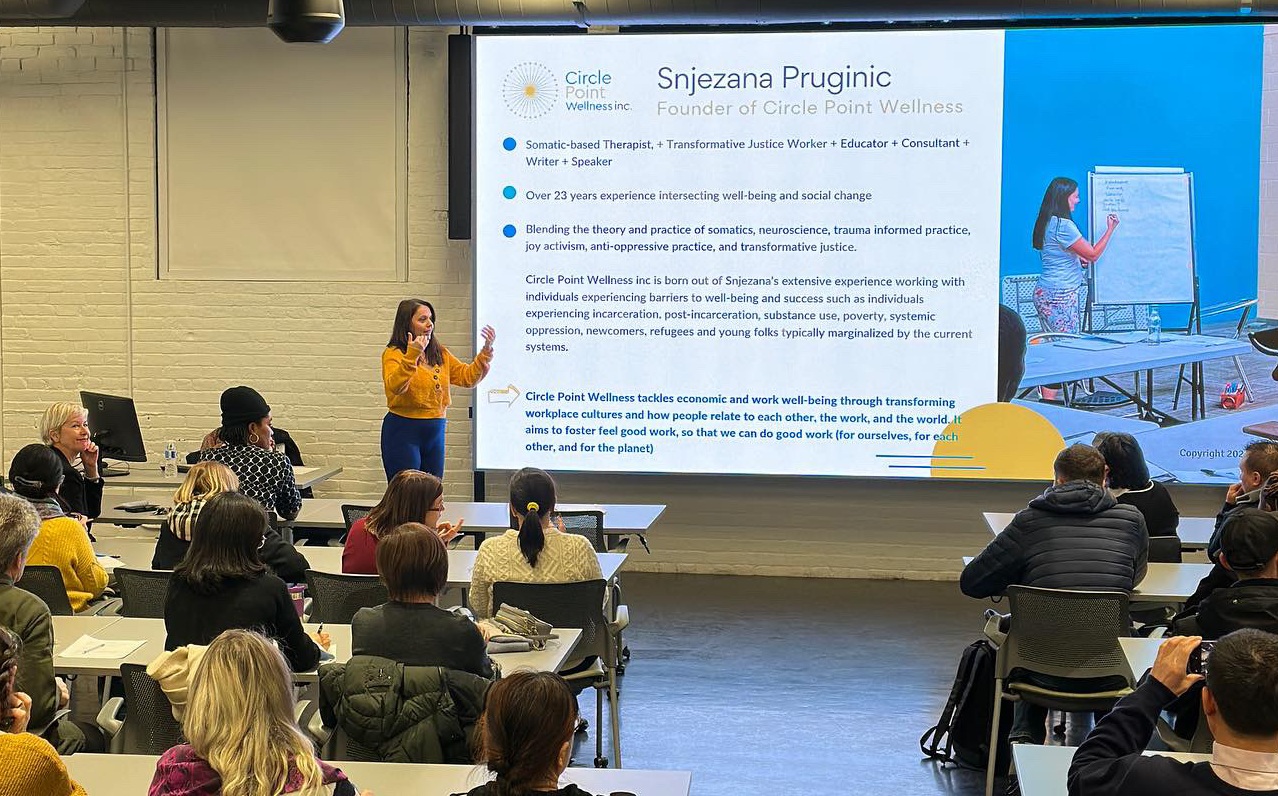
talk by snjezana

The Business Case for Healthier Workplaces 

While the framework focuses on workplace culture, its impact is also measurable in operational outcomes. 

“My hope is that the Crisis Curve™ helps leaders and all staff together build workplace cultures which are resilient, in which people treat each other with respect, where great work is both easy and rewarding to do" 

For employers, the benefits show up in metrics they already track. 

“For companies, the impact is practical and measurable: stronger continuity under pressure, fewer preventable escalations, reduced HR and labour load, better retention in key roles, and improved psychological safety and trust,” she explains. “In many environments, those shifts show up in metrics leaders already track: absenteeism or stress leave, incident reports, grievances, turnover, WSIB exposure, and internal climate scores.” 

She also sees workplace resilience as closely tied to the broader health of the Toronto region. 

“For Toronto, I also see this as an economic resilience issue,” she says. “When frontline-heavy workplaces are strained, the ripple effects hit customers, communities, and the talent pipeline. A more regulated, supported workforce that can work well together under pressure isn’t a ‘nice to have’, it is one of the biggest markers of success.”

Turning Human Complexity into Practical Tools 

One of the biggest challenges in developing the Organizational Crisis Curve™ was translating complex human dynamics into something leaders could use quickly. 

“The biggest challenge was translating something deeply human into something teams can use quickly,” Snjezana says. “Most staff don’t need more theory. They need practicality.” 

Instead of adding complexity, the framework focuses on a few essential questions teams can ask in the moment: What are the early warning signs of distress in the team? What’s the right intervention for this stage? What can we do next, without launching a major initiative. 

To keep the framework practical, Pruginic built it around relatable language and clear actions tied to outcomes organizations already measure.


Looking Ahead 

For Snjezana, the Organizational Crisis Curve™ is part of a broader vision for healthier, high-performing workplace cultures. 

“Long-term, my goal has always been to build work cultures where people and impact can thrive together, especially under pressure,” she says. “Where results come from trust, clarity, and sustainable ways of working, not chronic stress.” 

The framework helps organizations take a more complete view of workplace resilience. 

“The Crisis Curve™ becomes the backbone for that. It clarifies the journey from prevention to readiness to crisis response to recovery and repair. 

To introduce the framework and spark peer dialogue among leaders, Circle Point Wellness is hosting two leadership sessions this March focused on practical conversations about workplace resilience. 

“These sessions are designed for peer learning and candid, practical conversation,” Snjezana says. “They introduce the Curve™ while exploring what real-time resilience looks like and the practical moves leaders can make to strengthen it, not as a generic idea, but tailored to their own companies and realities.” 

Advice for Leaders Building Practical Solutions 

For others developing frameworks or initiatives rooted in human experience, Snjezana’s advice is simple: start with listening. 

“If you’re translating human experiences into practical strategies or frameworks, start with building relationships and getting to know what people are really dealing with on the practical level,” she says. 

From there, clarity and usability are key. 

“Then think about the shortest and simplest way to alleviate their biggest pain point. Assume your audience is busy and a bit skeptical: if it can’t be used quickly in a real workday, it won’t stick.”