Artificial intelligence is already changing how medicine is developed, regulated, and delivered. At the Board’s Next-Gen Medicine: AI’s Promise for Faster Innovation event, speakers focused less on distant breakthroughs and more on how AI is beginning to reshape day-to-day work across the health-care system, from clinical practice to drug development.
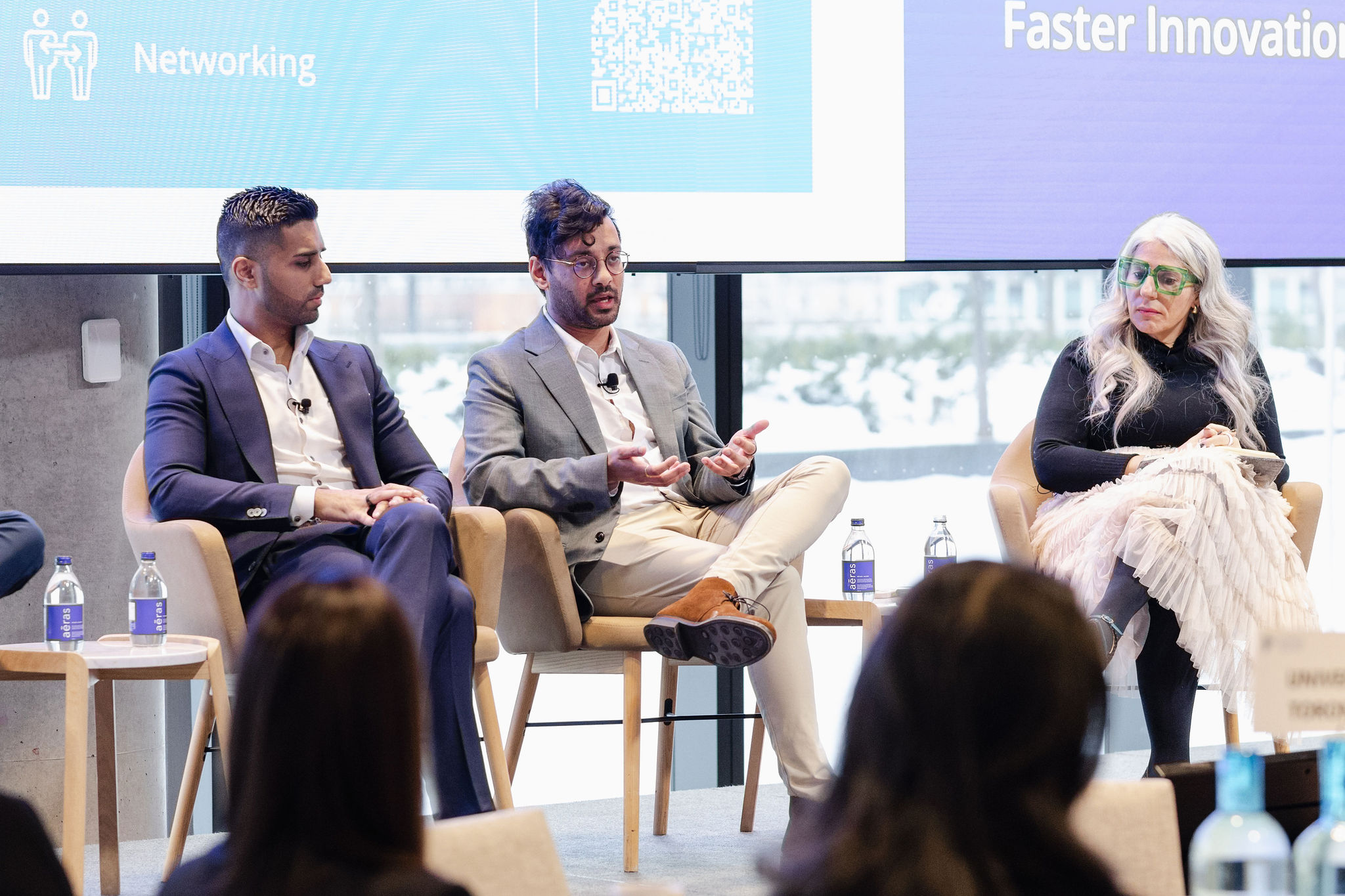
Artificial intelligence is already changing how medicine is developed, regulated, and delivered. At the Board’s Next-Gen Medicine: AI’s Promise for Faster Innovation event, speakers focused less on distant breakthroughs and more on how AI is beginning to reshape day-to-day work across the health-care system, from clinical practice to drug development.
For Shanil Ebrahim, Partner and the Life Sciences and Healthcare Consulting Leader at Deloitte Canada, the most immediate impact is not replacing people, but freeing them. He pointed to the volume of manual and administrative work that absorbs time across the system, often crowding out the work professionals are trained to do.
“For every one minute of clinical time, clinicians are spending about two minutes on documentation. You see the same thing in pharmaceutical and med-tech companies, where highly trained people are spending most of their time on regulatory operations, safety reporting, and other invisible work. A lot of that can be taken out with AI. I don’t think we have a human health resource shortage. I think we’re not using humans to the best of their ability because they’re spending 80 or 90 percent of their time on things they shouldn’t be.”
Keynotes and panelists explored what happens when that time is given back, and how the philosophy behind AI in medicine increasingly assumes that every line of code could ultimately affect a patient.
VIDEO | AI Isn’t Replacing Health-Care Workers. It’s Giving Them Time Back
Time, not talent, is the key constraint
Participants returned repeatedly to the imbalance between training and tasks. Highly skilled clinicians, scientists, and regulatory professionals are spending large portions of their time on administrative and manual work. AI was framed as a way to remove that friction and return time to judgment, care, and problem-solving. The opportunity is not to do more work, but to do the right work.
AI is already reshaping medicine, not waiting for permission
Speakers emphasized that artificial intelligence is already being used across drug discovery, clinical trials, and care delivery, often invisibly. The discussion focused less on whether AI belongs in health care and more on how systems adapt to tools that are already changing how work is done.
The challenge has shifted from innovation to integration
Speakers repeatedly returned to the idea that the technology is no longer the limiting factor. What now determines impact is whether health systems, regulators, and organizations can integrate AI at scale. Fragmented data, slow policy change, and infrastructure not designed for AI-enabled workflows were described as the real constraints. Moving from breakthrough to benefit depends less on new discoveries and more on aligning systems to use what already works.
Every line of code carries patient consequences
As AI is embedded deeper into drug development, diagnostics, and treatment pathways, speakers stressed that software decisions are no longer abstract. Code written upstream can influence patient outcomes downstream. That reality places a higher bar on how AI systems are designed, tested, and governed in health-care settings. The importance of maintaining a patient-centred approach was a core focus throughout the event.
AI doesn’t need to be perfect to be trusted
Speakers emphasized that trust in AI is not about eliminating error, but about reducing it relative to the system that already exists. Concerns about AI hallucinations were acknowledged, but participants noted that health care today relies heavily on human judgment made under fatigue, time pressure, and incomplete information. The question, they argued, is not whether AI will make mistakes, but whether it can lower the frequency and severity of the mistakes already happening, and how those trade-offs are measured and governed.
Weeks instead of years
How AI-driven approaches are accelerating early-stage drug discovery. Speakers explained that AI models can simulate and evaluate thousands of molecular interactions digitally, helping researchers identify and refine promising drug candidates in weeks instead of years of traditional lab experimentation. The result is a faster, more targeted start to the development process.
Millions of years reduced to minutes
A comparison used to illustrate the scale of computational acceleration now possible with advanced AI models. Speakers cited work in genomics where AI can predict how genetic variants affect RNA behaviour in minutes, problems that would take millions of years to compute using traditional methods. That shift fundamentally changes what kinds of biological questions can realistically be asked.
$1 invested delivers $2 to $4 in returns
An estimate cited during the discussion to frame health-care investment as an economic multiplier rather than a cost. Speakers pointed to examples where investments in health innovation reduce downstream costs by shortening hospital stays, improving workforce participation, and accelerating return-to-work timelines. In that context, spending on health was described as supporting productivity, resilience, and long-term economic growth, not simply increasing system expenses.
Up to $26 billion annually
McKinsey’s estimate of the potential annual savings for Canadian governments if AI is deployed at scale across health care. The figure reflects improvements in quality of care, patient and staff experience, reduced administrative burden, and system-wide optimization.
$10 billion per year
An estimate from the Canadian Institute for Health Information suggesting the value Canada may be missing annually by not fully using health data. Speakers noted that the cost is measured not only in dollars, but also in lost opportunities to improve patient outcomes.
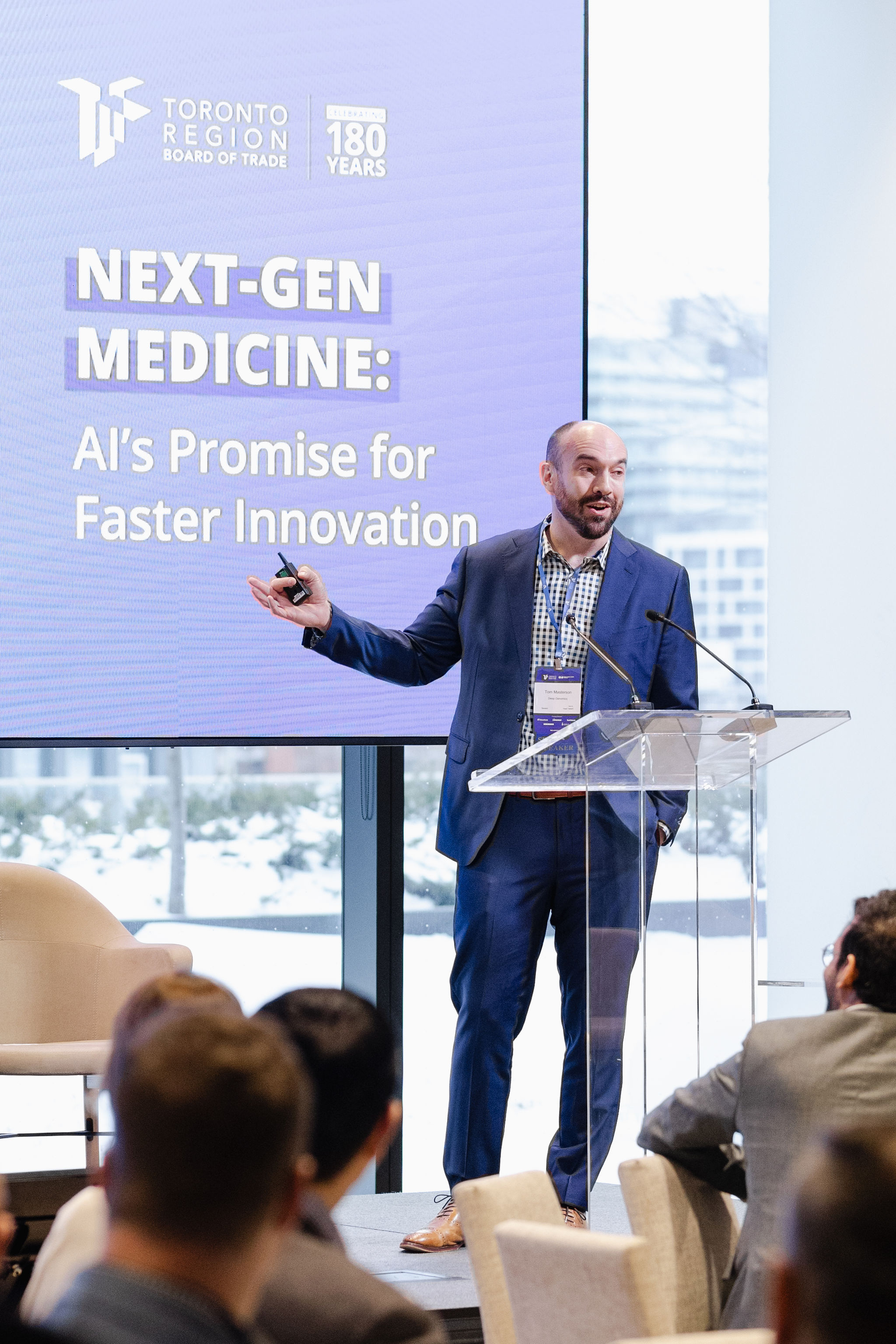
“At the end of this line [of code used to develop drugs], we’re going to start putting these things into human beings. It’s your sister, your brother, your mother, a friend of yours going through a health crisis. So, we pretend that every line of code goes into a patient. That’s easy to remember when you’re injecting mice, but when you’re sitting in an office in downtown Toronto, it’s easy to forget that someday that line of code you just wrote will matter in regulatory reviews and in actually making a patient healthy again.”
— Tom Masterson, Chief Operating Officer, Deep Genomics
“In health, the true value of AI isn’t found in what it subtracts. It’s found in what it multiplies. Better productivity isn’t just a business metric. It’s a life saved, a diagnosis caught earlier, and a patient returned to their family. For every one dollar invested in health, we see an economic return of two to four dollars, and when you layer AI onto that investment, the effects are amplified.”
— Laura Pagnotta, Vice President, External Affairs, Roche Canada
“We developed an AI solution called ChartWatch. It monitors every internal medicine patient every hour and looks at more than 150 different parameters. It predicts whether someone is going to die or go to the ICU in the next 48 hours. When we published our results, we showed a 26 percent reduction in unexpected mortality. These are real body counts. This is real impact. We’re saving lives.”
— Dr. Muhammad Mamdani, Professor and Director, Temerty Centre for Artificial Intelligence Research and Education in Medicine, University of Toronto
“Generative AI is changing how we build software by letting teams iterate much faster and remove bottlenecks across the development lifecycle. That matters because every line of code goes into a patient. It allows us to vet software more quickly and get the right tools to the right people at the right time, without cutting corners.”
— Sasha Manohar, AI Product Director, Evinova
“As a futurist, it used to take once a month for my mind to be blown. Now it’s happening six times a day. Just this week, Anthropic announced that Claude can not only crawl and identify the most relevant clinical trials based on your biology, geography, and other factors, but also guide patients through enrolment and participation, including the reasons people typically fall off trials. Before, hospitals and disease groups each had to build their own versions of this. Now it’s happening out of the box. It’s the kind of shift that makes you realize how quickly the ground is moving.”
— Dr. Zayna Khayat, Chief Program Officer, AMS Healthcare