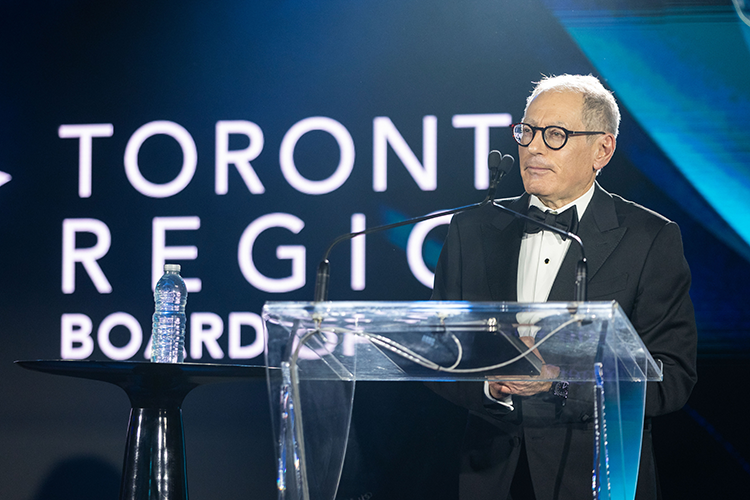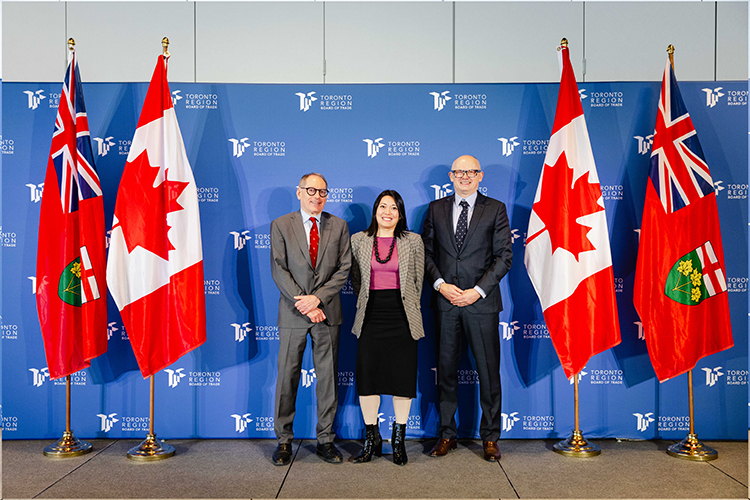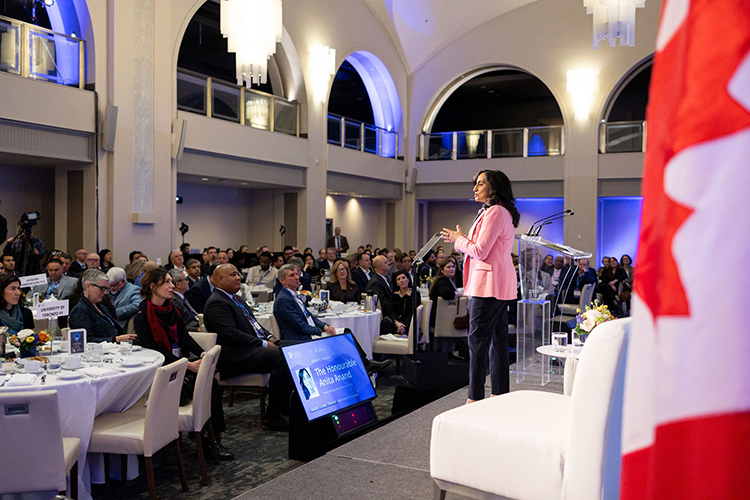
Canada’s Minister of Foreign Affairs, the Honourable Anita Anand, arrived in Toronto just hours after returning from trade negotiations in India to speak at our event, Canada’s Global Strategy: What It Means for Business. Minister Anand offered insight into how Canada’s foreign policy is evolving in this moment of global disruption. The Minister expressed that as the international trading system is being reshaped, Canada is responding with a strategy that combines long-standing principles with pragmatic economic diplomacy.
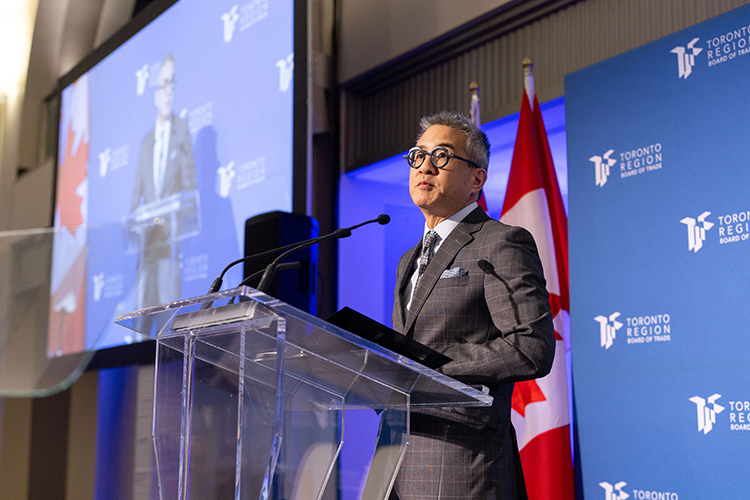
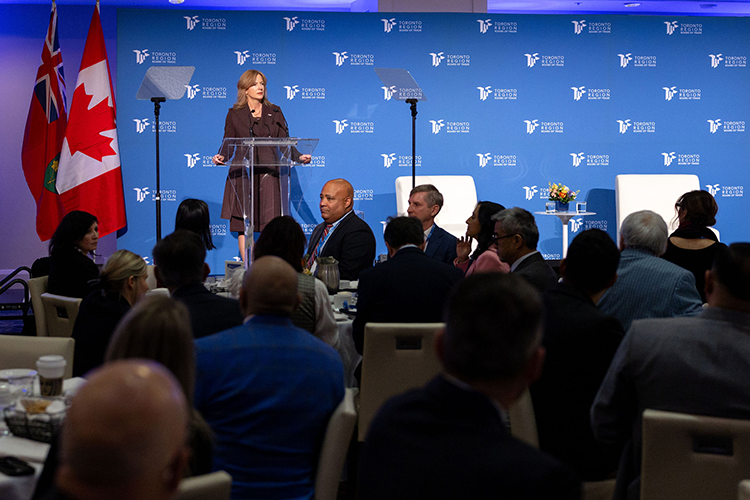
Opening the event, Joseph Wong, Vice-President International at the University of Toronto, emphasized the growing importance of trust in global partnerships. “Trust is increasingly the most important currency that undergirds international relationships,” he said, noting that universities and businesses are not sectors in silos but “assets and allies” in helping Canada expand its global reach.
In a fireside conversation with John Stackhouse, Senior Vice-President at RBC, the discussion touched on everything from the unfolding situation in the Middle East to Canada’s expanding trade agenda in the Indo-Pacific and beyond. The message was clear: global interest in Canada is strong, but turning that interest into economic growth will require businesses to move quickly.
Stackhouse noted that global investors are already signalling strong interest in Canada: “We’re hearing from sovereign wealth funds, from multinationals, from influential people around the world saying we want to move billions, and they do underscore billions — into Canada. But they stress they’re not waiting. You have to move this year on some stuff for us to make that portfolio allocation.”
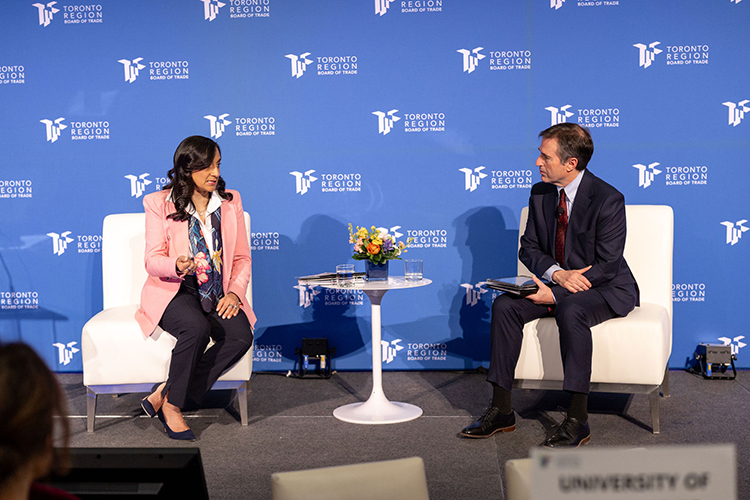
Minister Anand pointed to the strong international demand she encounters in meetings with global leaders and investors.
“There is not a room that I go into where people are uninterested in Canada,” she said. “On the contrary, they see an energy superpower, a country rich in critical minerals, a leader in AI and technology, and an agricultural producer the world depends on… We already have the infrastructure in place from a trade perspective. We need it to be operationalized and utilized.”
Closing the discussion, Alaina Tennison, Vice-Chair & Treasurer of the Toronto Region Board of Trade and COO and National Managing Partner, People & Partnership at PwC Canada, underscored the call to action for the business community. “Business leaders, this is our moment to make an impact.”
The global trading system is being reordered, and Canada is ready
Canada’s network of trade agreements is stronger than many realize. As the only G7 nation with free trade agreements with every other G7 country, the framework is already in place. The challenge is closing the gap between agreements signed and agreements used. With a free trade agreement with The Association of Southeast Asian Nations (ASEAN) expected to be finalized in 2026 and renewed engagement with India, China, and the Southern Common Market (Mercosur), the opportunity for diversification is real and present. The next step is mobilizing Canadian businesses, especially small and medium-sized enterprises, to take advantage of it.
Canada’s reset with India is producing concrete results
What began as diplomatic groundwork in October 2025 has yielded a substantive agenda. The visit to India with Prime Minister Carney marked a significant step forward in rebuilding economic cooperation between the two countries. A Comprehensive Economic Partnership Agreement is now being negotiated with a target completion date of the end of 2026. The approach reflects a two-track strategy: addressing security and rule-of-law concerns while advancing economic collaboration and investment.
Global investors are watching, and the window is open
With the CUSMA review expected this year and pressure remaining on sectoral tariffs on steel, aluminum, automotive goods, and lumber, decisions made in the coming months will shape whether that capital materializes in Canada. Ensuring tangible outcomes from international engagement and public investment will be critical.
SMEs are at the centre of Canada’s global ambitions
With small and medium-sized enterprises comprising 97 per cent of Canada’s capital markets, trade diversification is not simply a large-corporation story. It begins with SMEs across the country. Trade missions, trade shows, and tools like our World Trade Centre Toronto's Trade Accelerator Program provide practical on-ramps for companies looking to enter new markets. The infrastructure exists. The next step is using it.
$2.6 billion
The value of the uranium deal finalized between Cameco and India during Prime Minister Carney’s visit, for civil energy use. The agreement represents one of the most tangible deliverables from Canada’s renewed economic engagement with India and a landmark moment for the country’s energy sector.
12 agreements
The number of agreements Canada has reached across four continents in the past six months, reflecting the government’s urgency around trade diversification and international economic engagement.
85 per cent
The share of Canadian goods Minister Anand says continue to cross the U.S. border tariff-free under CUSMA. While sectoral tariffs on steel, aluminum, automotive goods, and lumber remain a source of pressure, Canada’s position remains more favourable than many countries in the current global trade environment.
End of 2026
The target timeline for completing a Comprehensive Economic Partnership Agreement between Canada and India, a step beyond a standard free trade agreement and a key outcome of discussions between leaders at the G20 in South Africa.
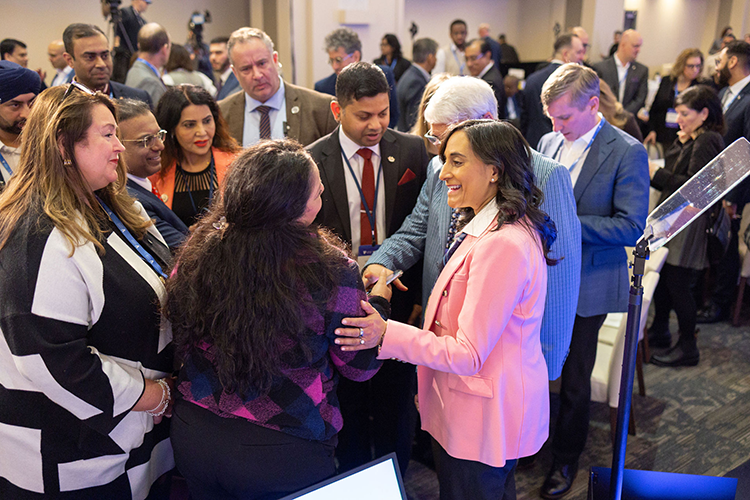
“I think it’s really important to unpack what we are doing internationally so that it’s understandable and useful to the business community. That’s what I’m trying to do — make foreign policy and the agreements we’re reaching accessible for businesses to utilize.”
WATCH: Minister Anand in conversation with RBC’s John Stackhouse
“We are the only G7 country that has a free trade agreement with every other G7 country. But what is missing is that we need those agreements to be operationalized and utilized, or they will simply stand there and we will keep having to rely on one trading partner.”
“We are in a moment where the global trading environment and network is being completely reordered. We need all of us to be utilizing the agreements that we are executing, or they will simply stand there and we will keep having to rely on one trading partner.”