When we asked participants in recent World Trade Centre Toronto webinars what the hardest part of CUSMA compliance was, 52% said "keeping up with the paperwork."
Not the tariff cost itself. The friction. The effort. The constantly changing rules. The administrative burden that pulls founders and operators away from the work that actually grows their business.
That answer tells you everything about where Ontario SMEs are right now when it comes to cross-border trade.
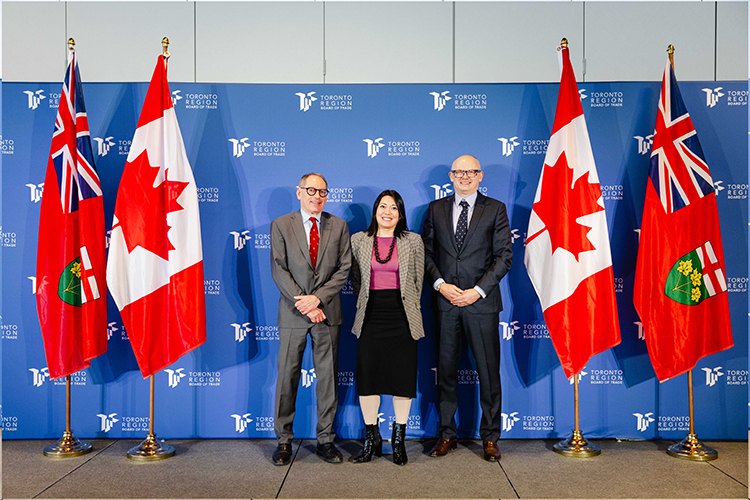
Today, the Federal Economic Development Agency for Southern Ontario announced a $500,000 investment to help the Board and World Trade Centre Toronto address exactly that problem. Chi Nguyen, Member of Parliament for Spadina-Harbourfront, delivered the announcement on behalf of Minister Evan Solomon at an event this morning.
This investment represents something we've been hearing about more and more from businesses across the region: the urgent need for practical, accessible guidance on CUSMA compliance.
The Reality on the Ground
Let me be direct about what we're seeing.
CUSMA compliance has become one of the most consistent pain points for Ontario SMEs shipping into the U.S. And here's what's important to understand: this isn't primarily about fraud or intentional misclassification. What we're hearing from businesses is that the compliance burden is high, documentation requirements are incredibly specific, and small teams simply don't have the internal expertise to navigate these issues quickly when a shipment gets flagged.
Take apparel as one example. Many assume that if a garment is cut and sewn in Canada, it qualifies for tariff exemptions under CUSMA. But the determining factor is often where the yarn and fibre originate. These "yarn-forward" rules have created confusion for decades, going back to NAFTA. And since very little yarn is actually produced in North America, even a t-shirt manufactured entirely in Canada typically won't qualify for the CUSMA pathway.
But the bigger shift happened when many companies lost the de minimis cushion they relied on for cross-border e-commerce. A year ago, a $50 t-shirt could cross the border tariff-free regardless of origin. That pathway no longer exists. Now businesses are forced into more formal customs processes more often, which means more exposure to classification issues, documentation gaps, and operational chaos.
What We've Built and What's Coming
That's exactly why this investment matters.
Since December, we've delivered webinars on CUSMA foundations, compliance, and rules of origin to 865 registrants across Ontario. The demand has been significant, and it's told us something important: businesses want to get this right. They're actively seeking support.
Next week, we're taking this initiative across Central and Southern Ontario with half-day, in-person workshops. We kick off in Thorold on February 10 in partnership with Niagara Economic Development, followed by Windsor with Invest Windsor Essex on February 11, Vaughan with the City of Vaughan and Vaughan Chamber of Commerce on February 19, Toronto with the City of Toronto on March 5, Mississauga with the Mississauga Board of Trade on in March, and Ottawa with Invest Ottawa and the Ottawa Board of Trade on March 12.
These aren't lectures. They're working sessions where businesses can bring their specific challenges, ask the right questions, and connect with customs brokers, trade lawyers, and compliance specialists who can help them solve problems before shipments get stuck at the border.
The Practical Path Forward
Our advice to SMEs has been consistent: do enough homework to understand the basics so you can be your own best advocate. Then get expert support early. It saves time, cost, and a lot of operational headaches compared to trying to fix things after the fact.
This investment from FedDev Ontario allows us to scale that support and meet businesses where they are, literally across the region.
The tariff concerns that dominated headlines a few months ago have shifted. Businesses are finding ways to move forward. But the compliance friction remains, and left unaddressed, it becomes a drag on growth, innovation, and competitiveness.
"For Ontario companies maintaining and growing their customer base in the giant U.S. market, CUSMA remains a vital lifeline, exempting them from increased tariffs," said Giles Gherson, President and CEO of the Toronto Region Board of Trade. "However, navigating CUSMA's rules and requirements can be complex, costly, and time-consuming for smaller businesses. Our thanks to the Government of Canada for this important support, enabling our World Trade Centre Toronto to deliver practical, hands-on programming to more than 700 SMEs to secure compliance and tariff-free access to the U.S. market."
To Minister Solomon, MP Nguyen, and the FedDev Ontario team: thank you for recognizing that compliance support is growth support. When businesses can navigate trade requirements confidently, they can focus on what they do best.
For information about upcoming CUSMA compliance workshops, visit bot.com/cusma for information about other programs and events, visit bot.com/events.