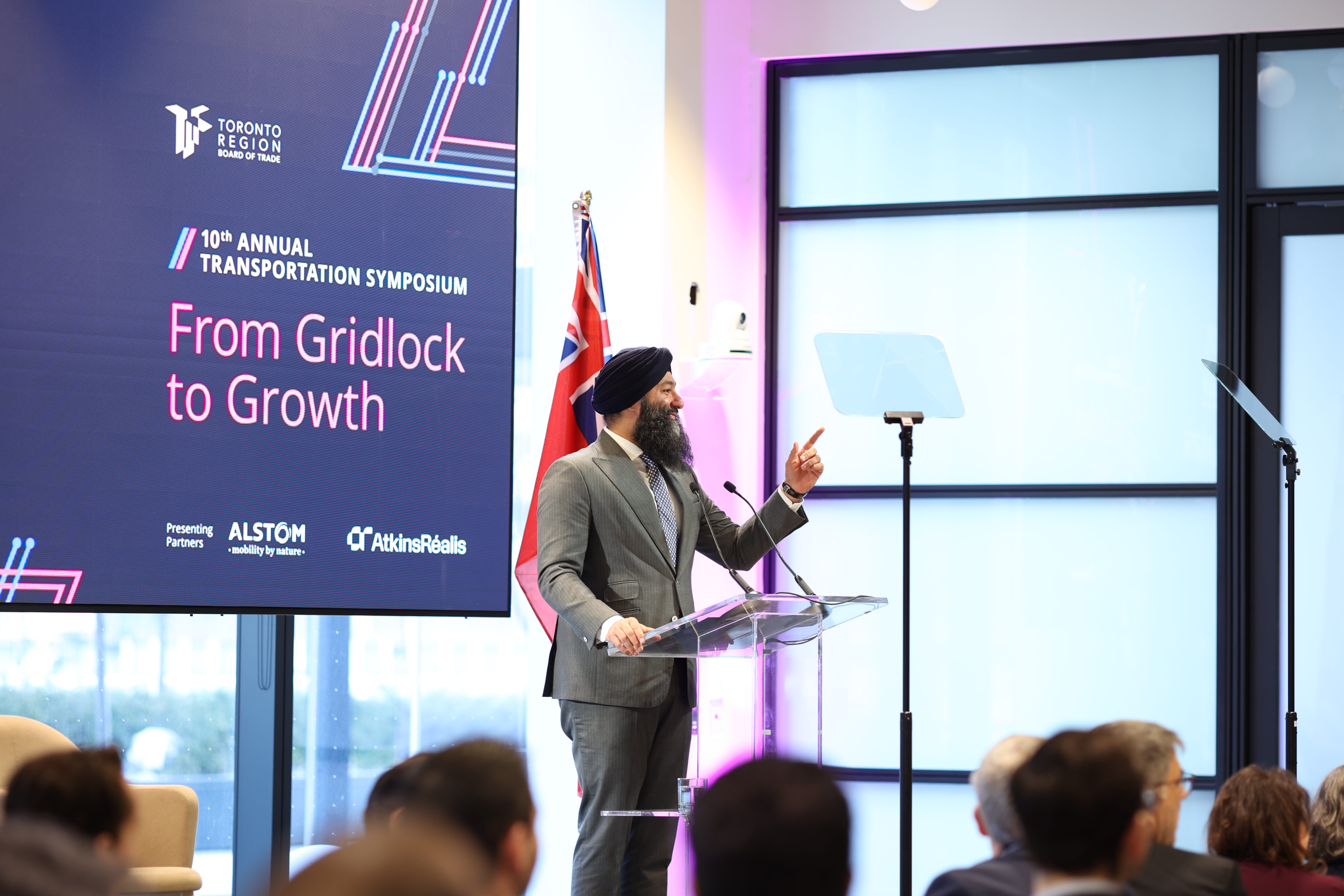
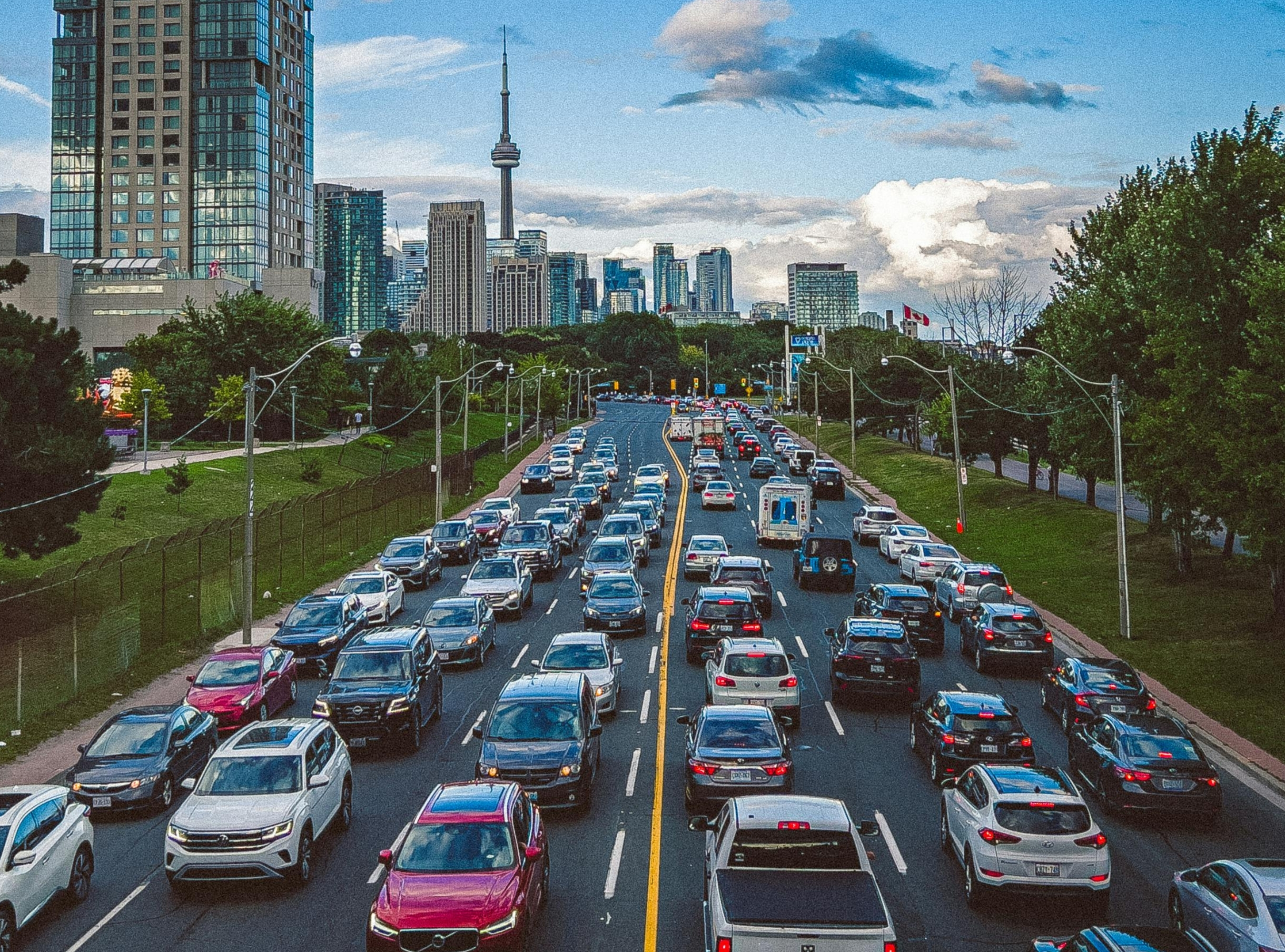
Toronto’s transit system sits at the centre of the region’s mobility crisis. That crisis now shapes productivity, competitiveness, and quality of life. Transit remains a long-standing priority for the Board because mobility underpins economic vitality across the region.
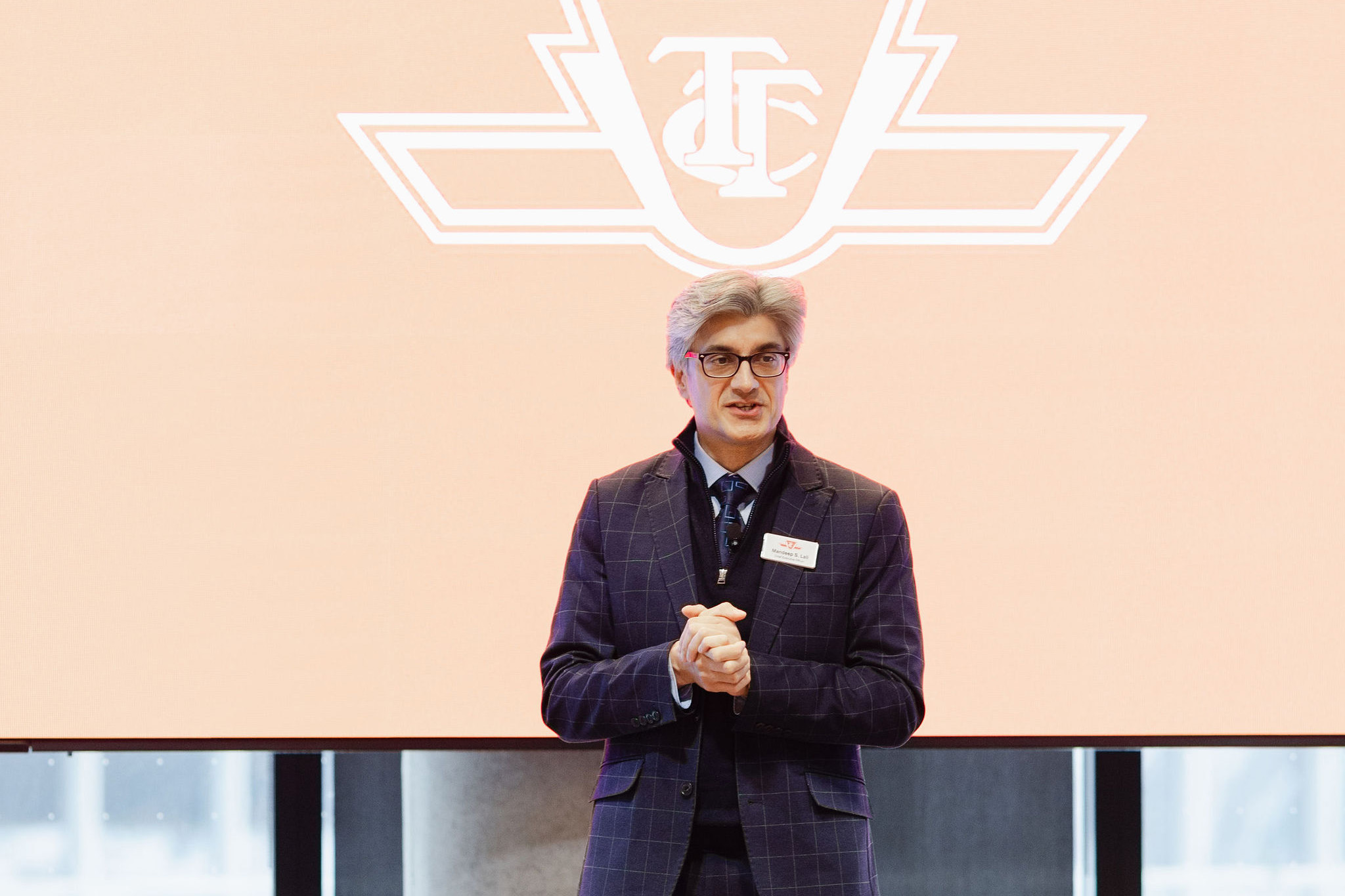
At our Transforming Transit in Toronto event, business leaders gathered to hear directly from Mandeep Lali, the TTC’s new CEO, as he laid out his vision for the system and its future role in the region’s economy. Framing transit as core economic infrastructure, Lali argued that “every day, Toronto either compounds productivity or quietly taxes it, depending on how well we move people.”
Drawing on experience from London and New York, Lali focused on the practical work of improving daily performance. He outlined a leadership approach centred on safety, service reliability, and long-term sustainability, with an emphasis on data, operational discipline, and partnerships to deliver incremental gains at scale.
The conversation widened to include perspectives from across the transit sector, with an industry leaders panel focused on how planning, technology, and delivery choices shape reliability and capacity over time.
KEY TAKEAWAYS
A city’s economy moves at the speed of its transit system
Congestion is not only an inconvenience. It is a drag on productivity and a constraint on growth. Improving mobility remains one of the most direct ways to strengthen competitiveness across the region.
Trust starts with customer experience and safety
Restoring rider confidence requires visible presence, faster response, and better coordination with city partners. It also requires a cleaner, more predictable experience that makes transit feel dependable during routine commutes, not only during disruptions.
Reliability improves through operational discipline and better data
Lali’s vision emphasizes repeatable processes and clearer performance measurement. Enterprise asset management, predictive maintenance, and smarter use of technology can reduce recurring failures and target investment where it delivers the highest return.
VIDEO | Can Toronto’s LRTs move faster?
Speaker 1
We'll see you next time. Here we rise, together, stronger.
GIles Gherson
Good morning, everyone. Good morning. Thank you for being here today for Transforming Transit, a conversation with TTC CEO Mandy Lally. I'm Giles Gerson, President and CEO of the Toronto Region Board of Trade. Before we begin, I would like to acknowledge that the Toronto region was a gathering place for the many Indigenous peoples who called this region home, the Mississaugas of the Credit, the Anishinaabe, the Haudenosaunee, and the Wendat peoples. And today, our region is home to many diverse First Nations, Inuit and Métis peoples. And the land that we're currently meeting on is covered by Treaty 13 with the Mississaugas of the Credit, a place where the living resources of the land and lake served as the foundation foundation for shared prosperity for First Nations communities, and that legacy anchors the conversations we'll be having today. Today's conversation is an important one. Why? Because you're all here. One reason. But because building up transit in our region is by far the biggest contribution we can make to solving Toronto's chronic congestion crisis, which is fundamentally a mobility crisis in our region. At the Toronto Region Board of Trade, we've been beating the drum consistently for more and better transit to alleviate congestion. Because as goes mobility, so goes the vitality of our region. And it's that important. From jobs and housing to investment and business growth, faster, more seamless mobility is indispensable to our region's prosperity and quality of life. Back in the 1950s, the board was an early advocate for the development of Toronto's subway system. In the early 2000s, we strongly supported the creation of Metrolinks and the Big Move transportation plan. And more recently, we've championed the Ontario Line, fare integration, and hopefully coming soon, regional service integration. And as we look through the coming decades, we also firmly believe that the transit system needs to be put on a stronger financial footing. It's clear to us, we may be alone in this, but I don't think so, that the funding model, the current funding model, isn't going to get us where we need to go. As I've mentioned, decades of underbuilt and underfunded transit have contributed to Toronto's growing congestion crisis, which costs the region a staggering $45 billion a year in lost productivity and economic opportunity. And especially in today's era of tariffs, which are really doing serious damage to our economy as we speak, $45 billion is a mind-blowing amount of money to be leaving on the table. There is some good news on the transit front. The TTC's service recovery rate from the lows of the pandemic, slow though it seemed, is actually now one of the highest in North America. As of November, worth applauding that. As of November, both Line 1 and Line 2 have returned to pre-pandemic service levels. And despite some significant early disappointments, line six, the new Finch LRT, is finally operating. So that is good news. So where are we now and where do we want to be in, say, 2040, for example? I think we need to have that long horizon. Where are we going? How are we going to get there? There's no question the TTC is facing a generational challenge in the years ahead. We have to acknowledge Toronto didn't build much of anything for nearly three decades, even as the region's population swelled, adding 2 million residents over the past 25 years. And those chickens are coming home to roost, big time. The symptoms are all too evident, nagging public safety concerns, reliability shortfalls, capacity constraints, cleanliness issues, and a weakening state of good repair. Not the user experience that Torontonians are looking for, particularly those who could and would be using the system but aren't. In fairness, the perception is considerably worse than reality. improvements are being made, and lots of them. But the challenge for the TTC's leadership is emphatically, more improvements, faster. That's why we've invited Mandeep Lali, the TTC's freshly minted CEO, to speak today. Now, before the holiday break, the board organized a meeting between Mandeep, Metrolink CEO Michael Lindsay, and some of our largest financial services employees, employers, we just met in a room. And that discussion focused on congestion, transit, and the impact of these return to office mandates that many organizations have put in place and the anticipated significant new volumes of commuters. What stood out for me in that discussion was the potential for change with a new CEO bringing a fresh but highly experienced set of eyes to the TTC, its challenges and its opportunities. As you'll hear, Mandate brings important, highly informed perspectives from London and New York transit systems. He's intently focused on using data and technology to deconstruct service and safety issues to come up with effective, less time-consuming solutions. And who wouldn't favour that? Or as he put it at our meeting, what do we do, how do we do it, when we do it? We'll hear from him in just a few minutes. If you'd like to ask questions during the upcoming Fireside Chat or panel, you can do so via our app, which you can find on a link on your table. Before we get started, I'd like to thank Alstom, today's presenting partner. Our event partners, Arup, Cima Plus, HDR, Hitachi Rail, and our host partners, AECOM, Canada Clean Fuels, WSP. And finally, the board's principal partners, Atkins Royales, Enbridge, Scotiabank, The Globe and Mail, and the University of Toronto. They make all of this possible. And now, to formally introduce our keynote speaker, I'm pleased to welcome Michael Carouet, President and CEO of Alstom of the Americas. Michael was... Terrific to have you here, Michael. Michael was appointed to his role at Alstom in 2021 after two and a half decades in business leadership, working on four continents at organizations like GE, Alstom Power, and Lurgy. Michael has an impressively strong track record of delivering great results to consumers and businesses around the world. So please join me in welcoming him to the stage. Michael.
Speaker 3
Canada's largest and most diverse city, the economic engine of our country. Every day, millions of people are on the move. In partnership with our customers, over 2,000 Alstom men and women build, operate, and maintain trains that keep Toronto moving. Designed and made in Canada, we build the streetcars, light rail, and subway cars, along with advanced signaling solutions for a reliable and frequent service that will serve the GTA for generations to come. Every day, we take pride in keeping Toronto moving.
Speaker 4
Hello everyone, ladies and gentlemen, distinguished guests, I'm Michael Carole, I'm the CEO for Alstom in the Americas, and it's an honor to be here today to introduce our guest speaker. And I want to start by thanking the Toronto Region Board of Trade and Giles for organizing this very important event. I also want to thank all of you for being here today, right after a major weather event in Toronto. And if you came here with such a good mood, it's probably because you used public transit this morning, right? and whether you use the Metrolinx going up system the Toronto the TTC metros or streetcars you used a product either manufactured by Astom or operated and maintained by Astom you use the system that is using Astom digital technology Astom is deeply invested in the Toronto regions economy and we're proud to help move thousands of people efficiently safely and comfortably every every every day but enough about Alstom it's a great pleasure for me to introduce Mandeep Lally the chief executive officer of the Toronto Transit Commission Mandeep brings over 20 years of leadership in some of the world's largest and most complex transit systems he served as executive vice president and chief operating officer for the subways at New York's Metropolitan Transportation Agency, the largest transit agency in North America. Prior to that, he spent 13 years in Transport for London, where he led major rehabilitation and modernization projects. ASTOM was fortunate to collaborate with Mandeep as the MTA and the TFL are both customers of ASTOM. And I can assure you that the expertise that Mandeep brings here in Toronto will greatly benefit Toronto commuters and the TTC. With an annual budget of $3 billion and a workforce of 18,000, the TTC is today one of the largest, most important transit agencies in North America and plays a critical role in keeping Toronto moving and with a capital plan close to 50 billion dollars, TTC also plays a great role in stimulating the economy here in Ontario and across Canada and as every dollar invested delivers around seven dollars to the economy in terms of economic social and environmental benefits. So in closing investing in transit isn't important, it's actually a necessity for Toronto's future. Demographics, pollution and the transportation of good and people are urbanization challenges that affect every major city in the world. The solution is more public transit. The solution is a strong and healthy TTC. And as Mandeep will explain today, the TTC is stepping up to the challenge. Mandeep, I speak on behalf of everyone in this room to tell you that you can count on our unwavering support. Ladies and gentlemen, please join me in welcoming on stage the TTC CEO, Mr. Mandeep Lally.
Mandeep Lali
Thank you for the kind words. That's a tough act to follow. Thank you. Good morning, everyone. Thank you for the invitation and the leadership in this room. As I was pondering in terms of the presentation today, I was thinking about the audience, the impact it's going to have, and how it will resonate not only in this room, but businesses across the region. As has been mentioned, the impact of the TTC is vast, not only on the public, but also on the financial impact of this fantastic city, Toronto. But if I roll back in terms of how did a toothless seven-year-old Mandeep, where the fascination of trains end up on this stage today in front of such distinguished guests. It's quite a story. So I'll just answer that rhetorical question and highlight how I've got here and how we move forward. So my first memories of transit stem back from my childhood holidays in the UK. We used to live in the Midlands, and our only form of transport, because our parents couldn't afford a car, was using national rail. And we used to travel to the seaside, per se, but we had to do it via the train. At the time, I used to think the train was going 1,000 miles an hour. The reality was it was probably 60 or 70. But as a seven-year-old, it seemed fascinating, the concept of seeing outside the glass windows in terms of real 8K visualization of the greenery and the passage of the trains going past. You could hear the whistling of the wind coming through the seals, which I don't think was meant to occur, but it was interesting to hear. My siblings would be bouncing up and down in the cabins because this was a class 2 network rail, diesel-led locomotive, so to speak. However, I don't really remember much of the actual holiday Western Superbet, but what I was fascinated with was how it works. My curiosity to understand, how does the train move fast? Can it move faster? How will it break? How do the rails keep the train on? And what I didn't realise at the time was that was the beginning of my curiosity compass, as I call it. And I've leveraged that everywhere I've gone. That curiosity compass has kept me sane, and sometimes insane in terms of the decisions I made, or my family, I believe so. So as I was progressing through life, I used to lean on my curiosity compass, as I call it. That led to one of the pivotal moments and decisions I made during life. When I left school, I decided, unlike my rest of my relations with friends and family, to become an electrician. I didn't fall into the academic arena and follow medicine or academia. My thought process at the time was, I'm going to travel the world and I'm going to fund myself by being an electrician because electricity is the same anywhere you go. The numbers define the ratings and you can work it out. So that was the plan. And it was going well. I was training. I became an electrician. And at this stage, I met my wife. And then my plan changed. And our plan was that I needed to study a little bit more, more than being an electrician, which I unduly did. And I spent some time after leaving Weetabix studying my various degrees in engineering and leadership thereafter. But as I was doing one of my thesis for my engineering degree, I went back to Weetabix where I used to be an electrician. And I used to make tea for the senior electricians, as you have to do that as a trainee electrician. And I was delivering a project which the organisation required. And I couldn't work out for the life of me some key aspects of the project. I'd gone through the entire technical library and I couldn't find it. And on the Sunday afternoon, Martin came along, saw me sit on the floor and said, "What's wrong, Mandeep?" I said, "I'm looking for this information, but I can't find it anywhere with books and drawings all over the place." And he said, "You're not going to find it here, Mandeep. Me and Jerry were here when East Midlands Electricity came, and what they did was XYZ, and we recorded it." I said, "Brilliant, where is it?" He goes, "It's in my notepad at home." And lo and behold, two days later, a fax came through, because fax was the normal means then, showing my age a bit, and it had everything on there. But it was a life-changing moment in terms of leadership. That was one of my curiosity compasses in terms of decision-making as I moved forward. Post that, I then had the opportunity to apply to London Underground on their prestigious graduate engineering scheme. Thousands of applicants apply every year. I was fortunate enough to be accepted. And I spent two wonderful years engrossed in TFL, London Underground, doing everything you could have by doing, looking for finance processes in terms of how the money comes in, looking at how power is distributed, looking at signal design, the design courses, maintaining the signals, working on rolling stock, on the gantries, in the inverts. And I just wanted to fulfill my curiosity even more in terms of how does an organization work? How can I make it better? And as I progressed through the graduate scheme, I landed a position as a planner. a planner because I see all aspects of a business in terms of delivery. Again, another fundamental moment in terms of what we do, how we do it, and making sure we deliver, no matter whatever scale that may be. And from that, I did a variety of roles within London Underground. But then my curiosity compass kicked in again in respect to I kind of understand London Underground. I've done most roles. I was leading organizations. But how does it work in industries where you've got shareholders? Everyone thinks they're good, but prove it. So I moved to an industry which I knew nothing about. I moved into Otis lifts and escalators. Key theme there, mechanical parts. Work that out, but people. Added flavor there was had three factories in Europe. How do I get, build an organisation, deliver my e-bird, and yet still get reliability with people, different culture, and different languages? Fantastic learning experience in terms of my curiosity compass. I did fantastic. My objective was, when I was employed, to earn one pence, which is equivalent to one cent. That will show you the condition of what I was getting into. I left with the highest reliability figures for Otis in the world and several million pounds worth of e-birth within the forecast and budget. So, astounding success. Post that, the Curiosity Compass kicked in again in respect to how does it work on a larger scale? Am I inclined to get back into railways? I had a fantastic opportunity within New York, within the Chief Operating Officer of Subways, principally different culture, speak the language, some would argue with that. But on a scale of something I've never come across before, but it's generally people understanding how things work and making it better, which I did and set their respective records. And as I was going through that, this wonderful opportunity came up here in Toronto. And I just grabbed it with both hands to unlock the talent that this organisation, this heritage holds. It's just an absolute privilege. And that is how my curiosity compass has led me to this stage in front of everyone here today to talk about the TTC. See, now, today I want to talk about how cities work, not in theory, but in practice. And I want to do it through a lens which is fundamental not only to nature, but also businesses in terms of ecosystems. Every day, Toronto either compounds productivity or taxes it, depending on how well we move people. And the reality is, every business here has been impacted upon that in some way, shape or form, and businesses that are not here. The power of ecosystems is phenomenal. In nature, ecosystems thrive on interdependence. Every part matters, every connection matters, and when ecosystems are healthy, energy flows efficiently, growth is resilient, shocks are absorbed. But when one part becomes unreliable, the impact does not stay isolated. It ripples quietly at first, then visibly. Cities work in the same way. Toronto isn't just a collection of businesses, buildings and infrastructure. It's a living ecosystem of people, capital, communities, ideas. The most successful cities in the world share common traits in respect to ecosystems. Connectivity. Not abstract connectivity, but daily operational connectivity. That's where transit becomes essential, not a service, but as the connective tissue of the city and the ecosystem. You'll have heard the phrase, the artery of the city. Well transit is a lifeblood of the ecosystem. The TTC doesn't just move people from A to B. We're enabling productivity, we're connecting labour to opportunity, and we're supporting the flow of commerce and ideas. Every weekday, we carry millions of trips that power the economy. And here's a simple truth business leaders understand. When the transit works, the city works. When transit struggles, everyone feels it. The global city cannot compete on ambition alone. It competes on how well the ecosystem functions every day. And that's a responsibility that sits with leadership in this room, outside the room, with myself, and one I take personally. My clear mission as I was appointed as CEO was a mandate to ensure that we have the safest, the cleanest, the most reliable and most convenient way to move across Toronto. While ensuring the system is also ready for the future, everything is anchored upon three simple priorities. Safety, service, and sustainability. These are not just slogans. These are the foundations of a healthy ecosystem. Safety is not just a nice-to-have. it's as I said the foundation of every ecosystem without safety participation declines without participation the system weakens over the past two years we've done a plethora of initiatives to improve safety over the last six months we've taken a direct deliberate approach looking at presence, looking at prevention and looking at partnerships Today in the TTC, we have over 160 more high-visibility customer service agents in stations, 137 special constables to react quicker, 111 provincial offences officers supporting the integrity of the system. We have streets to home outreach staff, we have community staff ambassadors, we have thousands of cameras now on the system, and introducing AI cameras on top of. We've also now embedded the Toronto Community Crisis Service workers across the downtown core 24-7 to ensure riders in distress receive the help they require without defaulting to enforcement. The TTC Safe App, user interface has gone up by 9%, working smarter. These results matter. Offences against customers are down 29%. Offences against employees down 38%. Let me just repeat that again. Offences against employees down 38%. Who in this room expects to go to work and be harmed? No one. We deal with this on a regular basis, but we're dealing with it in a positive way, which ensures we get the best outcome, not only for the people that need the help, but ensuring the city works with us in partnership to do so. We further strengthened our relationship with the police, who now do daily patrols on our busiest corridor. But safety isn't just about numbers. It's about care. It's about dignity. It's about predictability. People don't just want to feel safe. They want to be safe when they're on the platform, when they're on the way to work, when they're on the bus, when they're on the streetcar. That's how trust returns to the ecosystem. The customer experience is critical. Every TTC rider is also someone's employee, someone's customer, someone's parent, student, caregiver. Customer experience is not just cosmetic. It's human-centered design at city at scale. That's why we focus with this with great vigor in terms of core fundamentals. in terms of cleanliness, in terms of reliability, in terms of simplicity, in terms of predictability. We led pilots in terms of cleanliness at several stations across the network. The improvements were vast in terms of scores going up from the feedback from customers from 70s to high 80s. That didn't happen by accident. These are not aesthetics, but respect. Reliability is the real currency of a global city. Small, incremental improvements repeated multiple times across the network within the organisation changes how a city feels, changes how the organisations move forward collectively and together. I mentioned the key fundamental of ecosystems is the efficiency of the energy flow. From the TTC, that's a service we offer to our customers. We've increased service to the highest demand this far. Subway services at now, every two and a half minutes on line ones and two. That is exceptional. If you look at the type of signaling systems that are there in respect to line one versus line two. Streetcars now every six minutes on our busiest routes. we've also now enabled AI technology to assist on bunching and gapping and we're paying dividends there just under 10% in terms of improvement on performance not to do, but it's the incremental step, taking a look at that technology and there's a lot more to come from there again these aren't just slogans, this is operational discipline in terms of growing the ecosystem, as Toronto goes, we must expand and intelligently. There was references made to line 6. Yes, it's opened. Everyone's waiting for a date for line 5. And that will also open. But I think we need to understand where we are now and where we were previously. Previously, when TTC would do these projects. We would do the feasibility, we would do the design, we would do the construction, we would put it out to tender, install, build, commission, run, maintain. We would do it everything in-house or manage it in-house. The model we have now is Metrolinx do all of that. We are the operator. However, we are working in partnership with Metronome because this model has to succeed. It has to succeed for the city and for the ecosystem to flourish, which is everyone's objective here. And critically, Toronto depends on these partnerships succeeding. You'll have seen joint ventures across the board and be very familiar with them. This is just another iteration of that, but within transit. And when we talk about sustainability, that is future-proofing ecosystem systems. is not separate from economic success. It's how ecosystems endure. Our streetcars and subways are already at zero emissions. We're now applying that vigour, same vigour, to our bus fleet. We have over 340 electric buses, 168 chargers installed, six garages operating electric fleets. Nearly 30% of our buses are hybrid, therefore cutting emissions by 50%. And we will roll the wheel trans service within that capacity. Furthermore, contributing to the general goal of net zero by 2040, which will again ensure Toronto remains competitive, attractive and resilient. But let me be direct. Ecosystems across the city are becoming more expensive, not less. The TTC faces real pressures. Inflation, labour, energy, materials, ageing infrastructure that must be maintained safely. Higher expectations from customers, service, cleanliness, accessibility, the list goes on. grow in demand without a funding model that automatically grows with the city. These are not TTC-specific challenges. They are big city ecosystem realities. Any underinvestment in transit does not save money. It simply shifts the costs quietly. That said, we have a responsibility to ensure that we are moving forward in the manner that we need to move forward in. We are driving efficiency with vigour across all departments, whether it be procurement, scheduling, capital, management, asset management. Every dollar is scrutinised for value. Every investment must earn its place. Hiring pause, looking at the value add versus the risk. has been in place since the back end of last year. No ecosystem thrives on efficiency alone. Healthy ecosystems diversify their resources. And that brings me to what I need from you, the ask. Advertising as an ecosystem investment should be a call. The TTC is one of the most visible and trusted platforms in Canada. Every week, millions of people spend meaningful time at our stations, riding our streetcars, our vehicles. It's not passive exposure. It's high frequency, high trust. So my ask is clear and commercial. CTTC advertises not as sponsorship, but as an investment in the city's ecosystem. An investment that supports reliability, safety, strengthens workforce mobility, aligns your brand, delivers scale and credibility, traditional media may not. This is a shared value, not charity. Transit is not a cost to manage, it's an asset that sustains the ecosystem we all rely on. And why this matters, when transit is reliable, your workforce is reliable. When transit is safe, your customers move with confidence. When transit is financially resilient, the city competes. Your workforce doesn't start at the office. It starts in the ecosystem at the station, if not before. And that's a return worth backing. 2026 will be a big test for all of us in respect to the World Cup. Global events don't test ambition, they test ecosystems' readiness. We at the TTC are treating this as an all-organisation priority because when the world is watching, the ecosystem must perform. I've had the opportunity to lead transit systems across the world that have seen firsthand the impact of investments. We're disciplined, we're collaborative, when made proactively. To reduce this has an impact. Cities don't fall behind overnight. The future of Toronto will not be shaped by one institution alone. It will be shaped by how well we nurture the ecosystem together. In closing, ecosystems don't thrive by accident. They thrive through stewardship. What we choose to invest in now, together, will define Toronto for decades to come. The TTC's journey is inseparable from Toronto's ecosystem. And cities that win are ones that move together. Thank you.
GIles Gherson
Well, thank you, Mandeep. I think I really enjoyed hearing about the Curiosity Compass and where it's taken you from, thank you, from Transport for London to Otis and the New York Transit System. I guess one of the things that, you know, as we think about some of the issues that TTC is facing, it's always interesting when someone comes from a different background but has run similar systems. Because they always bring something that they've learned at a previous place. they look at the current things that worked in New York or that worked in London, I wonder if it could work here. Are there a couple of things that you, you know, as you look back on your experience, particularly in London and New York, that when you arrived at the CCC and now that you've been here for several months, and again, welcome to Toronto, which is lovely to have you, but that you think, you know, there are a couple of things here that could really work that we maybe weren't doing in a similar way?
Mandeep Lali
Yes. I'll just start with performance as everyone can relate to performance in terms of how we review performance how we understand our failures and how we pivot and pivot quickly the root cause analysis of what we do or used to do has shifted from 90 degrees there's still more to do and technology will support that However, what happens, for example, a failure in the morning, maybe as a result of the age of the infrastructure, I just spoke about investment. That failure, then we need to make sure very quickly that won't replicate itself for the PM. That rigor, that discipline, which is now coming through, will be further bound by the investments being made within EAM, Enterprise Asset Management System. The machine learning that will be applied to that to make sure that we can start forecasting that predictability. That will drive it forward. That's elements of what happens in London. It was one of the last straws I procured in New York in terms of adding machine learning to your enterprise asset management system. And it's a single source which drives then, takes the subjectivity out of what your capital investment really needs to be, should be, in order to show you get the best value. So there's a plethora of items that we can do, are doing, and are moving forward on.
GIles Gherson
I mean, some of it's going to be systems. How you make decisions, speed with which you make decisions, and so forth. And part of it's just going to be technology. I mean, one of the things that I think we focus on at the board is a little bit how, you know, lack of investment, and it's not the TTC's fault, but a lack of investment over many, many years has, you know, the signaling system seems to be outdated. There are lots of features that are outdated, and therefore, you know, where would you put your priority? If you think about, you know, I've got to do certain things fast, is it really in the sort of the systems of how we make decisions? Or is it we really do need to get, you know, an upgrade on a variety of technologies so that we can... I'll just give you an example. When you're in London, the trains come rushing into the subway station, into the underground, and they rush out again. Here they kind of come in at a more stately pace, and then they let people on, and then they kind of gradually move off again, and you feel like you're not in a rush. And, I mean, that's just symbolic in some ways. But I often wonder why is that the case? Because it is a bit symbolic of a system that isn't moving fast.
Mandeep Lali
It's a good observation, but I'll just draw you back I was in London when they had a historic level of investment. That investment started from substations. It started from the power of what the nutrients would require. It started with the crossings. It started with the cables. It started with the fiber optics. Then slowly moved up to the signaling, which now they're in the process of, if not all complete, most of the system, if not all the system. That's taken over a decade plus, but it comes back to my point in terms of how we invest in the ecosystem. What is our foresight? What is our long-term vision here? Because boom and burst. Now, again, I was also part of London Underground in the era where I was actually painting a roof, believe it or not, in my graduate. Yes, I was painting a roof of waterproof paint because the budget had to be spent, Otherwise, they wouldn't get the same budget the following year. Right. We've all heard about that in government, too. Boom and bust, and that was the Ken Livingston years. Not that I'm a politician by any needs. But that was the era. But for the light comparator, the next sweep of investments came over a longer period of time. And those investments were made methodically, proactively, with businesses. Some of the funding models you see now that have come through what Crossrail or the Elizabeth Line has done is now actually funding the Northern Line extension, the Bakerloo Line extension. It will also impact on the DLR, Docklands Light Railway. So there's a lot we can learn from businesses, other systems, in how we plan that ahead and not just rely on a single source of funding and diversify.
GIles Gherson
So when you look at, you know, when you arrive at the TTC and you look at this, you assess the situation, where are we at, and you compare it perhaps to the situation in London, you encountered the situation in New York. Is the backlog on technology, because there's a 10-year process, as you said, in London, to start with sort of the power source and then move up to modernizing the signaling. We probably don't have a decade to do all that, so is that the biggest problem that you're facing in terms of at least the subway system? Is it a technology stack problem or what? It's a combination of...
Mandeep Lali
It's a little bit of everything in respect to... If we have a single source, for example, on the EAM project, Enterprise Asset Management System, when I arrived, there was an eight-year maturity to be world-class. I just cut that to four years. And within the four years, I want to see what is achievable within that period of time. That is critical because that gives us a single source of the state of our assets, what will drive our funding. From that, we will understand the real nuances of where we need to fund, how we need to fund. If we tie in, as I said earlier, some machine learning into that, a basic level, that will give us even more granularity and focus our spending. we haven't got the money that London Underground have, but what we do have is the ability to shape our future more so because of where we're starting. More precision, it sounds like.
GIles Gherson
I mentioned in my remarks that, and kudos to the TTC, you're now past pre-COVID ridership levels on lines one and two. I think it was November, which was maybe the point at which you surpassed that level. But, of course, the city has grown enormously, as I pointed out in my remarks, enormously since COVID. And the congestion crisis gets worse and worse, and the city obviously is very keen to ameliorate that. To attract hundreds of thousands of new riders to the system, how are you going to do that, do you think? I remember reading a Toronto Star piece a while ago that mentioned, just again because of budget issues, that the TTC has buses in sheds, streetcars in sheds, and railcars in sheds. They simply can't put them into operational use for funding reasons, for budget reasons, operational cost reasons. But surely you're going to have to deploy all those assets. How are you going to do that?
Mandeep Lali
So in terms of – I'll start with your latter comment first. In terms of we operationalized the assets that we have. We took advantage of some federal and provincial threats. So very recently then, yeah. Yes, in terms of to expand the streetcar fleet. which was planned prior to COVID. I don't think anyone could have forecast what COVID did to the world. It was probably the largest change agent that anyone and every organisation has seen. But how we're pivoting from that is we're increasing the night frequency of our services. We're providing more frequency during the day. But there's a cost to that. There's a cost in respect to what is our maintenance hours now? what is the failure rate as a result of not being able to do the maintenance that we had originally planned. There's also a further cost to that in terms of congestion, in terms of city. There's a further cost to that in terms of, right, how could we improve our performance if we didn't have the parking? So it's not a one fit all. It's everyone needs to look at this collectively together in terms of how we improve as a city.
GIles Gherson
But do you have the assets? Do you have the number of buses, streetcars, subway sets that you need? Yes. Okay. Yes.
Mandeep Lali
A good testament to that was referenced earlier about the recent storm. It's my first winter. I'm not sure if it's a good thing or a bad thing.
GIles Gherson
You've seen it all now.
Mandeep Lali
I've been exposed to it. But the planning that went into prior to service was phenomenal. Our performance on the day was done weeks ahead, not on the day. On the Sunday when it occurred, I was out at actually the control center at 3 a.m. in the morning. Two-thirds of the subway network was functioning. By 6 the following day, all the subway was functioning. We had streetcars functioning. We had buses functioning. I'll quickly drop you a snippet here. I was on the shuttle bus, because I don't have a car, and I was travelling from Daviesville to Bloor, and there was this gentleman who was talking to this young lady. I don't think they were related. And he was saying how awful this bus journey was. And he clearly didn't know who I was, so I took my hood off because my ears were cold, but anyway. And I asked him, well, how many times do you travel to TTC? He goes, no, I don't travel, but I only travel a few times a year. I said, okay, so why have you decided to travel today? He goes, it's not safe to drive my car. I thought, okay, it's not safe to drive your car, but you'll get a bus, which is still functioning, and it comes back to your question. We were able to do that because we had the assets available to run the shuttles in the pre-planning we had done in order to pre-empt what the storm may or may not have done.
GIles Gherson
Now, you've had your worst, maybe the worst snow day you'll have while you're in Toronto, hopefully a long time, so maybe for a very long time. But in June, we've got FIFA. So that's going to be equivalent to worse than a snow day, probably, in terms of the numbers of people that will be wanting to use the system. The city has said transit-first strategy to address congestion during FIFA. You're going to have something like 45,000 people at the stadium, at Toronto Stadium. You're going to have further 25,000 at FanFest down on the waterfront. That's a lot of people, and TTC is going to be relied on. Are you ready for that? What sort of maybe gives a little bit of a flavour of how you're thinking about FIFA? Because that will be a bit of a test of the TTC, I think.
Mandeep Lali
I think it will be a test for everyone in respect to how we perform. Football matches, and I used the correct term there, football matches as they planned are quite rigid in their timings in terms of you know the 90 minutes, you know what extra time will be, and you generally add some time on for fans to disperse. So unlike baseball, football is quite predictable. In terms of leveraging knowledge of Lent on London Underground in terms of events that they have also done, as well as organizations, not only in this country, but also in the US, who are looking at the planning diligence of what we will require. This won't be the first largest event the TTC is delivering. But it's huge. It is huge, and we do have tacit knowledge and worldwide expertise coming to assist us on that as well. So as I mentioned in my brief, it's something that's front and centre. something we're diligently working through, and we'll ramp up and communicate out in terms of what we've done, how we're doing it, and what that looks like with a clear roadmap.
GIles Gherson
You've actually got the physical assets to do that, you think? Yes. Okay, that's good to hear. Reliability, which you touched on in your comments, and I mentioned as well. I mean, clearly, one of the frustrations of the public currently, the traveling public, is the reliability of whether it's both the streetcars, whether it's buses, stuck in traffic, whether it's the subway itself. One of the things that I was struck, I was in Paris before Christmas at a conference, and I had to use this, what looked like Eglinton or St. Clair, it's called Boulevard Berthier, and it runs across the top of the city. And it has a LRT that runs down, exactly like St. Clair. And what I noticed was, we stopped to let people on and off, we whizzed through traffic lights. And I would say reasonable speeds. It might have been close to 50 kilometres an hour. At least it seemed that way, a bit like when you were a kid in the train. It seemed really fast compared to what we have here. Can we move to that? I mean, obviously, you've got the issue with Finch West, Line 6. When Eglinton opens, I think it's going to be an issue if we can't move people more quickly than we currently do on our LRT system. But it seems that the whole technology of priority signalling, for example, would make a huge difference. Is that something we're committed to, or how do you see that unfolding?
Mandeep Lali
So I'm not familiar with that system in France. I'll take your word for it. Your curiosity compass should take you there. I haven't spent as much time in Paris as I would like. As you would like. Yes. Again, I would blame my wife for that. She's not here. But I have spent some time there. In terms of your question, would it help? Yes, it would help. Would it be the only solution? No. There's got to be an accumulation of these small improvements that give you the overall improvement. So we are going through a process now where we're actually reviewing the standards. We have actually implemented a trial looking at the phase rotation and then adding to that with more digitalised cameras to assist that to speed it up. and that trial should be concluded by the end of mid-March, I would say. So post that, we'll then have a framework to look at where we have, on the right-of-way, where we can speed the TSP up. But that's just one aspect of it. I spoke about left turns. I spoke about parking. I spoke about the collaboration of businesses.
GIles Gherson
We're with you on all those things.
Mandeep Lali
So even things like, I look at the detail in terms of how long it takes to deploy a ramp, how long it takes to retract the ramp, the distance of the stations, the acceleration of the streetcar compared to the size it used to be to what it is now, in parallel to the station, is something that hasn't been reviewed, but I am looking at. because you can only reach a certain speed before you have to de-accelerate in order to use the weight of the car. So these are all incremental aspects of it, which I will ensure we look at to improve the overall performance. But congestion is key. And if you look at cities across the world, and New York followed the lead of London, they took congestion park and congestion charge as an avenue. London on top of that also have ultra low emissions zone, which again contributes to transportation as well.
GIles Gherson
I mean, it really is ironic that the transit system, at least the on-road transit system, is a victim of congestion as much as it's an alleviator of congestion. And people maybe don't realise that as much. Safety, you talked a little bit about AI cameras, AI operated cameras, some of the other things that you've done, and it sounds like you're really making some progress there on sort of the personal safety aspect, because that is something that you hear a lot about anecdotally more than the data probably. I mean, I don't think the numbers are that terrible, but you hear these anecdotes and they kind of reverberate around and people then think, my God, it's an unsafe system. And you hear a lot of employers say, I'm worried about my employees taking the subway later in the evening and that kind of thing, or the streetcar. Tell us a little bit more about what you're doing. And I think there are a couple of questions here about metrics. So how you define success on, say, something like safety, but I'd say the same thing about reliability. Do you have absolute measures about how you'll define success? You have incremental improvements, but where do you want to get to?
Mandeep Lali
So utopia is clearly that no one gets injured. And I think we need to strive towards that. But we've got to be cognizant of the fact, Where are we coming from and where do we need to go? One of the key things is everyone wants to be great at everything, but no one has an incremented plan to measure themselves in terms of the activities they're doing in order to get there. And putting in a function which allows you to course correct. You cannot do everything yourself. I rattled off several organisations there in respect which are supporting us to achieve that, as well as the police. The differentiator now over the last six months has been We're now managing this and controlling this from the control center as a central source, as a central brain. We're sharing data with the police. The police have more data than we do, and it's very beneficial. We're fostering that relationship to see where do we mobily, dynamically put these resources before it does become a disruption. The final key aspect of this is it's not just about moving the individual or individuals from off the system. It's the 360 in terms of if you just move them off the system, they're going to go to the next station. They're going to go to the next streetcar. They're going to go to the next bus. It's about moving off the system and into the care of the city. So it's a joint approach. And it's going to take time because we're moving from a different methodology to a different psyche in terms of how we manage this process. And there will be learnings along the way.
GIles Gherson
Do you have a numerical target? So we had X number of incidents last year. We're aiming at getting that down by half or, you know, a third or what have you over the next three or four years.
Speaker 1
Do you have a numerical target like that?
GIles Gherson
the target that I've set the team for this
Mandeep Lali
is 3% for this year. What was it last year? It was 3% higher.
GIles Gherson
Well, that's good. Okay.
Mandeep Lali
And you could argue, well, Mindy, you're not being ambitious.
GIles Gherson
Yeah. No, I know you believe in building the foundations and moving forward. You don't believe in, you know, I get that.
Mandeep Lali
But it's the facilitating to get that movement because it's not just one person, one team. It's the entire organization that contributes towards it. It's the station agent at the stations who calls it in, who ordinarily, previously, may not have done that. It's how we record it, how we deploy the teams, how we dispatch the teams, the time to dispatch the teams once we've had the call. These are all aspects which we're doing, trialing, I need to improve on to ensure that we're really maximising it. And why I said it's 3%, because then we need to make an assessment based upon the information we get from the police. Do we have enough resources to do this? What's our return on investments from 1,000 to 2,000? Is it palatable? So it's really breaking these down, not only from a safety perspective, from a cultural perspective, but from a business perspective, and looking at the impact that it can have and will have going forward. That makes sense.
GIles Gherson
But as you said in your remarks, efficiency can't be everything. I mean, I know you're focused on effectiveness through efficiency and changing techniques, but ultimately I think the question does emerge, and we have a view at the board of whether, and I see the chair is here, so we'll have to be cautious, but I've often wondered about the financial capability, the financial resources of the transit system here, whether it's not woefully under-resourced compared to other systems. There's lots of ways to skin the cat. There's lots of ways to resource a system. But this one seems to be remarkably weak, I would say. And I think about how do we get to 2040 with the current structure? What are your thoughts on that? If you come here from other systems, and it's not to cast aspersions on ours, but I think we do have to probably think about changes. But do you have thoughts on the sort of resources you have to deploy?
Mandeep Lali
That's a good question. And what I have encountered is just the mechanics of how funding works here, which is interesting. Not to say convoluted? The chair is sitting right there. That's right. It's interesting. However, that said, if you look at, as you said, different transit agencies across the world, if you look at how London is funded and the plethora of opportunities they use to leverage that, if you look at how Rio is funded, it's the complete opposite in terms of funding strategies. So it's something that's on the horizon, but my number one objective has been to ensure we were in a good position for this financial year. As we look at the next five to 15 years and then longer term funding models, which takes on board exactly what you said, looking at the systems across the world, because there is definitely opportunities there.
GIles Gherson
I mean, last question, that's all we have time for, but on the same theme, there is a question here from the audience about asset management. And that's something that at the board we've wondered about. How does an organisation like the TTC or Metrolinx or the province of Ontario or the city of of Toronto leverage assets to the maximum impact, right? There's lots of different approaches out there through joint ventures and things like that that can leverage assets highly effectively. You think about the real estate assets, for example, the TTC. So there's a question here about, are there opportunities there, do you think?
Mandeep Lali
- I would say there's definitely opportunity there in terms of looking at different ways to leverage that. Could we do more? Absolutely. Will we be doing more? We would definitely be looking at that because it's a proven methodology across the world. We're not creating anything new here. The dynamics in terms of the nuances may differ, but it's nothing new. We're not inventing something new. So that is definitely on the cards to be looked at in greater detail.
GIles Gherson
Super. That's all we have time for. Thank you very much, Mandeep, for a terrific discussion. Really appreciate it. Thank you, thank you. And we'll hope that the rest of the winter is a little bit kinder to you as we progress. Now we're going to move on to this morning's panel, which is entitled Future-Proofing Transit, Reliability, Technology, and Growth. And it's my pleasure to introduce panel moderator Carla Avis-Burch, Principal and Major Rail Project Leader at Arup. Carla joined Arup earlier this year after nearly two decades at Metrolinks, rising through the ranks to become Chief Planning Officer. She graduated from TMU with a Bachelor of Engineering, and while she was there, she co-founded a local chapter of the National Society of Black Engineers of Canada. And in November, Carla was named WTS Toronto Chapter 2025, Women of the Year. So congratulations, Carla, and please welcome Carla to our stage.
Karla Avis-Birch
Good morning everyone, good morning. So last spring, Arup celebrated 25 years of growth and impact in Canada, along with a lot of you who are in this room with us this morning. The aspiration behind that really quick clip and all those beautiful pictures is client satisfaction, technical excellence in service of shaping a better world. So for all the years that I've been in transit and Mandeep reminded us, transit is not just about tracks and signals and rolling stock. It really is, as he said, the lifeblood, essential lifeblood feeding an ecosystem. So it's about creating reliable, adaptive, and scalable and resilient means for people to travel. So future-proofing transit in Toronto. Thinking of the long term, what's required, population growth and why we need it, population growth and ridership, supporting work that we've done with Go Transit and their LRTs. Why we need to future-proof, we want reliability and service expectations met for the very community that we're delivering for. Working with our partners at TTC on the young blur capacity improvements, enhancing capacity and accessibility. Why do we need to future-proof our system, technological advances, we're leading the way with digital twin and digital solutions, working with Infrastructure Ontario on Edlington, Crosstown, and other projects. And why do we need to future-proof our system? We want economic and environmental imperative as we work as the owner's engineer with Alto High-Speed Rail. So while these things come together, it is an ecosystem. It's not just one part of the system to really future-proof, Which brings us to our topic for today. I want to invite to the stage our speakers on the panel. Mr. Tyrone Gann, Senior Vice President, HDR. Arnaud Bess, Chief Operating Officer, Urban Rail. Shahid Pasha, the Vice President, Energy and Resources at CIMA+. And on his way, Mother Nature got in the way a little bit of a flight, but he'll be here any minute. Oh, whoa, he's right here. Sorry. Ian Hodginson, Vice President at Alstom. Please join us. You're here.
Speaker 7
At HDR, we've always helped communities adapt to a changing world, leading the transportation transformation and modernizing mobility. With the unique perspective of many, we're motivated to shape our world for the better through inclusion, collaboration, and innovation. At HDR, we do things right to make great things possible.
Karla Avis-Birch
Okay, I feel I need to come up, I need to see you. We could talk a little bit and share. So, we're talking about future-proofing our system here, and we heard a lot from Mandeep at the TTC. There's this saying that you all know that, you know, we can't get there how we got here, right? And behind that, a quick Google search taught me a little bit about innovation. Innovation is not just something fancy and new. It's not a bright idea. Innovation is really purpose-driven. So it told me that innovation is practical implementation of new ideas, but the purpose here is that it creates value, it improves efficiency, and it fosters growth. Not just anything for anything. So with that in mind, each of you bring a unique perspective on how innovation and new technologies can enhance transit service for customers and improve operational efficiency at the end of the day. How do you envision innovation shaping the TTC, particularly as our topic of conversation today, in the coming years? And maybe I'll start with you, Ian.
Ian Hodkinson
Thanks, Carla. I'm glad to be here, literally in the nick of time. And I love that definition of innovation. I think that's spot on to look at the practical application yielding value. You know, if there's one thing the last few years have shown us, we're not done with digital, right? Digital, I mean, I think a lot of us were willing to say, you know, after cell phones, that's it. But then AI happened and whoops, we're all the way back to zero again. There's lots of room in digital. Alstom is very much a digital company, right? We look at lots of different facets of digital. And as we look at the needs of Toronto as it grows, We're expecting exponential growth over the coming years. That means a need for higher capacity. That means a need for higher reliability. It means a need to enhance passenger experience to attract people on board. We have developments going on in all these fields. In terms of signaling and train control, we have a latest generation train control that's train-to-train that allows incredibly short headways and incredibly big capacity. We're looking at predictive maintenance to try and reduce the amount of downtime that we can expect to have trains through our product called Health Hub. And then we're looking to enhance passenger experience. So I think taken all together, all of those things will allow us for a pretty exciting future. And when you lay on the application of something like AI to things like predictive maintenance, like passenger experience, there's a bold new world to come forward, and we're looking at it.
Karla Avis-Birch
Tyrone, how is HDR thinking about innovation? Thank you for that lovely first video, by the way.
Tyrone Gan
Thanks, Carla. I think you can look at innovation in a couple of ways. One is taking advantage of the data that's available out there to do better transit planning. With a wealth of information, we can get a better idea of where people travel, how they travel, their preferred modes, how can TTC better serve those trips. And the second point I would make is from a customer service experience, building on best practices elsewhere around the globe, for example, on the Tokyo subway station, on the cars, you can see which car you're on, where your train is relative to the line. You can see when you get off the train at any station where the escalators, elevators are. So these are things that are opportunities for us.
Karla Avis-Birch
Thank you very much. Arnaud, what are your thoughts around innovation at Hitachi?
Arnaud Besse
Thank you, Carla, and thanks for saying my name properly.
Karla Avis-Birch
De rien, de rien.
Arnaud Besse
I'm bringing some diversity, a little bit of a French accent here. So just a couple of points. It was mentioned in the introduction that population grown by 2 million over the last decade. Good news or challenging news is for the next decade, it's forecasted to increase by 1.2 million. So I think we're all going to be extremely busy in this room trying to deliver on this. The second point, so to please Mandeep and to please myself, if you look at how many users are actually inclined to use public transit, in London it's 69%. In Paris, where I'm from, it's 65%. In Toronto, 37%. And why is that? It's because people are after better capacity, increased safety, and so on and so forth. So really, the challenge for us is how do we do that? So to answer to your question when it comes to innovation, the first one is we are delivering or about to deliver on the Ontario line. It's going to be a driverless system. Okay, so from safety, we will have passenger screen doors to prevent passengers to go on the track. But it's going to be also a very good throughput, as my colleague from ISTOM was mentioning, down to 90 seconds. So that's going to be increasing the efficiency of the system. What we will bring as well on Ontario Line is bringing AI. It's called H-Max. So it's basically driving the data, getting all the data, creating a digital twin. You mentioned it in your introduction so that we understand what's happening. The way I'd like to describe H-Max is like for us human beings, it's having a doctor and a surgeon monitoring us 24-7 and making sure that if something goes wrong, you actually, as an operator or as a maintainer, you know what to do and how to do it.
Karla Avis-Birch
Thank you. And Shahid, why don't you round us out in terms of how we're going to use innovation to really shape what needs to happen next?
Shahid Pasha
Thanks, Carla. Interesting insights. So I think from our vantage point, being in the consulting space, we work with a lot of partners and transit agencies, including TTC, We see that innovation is an incremental change that is delivered through agile decision-making. So for the future transit systems, I think partnership approach, taking all the data and the insights that TTC already has, connecting it with technology and tools like computer-aided dispatch, automatic vehicle location, combining all of that and then taking in mind forefront the user experience. And like Tyrell said, pushing that out to customers through apps, I think is a great opportunity to innovate.
Karla Avis-Birch
Thank you, everyone. Mandip, if you have a question box, we might want to put all those ideas there to kind of share. Arnaud, I'll come back with you and not to bring any healthy competition between Alstom and Hitachi as they started off at the beginning, but Hitachi's signaling technology enables subway systems to move more reliably without the need for new tracks or tunnels, correct?
Arnaud Besse
Yeah.
Karla Avis-Birch
All right. Here in Ontario project, as you mentioned, your company is introducing advanced subway technology all over the world. What are some of those things that you are doing there that needs to come here and maybe vice versa?
Arnaud Besse
Yeah. So I mean, first, let me highlight one point is here in Toronto, we have the competence center when it comes to signaling. So when it comes to urban rail signaling, CBTC, communication based train control, we have 1200 people here here working on this it's a global competence center addressing the entire world and one of our specialty is actually to go after what we called complex resignaling resignaling projects so we've done it in New York we've done it in London in Paris in Singapore and elsewhere and what we've seen in terms of clear trend when it comes to having a proper efficiency when it comes to delivery it's it's what we call or what I like to call being global okay we need to be global so we need to rely on our competent center in the case for us it's in it's in Toronto but also invest of having local team that are really empowered to make decision on their feet interact with the with the customer on a daily basis and if I again insist on the London example you were mentioning the big resignaling job that is almost done but not not quite there yet it's called the forum project for four line modernization it will bring 33 train per hour instead of 28 today and in the core it's going to be a 33 increase in terms of capacity so moving people around which is again the main the main objective of any transit industry it's going to be improved but Really, the collaboration there was and is key. And today, if you go into the project office of Transport for London for 4LM, you're going to have difficulties to know who's Itachi and who's TFL because they are co-located in the same place working together. So really, collaboration is key here.
Karla Avis-Birch
Definitely a renewed focus for us in Canada to really balance what we're doing on a global stage but really kind of build a stronger, more resilient and autonomous Canada. So that's really good for us to keep our eye on. Tyrone, HDR has contributed to major transit projects across GTA and beyond. And Toronto is currently undertaking an unprecedented transit expansion with four new LRTs. Our initiatives are underway in other projects and sort of state of good repair and just general work leading to congestion, as we talked about a little bit as well. What strategies do you recommend for effectively managing the delivery of these projects? And how can we avoid the challenges encountered in past projects? I mean, I would raise my head and say leadership starts with leadership, right? But what are your thoughts there on HDR?
Tyrone Gan
Building transit is hard. Implementing transit is hard. And you can see the results. Transit projects are some of the most complex infrastructure projects that you can implement. And the track record isn't great. Project delays, over budget, projects not meeting expectations of the owners. And I would point to five lessons, things that could be done better, starting with planning. And it starts with, are we building the right transit project? And it goes to what are the goals of the project? What benefits are we trying to achieve? And I look back in the 1990s, connecting southern York region with the Finch subway station. What was the right solution? Bus rapid transit was being looked at seriously at that time. But if you look ahead 20, 30, 40, 50 years, you know that's not the solution. And now we've got the right thing happening with the young subway extension to Richmond Hill. A second point I would make is, have we done thorough planning for the project? And when you don't, you end up with projects like California high-speed rail. Over budget, goes from nowhere to nowhere. And the lesson learned there is to do thorough planning right at the beginning. Spend the time necessary to line up your ducks, to de-risk the project, and with that you can get swifter and more efficient execution and construction. The third point I would make is have we engaged sufficiently with communities and the public? and this applies all the way through to design and construction. And I point out a great example, the TTC. When the downtown relief line, the predecessor of Ontario line, was being planned, the need for a new subway line downtown Toronto wasn't even established, but through good planning with TTC, a solid case was made for that. And then solid planning was carried out on alignment stations and so on. So that's a great example of good planning. The fourth point I would make is de-risking projects before procurement. And there are many things you ought to do to de-risk. I'll just point out a couple. One is, for example, on Ontario Line, We carried out geotechnical investigations, detailed top-hole surveys, subsurface utility investigations. These are all essential, vital data for designers and contractors. And a second example is on Ontario Line, working collaboratively with your partners. So Metrolink's working very closely with TTC on designing a new subway station underneath the existing Queen subway station. And you can imagine the complexities with that. But having that collaborative engagement with your partners is essential. And the fifth and final point I would make is having the right strategy for procurement and delivery. transit projects are inherently complex they're unique one size doesn't fit all in terms of procurement so Ontario line as an example was originally one big design bill finance operate maintain now through market soundings and to de-risk the project and looking at market capacity is 28 individual contracts, six major contracts from progressive design bill to DBFOM to traditional design bid bill. And the Waterfront East LRT is the final example I'll point out, which will be running right in front of this building. And the City of Toronto is taking a proactive approach in determining what are the right, how do we implement the LRT as efficiently and quickly as possible. So, we're working with the city to look at alternative packaging, procurement methods, delivery methods, with the goal of getting LRT on the waterfront by the early 2030s. So just to sum up, Carla, implementing transit is really, really, really hard. And there are things that can be done to mitigate these challenges, but it requires
Karla Avis-Birch
constant effort. I mean, I agree. And I think that, you know, underpinning all of that is people. You know, all those mechanisms, all those tools, all those strategies are only as good as the people that you have driving it on the back end, really kind of having a new mindset and a mindset of collaboration is our buzzword of 2025. I don't know if it's going to move into 2026 as well. Maybe AI will be the 2026 buzzword. Shahid, while we await the completion of these major projects, as we've kind of been talking about all through the morning, there's an urgent need to improve transit now. And it was a great example that Mandy gave about that gentleman that was on the bus, complaining about the bus, but knew that it was the service and the service was available to him in the safest service as well. People need to be safe and feel confident in their commuting patterns and their commuting needs. So what short-term measures can be taken to support the TTCs and enhance the customer experience overall?
Shahid Pasha
Great point, Carlo. And yeah, for the gentleman that was riding the bus, I would definitely, if I was the bus driver, I would say thank you for stepping into the TTC and for riding the rocket. So I think that that would just enhance his experience. But with regards to short-term and, you know, with that respect, long-term investments are necessary and they need to be made and they need to be, you know, deliberate and judicious in which investments are made. But in terms of short-term improvements, for sure, AI, machine learning, using the data that's available in the TTC ecosystem, along with partners like Metrolinx and other transit agencies, including the City of Toronto with the signaling systems, I think could bring short-term improvements in transit signaling prioritization. TTC is doing some pilots with stopping gapping and making sure that the user experience. Most people who take the TTC, I think they care about two things, three things. using a safe, reliable system, making sure that they get to and from work on time, and how their experience is, how long they're waiting between buses. So, you know, using data from systems that are connected and using the new technology that comes into play now, I think we have an opportunity to enhance that user experience by analyzing writer volumes and providing in real time improvements. The other thing I would say is that with respect to all the technology and tools that we have available, I think you made a good point. It's all about collaboration and agility. You've been a part of the innovative electric bus pilot that TTC started pre-COVID, and now with our partners at Power On, we're part of the implementation of, I guess, which is one of the largest electric bus programs across North America. And I would say, I think the... I think including for us and internal teams at TTC and other stakeholders, we've seen that changing the mindset as to how you prioritize which stakeholder comes to the table to make the decision and kind of taking the signal out of the noise, I think will add a lot of value.
Karla Avis-Birch
Agreed. Bringing us back full circle to rolling stock, and I say that very lightly because it feels stock is more technology than just trains and buses and so forth. But Ian, at Alstom, you guys play a really key role in modernizing TTC's trains and streetcars. How can rail equipment manufacturing support a robust Canadian manufacturing sector, kind of what we talked a little bit earlier before, and what benefits does this bring to transit modernization writ large?
Ian Hodkinson
Sure. Thanks, Carla. I mean, I don't know if everyone realizes it's almost like a little but Alstom actually has three manufacturing sites in Ontario. One in Kingston, one in Brampton, one in Thunder Bay. And over the years, I mean among the many projects we've built, we've built all the GO Transit, commuter rail cars, the TTC Rocket, TTC streetcars, the LRVs for Eglinton as well as for Waterloo, as well as for Finch. All of those vehicles came out of plants here in Ontario. On top of but we have an impressive engineering base. We have capacities where we've developed one of the most innovative monorails in the world. We also have a fantastic test track at Kingston. Beyond that, we also have a long history. Thunder Bay has been around since 1909. It's actually been more than 100 years, 100 years of sustained activity. It even contributed to the war effort in World War II, building fighter planes. Today, we employ more than 2,800 people in Ontario. We inject 350 million Canadian dollars into Ontario's economy every year. That happens through local manufacturing. And we believe in it so much, and if you think about it, local manufacturing has such a positive impact, there's less risk in these times of uncertain economic aspects. There's less risk because we're local. There's more determinancy. We have local teams that can engage directly with our customers, directly with the TTC. So we believe in it so much, it makes sense to be local. That we have a policy in Alston, we call it being multi-local. That means we are local wherever we are around the world. That means we can bring these benefits to every community, including right here in Ontario. And there's no better example than the recent contract we had with the TTC, for which we're extremely grateful, in which we're able to meet 55% Canadian content as part of the contract. And we're very grateful. We're very grateful to the TTC. We're also very grateful to the expression of confidence from the three layers of government that decided to make this project happen, the federal, provincial, and the municipal. It's rare that we see such a stark alignment. And we're very hopeful, looking towards the future, that by Canada and by Canadian policies will allow us to keep building cars here to continue this history, to continue driving the economy, and to continue having know-how right here in the province of Ontario.
Karla Avis-Birch
Thank you. I mean, before I launch into our closing question, I have a question from the audience here. So you didn't hear it before, so it's new. You're going to have to think on your feet. Going back to our topic of innovation, the question is, how do you leverage innovation to address environmental and social imperatives? and I think you know you know from my experience working in these big projects and really looking to bring value particularly around the environment and social imperatives you really have to engage early and often right and you have to engage early and often with a mindset that you're actually trying to take something back you were not checking a box to just be there the ideas that you're actually learning so maybe I'll just throw it up like a jump ball and who wants to grab it? Yeah.
Tyrone Gan
All right. From a social perspective, innovation can help us understand the communities that we're trying to serve. And it's not that a rider is a rider. We have different riders. There are folks who commute to work, but then there are folks in, say, lower-income neighborhoods who don't have cars, who rely on transit. So that's where public transit fulfills a social need for those who require transit. And innovation through digital mapping and looking at demographic social economic characteristics can help attain equity from a transit and transportation perspective. So it's not just carrying passengers. It's serving the broader needs of the community.
Karla Avis-Birch
Gathering fact patterns. Ian.
Ian Hodkinson
Yeah, I mean, and it's interesting because I think one theme, I mean, I love the point about it's the mode of transit that accesses or provides access to everyone, right? It's the way everyone can get away. It's affordable, but it has to be available to everyone. And so that concept of accessibility is something that we've made great strides in, but through things like digital technology, there's the opportunity to enhance. So I think that idea of addressing and thinking about accessibility from the get-go of projects is a key aspect. And I agree with you in terms of environment, thinking about the environmental impact, about the degree of recyclability, about the energy use, is something that needs to be factored in up front and where innovation can bring tremendous gains.
Karla Avis-Birch
Thank you, Ian, for that.
Shahid Pasha
Just to key in on a point of equity, I think, like with regards to designing transit systems and transport systems around 15-minute cities, I think adding a peg like micromobility to be able to add equity where kids and people in certain areas do not have access to cars or can't afford cars, I think will go a long way as well with the social aspects of it and help ridership on the TTC. So, for sure, integrating with the Toronto Bike Share Service and other micromobility companies, for sure, I think will add to that social aspect.
Karla Avis-Birch
And Gilles mentioned in his opening statement a little bit around, you know, the big move at one point and regional transportation plans and integrated service and one fair and all these things. And, you know, the Toronto Board of Trade has been very active and helping all of us really kind of get to these policy positions that really kind of help us with bringing new innovative ways to deal with social issues. Did you want to weigh in on that?
Arnaud Besse
Yeah, just one point and maybe taking a different length or looking at the ecosystem from an employer point of view. Social innovation is also how do we get to university, how do we provide internship to the new generation, You know, the market is not necessarily extremely easy right now. So we are here trying to build the better of Toronto when it comes to transportation. We also need to build into the new generation. So we do need to go into university and explain what is real, get the manpower of tomorrow train so that we can really get into the next step and really build the future.
Karla Avis-Birch
And I think we've got to start in high school. by the time these projects I design and get finished, we've got to start real early to get everybody in there, right? Okay, our closing question, I'm going to start at the end with you, Shahid, and kind of bring us up for a close for this morning. And it really feeds into a little bit of what we were just talking about, but really getting to the heart of, I think, a lot of the reason a lot of us are in this industry, really, is the ultimate social environmental benefit, and we talked about it throughout. Transit is widely seen as an environmentally friendly and bus electrification further helps that cause in reducing emissions. So when we look at this idea of electrification, what's needed, what steps are needed to accelerate that work with TTC and other owners and operators across our region to support that and other sustainability initiatives for the Toronto meeting their climate needs?
Shahid Pasha
Yeah, I guess to reflect on some of the discussions we've had today, I think it's, you know, one thing I'll say, it's a great time to be in the transit business with the mass programs, with TTC, Metrolinx, the biggest, largest expansion of our transit in the past 50 years. So, with regards to how we can do better and do it faster, I think the key points are definitely around collaboration. Shared risk, I think one thing's for sure, large capital projects have a lot of inherent risk. doing them with an agile mindset, making faster decisions. Because sometimes what happens is by the time the decisions are made, the technology is already obsolete. And then we're scrambling again, lots of inefficiencies. So definitely taking a partnership approach and, like I said, taking the signal out of the noise and making sure that the right people at each organization come to the table and having committees to move those decisions through. This is what we've experienced, not only working with transit agencies like the TTC, Metrolinx and others within the province and across the country. Also to Arnaud's point, from a community-based approach, being stakeholders and developing the next generation of students, transferring that knowledge freely within organizations. And third thing I would say is celebrating the wins. You know, this is not an easy task. That's a good reminder. Yeah, there's no playbook for this. You know, COVID obviously taught us. So celebrating wins and no matter how small they may be, and I think that will engage the community even more. And they'll be a proud part of the ecosystem.
Karla Avis-Birch
Arnaud, how would you guide us in doing more and faster, meaning the moment?
Arnaud Besse
Yeah, if I take it from, I would say, a technology innovation point of view, I mean, electrification, I think, is going to take a very long time. So we need to have, I won't say, an intermediate slash permanent solution.
Karla Avis-Birch
Is that a little cold water on our aspirations?
Arnaud Besse
No, but, you know, battery powertrain, hybrid technology,
Speaker 1
I mean, things that are in revenue service today in the UK, in Japan, in Italy.
Arnaud Besse
So you take the time and you really go through that because, again, going through electrification of the entire system will take a while. So that's one aspect. The other one is, yes, we can, you know, transfer the fleet to be a battery or the train, but we could also look at how do we use the technology do we have to improve the efficiency of the consumption of electricity. So, for example, when it comes to signaling, which, again, it's our DNA here at Itachi in Toronto, we have developed an algorithm which we call Green CBTC, so Green Communication-Based Train Control, So green being applied to signaling, where through a very detailed algorithm, we can save up to 20% of energy and the attraction power. So that's something we put in service in Dubai. 10, 15% has been saved. Now we are with Singapore developing this algorithm to the extreme using AI. We've been talking a lot about AI this morning to reach the 20%. And as we know in those type of technology, reaching the one additional percentage, it's taking more and more time. So we reached the 10%, 15% now to reach. So we can look at electrification, but we can also look at how do we use the current energy that we have in our hands.
Karla Avis-Birch
I like that. There's different solutions to solve the problem, and we want to explore the right ones, for sure. Tyrone at HDR, what are you looking at in terms of getting us there faster?
Tyrone Gan
Well, in terms of electrification, we're working with clients across the country on bus fleet electrification, maintenance storage facilities, and so on. But there are challenges that need to be overcome with bus electrification. One is power supply, the drain, increased demand for power. Another is recharging buses and shortening the time required for recharging buses. And for transit planners, the limited range for battery, electric buses, and the impact on service planning. To me, that's a huge challenge that needs to be overcome. I don't think we're there yet.
Karla Avis-Birch
The reality of how much we can kind of get out of it.
Tyrone Gan
That's right. And it has a significant impact on route planning for transit agencies.
Karla Avis-Birch
Thank you for that. Ian, I'm going to close out with you in terms of this formal question. I have one more question after from the audience, but go ahead.
Ian Hodkinson
So I have a little story, which is, I mean, as you may have deduced from my tardy arrival, I live in Montreal. And I have family in Toronto, though. And, you know, a couple of times a year I have the occasion to make that drive from Montreal to Toronto. Every time when I arrive in Toronto, I get to experience the 401. And I arrive, and it's good heavens. It is the greatest density. I think it's the busiest highway in all of North America, or at least the United States and Canada. It's extraordinary. Everyone in cars, the vast majority of which are still on thermal engines, generating emissions, contributing to greenhouse gas emissions. But the thing that I find fascinating about Toronto, what I love, is there's a contrast. and that's the rocket. Every day the rocket transports more people than the 401. It has more capacity than the 401. You think about those hectares of asphalt, those lanes of traffic, all those people staying there. I'm late. What am I going to do? And then there's the rocket delivering trains, delivering people reliably on time. I think that shows the impact that trains as a whole can bring to reducing greenhouse gas emissions. And so when we talk about electrification and electric trains, the rocket is that emblem for me, that north-south regularity that can provide tremendous capacity. I mean, in terms of technology, we're looking at lots of things into the future. We're looking at battery trains, you're looking at ways to make trains operate more efficiency. But I think ultimately, looking at ways to extend the network, to make the trains and rail service more attractive, more compelling, by making it more reliable, having a better experience, all of those things together will have the greatest impact to try and bring people to a zero emission technology, which is riding the train every day and reducing those impacts.
Karla Avis-Birch
That was a great comparison with the Rocket and the 401. I think we're going to use that somewhere. We have just a few minutes left, and I do want to leverage the last question we have from the audience because I think it goes back to my comment around people, and it goes back to this idea around the workforce and having to start in high school, right? So the question is, what is the workforce development and recruitment plan, or maybe some ideas around what your organizations are doing to really get into the minds of the next generation, particularly within broader economic context, and competition is extensive across sectors like energy and water and nuclear and transit and so forth. Do you want to start, Ian?
Ian Hodkinson
I'm champing at the bit, so let me jump in. So first of all, I mean, I think we're at a unique time. In terms of the public transit business as a whole, and specifically business in Canada, we're coming up with a period which sees potential huge growth in our industry. And one of the things that's been identified is being able to attract talent and retain talent is going to be a huge challenge. There's just not going to be enough people to build everything we've got to build going forward. And so we've actually done a concrete move on that here in Ontario, at Ontario Tech in Oshawa, where we actually co-sponsor a program to start developing the next generation of technology a minor specialization in rail transit technology, and we participate in events with the university. We're doing the same thing in Montreal with Polytechnique, and we're working with partners. It's not just us by ourselves. It's that kind of investment in the future that I think we're going to need to do or we're going to deliver on what we see coming into the future.
Karla Avis-Birch
No, I think I teased a little bit earlier about leadership and, you know, working with the Future of Infrastructure Group, really kind of tapping into kind of a leadership academy and working with industries and the University of Toronto and we'll love to come back to the Toronto border trade and share some of that.
Ian Hodkinson
Absolutely. I really liked your comment earlier, Carla, which is that there's a reason why we get into this business and we stay hooked on it. It's that ability to deliver and make a difference on a daily basis and help people to get jobs, lower emissions, things like that. I really hope we can communicate that to younger generations to encourage them to come in. Absolutely.
Karla Avis-Birch
Any other comments? No.
Arnaud Besse
Yeah, just to build on what Ian mentioned, yes we need to again attract get partnership and so on so forth but I think what's important for us as industry is to fight the rail industry is not moving fast rail industries conservatist conservative as some conservatism when it comes to technology you know we talk about the I we really need to show to the young engineers here the next leader that we are investing into new tech because, again, we are competing with finance. We are competing with DGAFA to attract those talents. So we need to show them that our industry is also at the forefront when it comes to innovation.
Karla Avis-Birch
And some of those other extracurriculars, if you say, actually apply to what we need to do in transit as well. It takes an entire series of careers in the industry. Shahid and then Tyrone.
Shahid Pasha
Sure. I think from our perspective as an organization, we understand there's a talent gap. and we're competing not only in the rail space but the energy space, the infrastructure space. I think part of the reason is coming back to not celebrating the profession or the various professions that are involved in building out this infrastructure. So it wasn't cool to go into conventional engineering in the last 20, 25 years. It was Google, Microsoft paid better. But we can definitely see a swing towards more people. And I think it starts with outreach. From our perspective, like Arno said, we're reaching out to partners, academic partners, clients. And we also see that our clients are also pushing us that they have a big pipeline of investment. And there's not enough people to deliver this work. So we're investing heavily in training or re-skilling our own people where there's ebbs and flows in different business lines and creating a multi-sector knowledge-based, knowledge-sharing approach to deliver the future demand.
Karla Avis-Birch
And Tyrone, for our last few seconds on the clock.
Tyrone Gan
There's retention or recruitment of staff. There's also retention of staff. And the key to retention as an employee-owned company is providing different avenues, different opportunities for staff to grow, whether a technical stream or a project management stream, and providing the training, the opportunities along the way, and then having a good track record of being able to retain staff and having those staff advance to senior positions within the company. That's our path.
Karla Avis-Birch
Thank you. Thank you everyone on the panel for joining us this morning. Thank you to the Toronto Border Trade for getting us all together. And thank you all of you for joining us.
Speaker 12
- It's the question that moves society forward. It's the pioneering spirit that has led us for over a century pursuing the next breakthrough in connected transport, sustainable energy, optimized industry, and digital technologies, enabling us and our partners to take on the planet's most formidable challenges. What's next? We can't wait to show you. Inspire the next. Hitachi.
GIles Gherson
Well, thank you, Ian, Theron, Arnaud, Shahid, and of course, moderating. Really a terrific and lively conversation, Carla. Lots of nuggets, I think, about deploying technology and innovation to speed up and make more effective the planning, design, build, and operating transit systems of today and tomorrow. Best thing I heard, looking out the window, is having Waterfront East LRT in place in the early 2030s. So that was good to hear. And also, well, you know, hope springs eternal, but it was also good to hear. Also, I think I really have to point out, I mean, when Ontario's economy, its manufacturing economy in particular, is under siege from tariffs as it is today, really great to hear about Alstom's manufacturing. has the contract for the new Bloor-Danforth line subway cars. Really, really important, I think. We really need to use these public investment dollars as well as we can to shore up our manufacturing economy, which is so important to the region. Now, I'm pleased to introduce Jamal Myers, City Councillor for Ward 23, Scarborough North. Councillor Myers was first elected in 2022, and appointed chair of the TTC, so Mandeep's boss, in 2023. Now, like Mandeep, Councillor Myers is a regular transit rider, as am I, every day. He takes the TTC five days a week, which he says help him make decisions from the user experience level. He probably hears the kinds of conversations that Mandeep heard the other day. Councillor Myers recently said that a TTC chair who doesn't take transit is like a chef who doesn't eat in his own restaurant. So there. Please welcome Councillor Jamal Myers.
Jamaal Myers
Good afternoon, everyone. Thank you to the Toronto Region Board of Trade for hosting this important and timely discussion about the future of transit in Toronto. I'd also like to give a shout out to my colleague, Deputy Mayor Osma Malik, who's the local councillor here and also a fellow commissioner with me on the TTC board. She's sitting right over there. We've heard a lot. Yeah, yeah. Let's give her a big round of applause. We've heard a lot about transit's role in Toronto's ecosystem and how it will define our collective economic future for years to come. This is all true, but transit's role in our ecosystem goes beyond simply economics. It's also a powerful tool for equity and inclusion that connects people to education, health care, and employment opportunities that they would otherwise be out of reach for them. I think of myself. I grew up in Toronto Community Housing in Scarborough, but I had the good fortune of living within walking distance to a TTC subway station or streetcar. This meant that I could get to my track and field meets in Etobicoke. It meant that I could get my first job in high school as a dishwasher at a downtown restaurant. want, and it meant that I could get a job as a TTC summer student working the overnight shift from 8 p.m. to 5 a.m. cleaning trains at Greenwood Yard to pay for school. Each of these opportunities were critical steps on my pathway to getting out of poverty, eventually becoming a lawyer, and eventually TTC chair. And as chair, that's my focus: building a a safe and reliable and affordable transit system that connects the next generation of talented kids to opportunities across our city. And with Mandeep at the helm, I'm confident that we have the visionary CEO we need to get there. But when I became chair back in August 2023, the situation looked quite different. Most Torontonians view the TTC as dangerous after a 16-year-old boy was murdered in March while waiting for his train. In May of that year, TTC workers won their right to strike back, and everyone anticipated labor strife. In July, the Scarborough RT derailed, sending seven people to hospital, and Line 3 was permanently shut down. The Line 2 trains were nearing the end of their life with no money to replace them. An audit found fare evasion was costing the TTC approximately $140 million a year and there was no plan to fix it. And to top it all off, Toronto Life published a front page article, Who Broke the TTC Inside Toronto's Public Transit Disaster? Not the usual assignment you give a Rookley councillor in his first year in office. Needless to say, that's not where we are now. As Mandeep stated, the safety situation on the TTC has improved dramatically. All union negotiations were successfully concluded without labor disruption. The TTC is building a busway in the Scarborough-RT corridor that will be finished in September, months ahead of schedule. Funding for Line 2 trains was secured by the federal and provincial governments, and I'm proud to say we'll be making those trains in Canada and creating good-paying jobs in Canada. Fair evasion is significantly down, line 6 is open and line 5 will open shortly, and we are finally addressing long-standing customer complaints from slow zones to on-time performance. For all of these reasons, I'm incredibly proud to be an honorary member of the 18,000 strong team that TTC is leading this comeback. But as a steward of the ecosystem and and the city as a whole, I have to be honest, doing what we've always done and hoping for the best is no longer going to cut it. World-class cities don't achieve world-class transit through municipal funding alone. No major global transit system, not London, not New York, not Paris, is funded solely by the residents it serves. That is why my message is clear. Toronto needs a stable, predictable, long-term funding partnership with both the federal and provincial governments. Not one-time injections, not short-term crisis solutions, a real sustainable model that reflects the scale and importance of a system that serves millions. As a first step, the province needs to return to the table with predictable, long-term, and stable operating funding for transit. But rather than simply asking for a check, I'd like to propose something more radical. Inspired on a recent trip to Germany to learn about their transit system, and they have introduced something called the Deutschland ticket, a transit card that costs 49 euros per month and provides flat rate use across all local and regional public transport in Germany. Which is why I would like to propose that we advocate for an Ontario card, a simple, unified provincial transit pass that builds on one fare and open payments with a province-wide fare cap across all participating local and regional transit systems. One card, one cap, one province. For all of you that don't know, fare capping is a system where a maximum amount is set for public transit fares over a specific period of time, and after a rider's fare reaches the cap, any additional rides they take with that period are free. The TTC is set to introduce fare capping at 47 rides per month in September, and Go Transit already has a 40 rides per month fare cap in place. The TTC's own modeling shows that a 32-ride monthly fare cap would deliver over 51 million more rides a year, the equivalent of taking 70,000 cars off the road every single day. So how would an Ontario card work in practice? Well, if you're commuting from Mississauga to downtown Toronto and took my way to the GO train and then to the TTC to get to the office and then came home on the same route, nothing would change. You would still be covered by one fare and you would still use your debit or credit card to pay. However, when you hit 32 rides in the month, which would include both your local trips within Mississauga and your regional trips to Toronto and back, all My Way, GO trains and TTC trips would be free for the rest of the month. At 32 rides per month, the Ontario card would cost the TTC roughly $100 million a year, which represents about 1% of the $10 billion annually in direct economic costs that the Toronto Region Board of Trade estimates that gridlock drains from our economy. It would also help ease congestion as Toronto commuters face the longest commutes in North America, spending about 98 hours a year in traffic. But fare capping alone isn't enough to keep riders or attract new ones. Most drivers, even in an affordability crisis, won't switch to transit if they view it as unreliable. That's why I'm calling for $132 million in new annual operating funding to restore the TTC's 10-minute bus network, expand express routes, and ensure no bus runs less than once every 20 minutes. Taking together, the funding I'm proposing represents about 2.3 percent of the current cost of our congestion problem. And with the investments the city has already made in restoring services on Line 1, Line 2 and the streetcars, it would provide the type of safe, predictable ride that commuters would like. Toronto can't, nor could any other municipality, pay for the mobility revolution the Ontario card would bring. And even if it could, Toronto lacks the capacity to implement this on a province-wide scale. Only the province could do this in partnership with local municipalities. And if we're serious about stewarding the ecosystem, we need to think big. We need sustainable operating funding and we need innovative ideas that make our ecosystem stronger. And in my opinion, an Ontario card is one of those ideas. And I'd also like to just end on a note, you know, we have an election coming up, the municipal election coming up in 2026. And you know, it's the Toronto tradition for mayoral candidates to propose these grandiose transit plans. We remember Subway, Subway, Subway. We remember the Shepherd Subway. We remember the Smart Track stations. I think it's really incumbent upon the people in this room, particularly the people in this room, to really hold our leaders accountable. Ask them how they're going to pay for this. What's the due diligence behind their plan? And how does their plan grow the ecosystem and make it stronger? And with that, I thank you all for listening to me, and I look forward to working with you all to build the transit system we all deserve. Thank you.
Speaker 14
SEMA Plus has been innovating to help build a sustainable future. Through our agile and multidisciplinary approach, our entrepreneurial culture, and our drive to innovate, we are pushing boundaries and confidently positioning ourselves as a socially responsible firm that is a leader in sustainable engineering.
GIles Gherson
Well, thank you very much, Councillor Myers, for that closing address. The Ontario card, you heard it here first. But it does expand the base of our current transit system at a time when, as Councillor Myers pointed out and I pointed out, we have a huge congestion problem and the need to get more people using public transit. I was quite taken with the numbers that we heard. I'd never heard it before in the panel of only 37% of Torontonians being inclined to use transit versus 69%, I think it was, in London and 63% in Paris. That's a huge gap, and it shows the potential ridership that we have that we're not really taking advantage of. We're going to have to. But that was really what this conversation this morning was all about, transforming transit to make it safer, more reliable, and faster. We heard from Mandit Lally. Really, really, I think, interesting presentation about where his curiosity compass has taken him and really, and kind of an interesting approach, I think, to his new role, really looking, I think what you're doing is disassembling all the various pieces of the TTC, examining them closely in terms of where they fall short and how they might be improved. It's like a jigsaw puzzle. You've taken kind of the pieces apart, now you're going to put them back together. but with incremental improvements. It's got huge potential, so we're very excited to see all of that come together in coming years. We heard about innovation and the importance of innovation, particularly as we're now going to see it on the work for the... We're seeing it in the Ontario line. We're seeing it in the LRT, the Lakeshore East LRT, using different technologies in design, planning, packaging, and operating. So that's going to be, we can start to see the revolution happen, which I think is very exciting. We heard about that this morning. So great, valuable discussion, I think. Looking forward to seeing it all take shape in coming years. And so with that, I think we think about literally one of the largest transit systems in North America and how it's transforming. We've got to realize that's a big job, and it's not going to happen overnight, but it is great to see the progress that's being made. I want to thank Mandeep for then sharing his vision for transforming transit in Toronto with us this morning. I'd like to thank Alstom, today's presenting partner, and our four event partners, Arup, SEMA Plus, HDR, Hitachi Rail, our host partners, AECOM, Canada Clean Fuels, WSP, and finally the board's principal partners, Atkins Royales, Enbridge, Scotiabank, the Globe and Mail, and the University of Toronto. Before we wrap up, I'd just like to draw your attention to two of our upcoming events. We'll be continuing today's transit-oriented conversation on March 26th at our 11th Annual Transportation Symposium. Throughout the day, we'll be highlighting a bold, multimodal vision that connects every part of our transportation system. A little bit about what Councillor Myers was talking about just now. You can scan the QR code behind me for more information on that symposium. And on February 26th, we're hosting the board's premier event of our 136th annual dinner. We'll be hosting over 1,000 influential leaders and changemakers from across the Toronto region business community as we celebrate those who dare to lead. and I hope you'll join us for both events. You can visit bot.com slash events for more information. We look forward to seeing you again soon. Thank you very much. Thank you.
Partnership is now a delivery requirement, not a preference
Major expansions and new lines depend on coordination across agencies, suppliers, and governments. The panel reinforced that large projects succeed when planning is thorough, risks are reduced early, and delivery models match market capacity.
Innovation must create practical value for riders
Our Future-Proofing Transit Panelists highlighted a shift toward tools that improve daily operations and customer experience. Better passenger information, more precise service planning, and digital systems that anticipate failures can increase capacity without relying only on new tunnels or tracks.
KEY NUMBERS
Every 2.5 minutes
Peak subway service frequency now operating on Lines 1 and 2, reflecting the TTC’s return to pre pandemic service levels.
Every 6 minutes
Streetcar service frequency on the TTC’s busiest routes, enabled through targeted service increases and operational adjustments.
29 percent and 38 percent
Reductions in offences against customers and employees respectively, following expanded safety presence, partnerships, and crisis response initiatives.
340 electric buses
The number of zero-emission buses now in service across the TTC network, supported by more than 160 charging units and six operating garages.
Up to 33 trains per hour
The level of capacity enabled by modern signaling systems on comparable global transit networks, cited during the panel as the benchmark Toronto must plan toward.
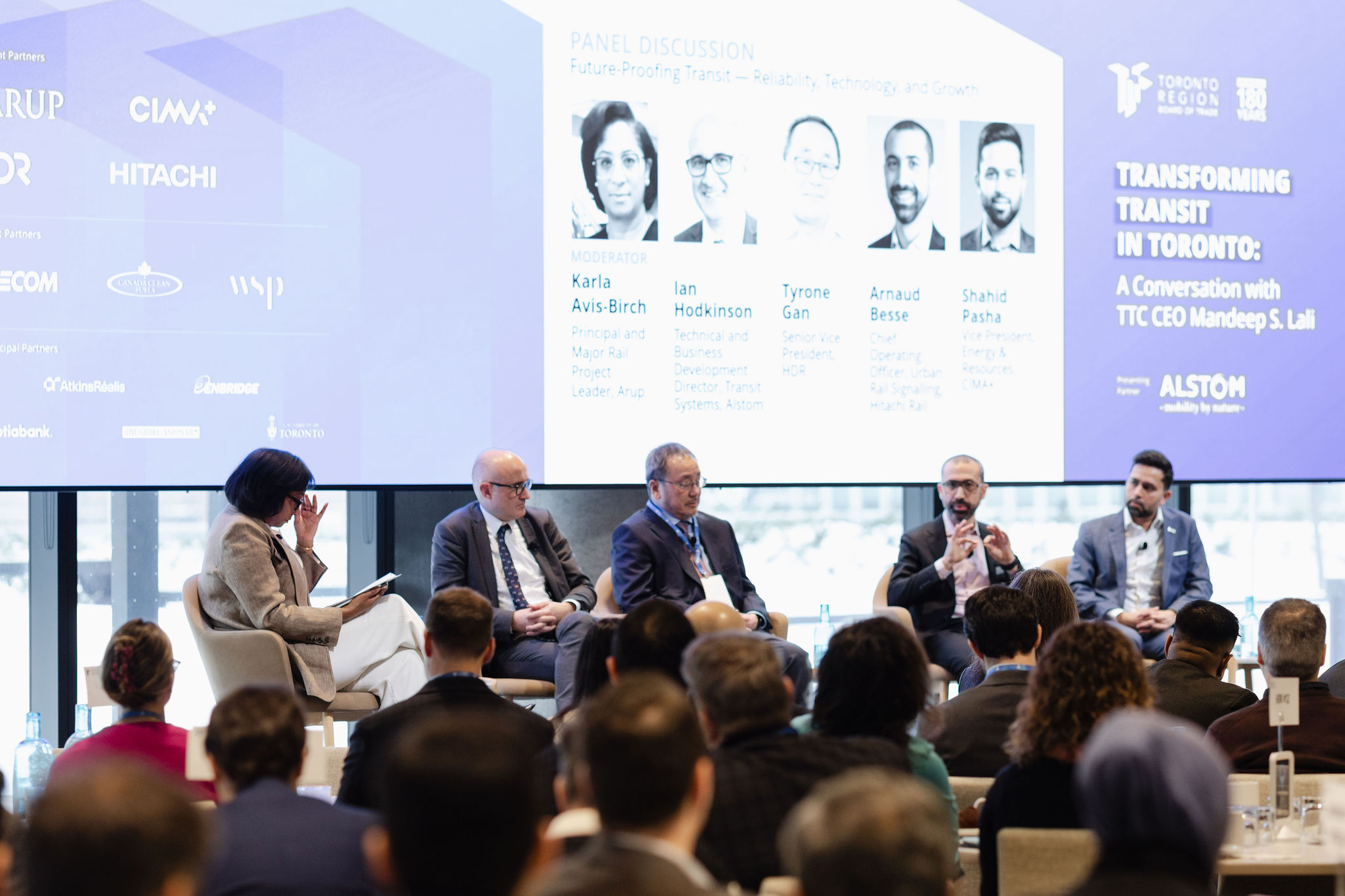
IN THEIR WORDS
“Building up transit is by far the biggest contribution we can make to solving Toronto’s congestion crisis. As goes mobility, so goes the vitality of our region.”
— Giles Gherson, President and CEO, Toronto Region Board of Trade
“Transit is not just about tracks, signals, and rolling stock. It is the lifeblood that feeds an ecosystem and allows a city to function.”
— Karla Avis-Birch, Principal and Major Rail Project Leader, Arup
“When I became chair, the situation looked very different. Most Torontonians viewed the TTC as unsafe, labour relations were strained, and confidence was low. That’s not where we are today.”
— Jamaal Myers, TTC Chair and City Councillor, Ward 23
“Transit projects are some of the most complex infrastructure projects that you can implement. And the track record isn’t great. Project delays, over budget, projects not meeting expectations of the owners.”
— Tyrone Gan, Senior Vice President, HDR
“We are not done with digital. Capacity, reliability, and customer experience will all depend on how well we apply data and technology in daily operations.”
— Ian Hodkinson, Vice President, Alstom
“If you look at cities like London and Paris, the share of people inclined to use public transit is much higher. That gap tells us what is possible if reliability and safety improve.”
— Arnaud Besse, Chief Operating Officer, Urban Rail Signalling, Hitachi Rail
“Innovation is not about bright ideas. It is about using the data we already have to make better decisions faster and improve the customer experience.”
— Shahid Pasha, Vice President, Energy and Resources, CIMA+