For many Canadian companies, international expansion follows a familiar script. A new market is identified, regulatory requirements are mapped, risks are assessed and a sales strategy is built from the ground up. When that foothold is secure, the process begins again elsewhere.
It is careful and deliberate, and for some firms it works well. But it is rarely the fastest path to meaningful global scale.
Some of Canada’s most successful exporters have taken a different approach. Rather than advancing country by country, they aligned themselves with customers that were already expanding internationally.
McCain’s growth story is a well-known example. The company did not enter dozens of markets independently; it grew alongside McDonald’s, scaling its operations as its anchor customer expanded around the world. One strategic relationship unlocked access to many jurisdictions at once.
For Canadian service exporters, that same principle deserves renewed attention.
Moving Beyond the Country-by-Country Model
Many firms still approach international growth linearly. Enter one country. Build presence. Invest locally. Repeat.
While this is a steady approach, it's also a slow one. Some of the most successful global companies scaled differently. They aligned with anchor customers that were already expanding.
McCain’s growth alongside McDonald’s illustrates the point. Rather than entering dozens of markets independently, the company grew in tandem with a global partner.
For service exporters, the same principle applies.
Instead of asking which country to enter next, firms can ask which global organization already serves the markets they want to reach.
- Where are procurement decisions made?
- Where are international partnerships structured?
- Where do global networks converge?
Why the UK Stands Apart
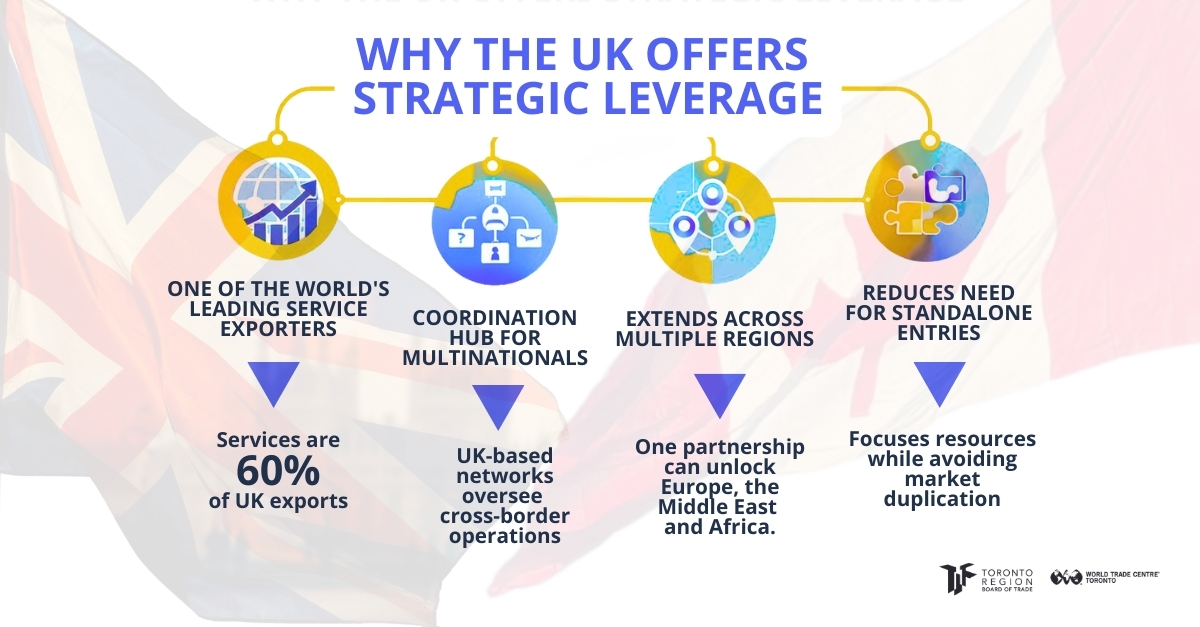
In many sectors, global decision-making and partnership coordination converge in the United Kingdom. For Canadian service exporters, that concentration of influence creates tangible advantages:
The UK is one of the world’s leading service exporters, with services accounting for close to 60 percent of total exports, reflecting structural strength in professional, financial and technology sectors.
Service exports have continued to grow even during periods when goods exports slowed, underscoring the resilience of the UK’s services economy.
Many multinational firms coordinate procurement, international delivery and client management from the UK, making it a central hub for cross-border operations.
A relationship with a UK-headquartered organization can extend beyond the British market into Europe, the Middle East, Africa and Asia through existing corporate networks.
Embedding into a UK-based platform reduces the need for separate market entry strategies in each jurisdiction, accelerating exposure while lowering duplication of effort.
The opportunity is not simply to sell into the UK. It is to use the UK as a point of leverage within global services networks.
From Market Access to Market Leverage
Trade agreements remain a critical foundation. At our recent Global Growth Series webinar, Unlocking CETA: How Canadian SMEs Can Maximize the EU Market Opportunity, the discussion centred on execution. Participants explored how to properly claim tariff preferences, navigate rules of origin and compete in European procurement markets. The session reinforced that preferential access is valuable, but only when firms understand how to use it effectively.
CETA reduces friction for Canadian exporters seeking to diversify into the European Union. The UK, while outside the EU framework, remains deeply interconnected with European and global markets through finance, professional services and corporate headquarters functions. Together, they offer a combination of access and connectivity that can be strategically powerful.
For service exporters in particular, those networks often matter more than tariff rates alone.
Anchoring for Global Scale
The most scalable international growth strategies are relational, not territorial.
They begin with a simple shift in thinking.
Not “Which country next?”
But “Which anchor unlocks multiple markets?”
Firms that embed themselves within global systems expand differently. Once aligned with customers or partners that already operate across borders, growth follows established networks rather than isolated entry plans.
For Canadian service exporters in fintech, AI, engineering, cleantech advisory and digital services, this shift can fundamentally reshape expansion strategy.
Instead of building multiple standalone presences, companies can:
- Focus investment where global decisions are made
- Align with platforms that already span regions
- Scale through networks rather than geography
The United Kingdom offers that concentration of influence and coordination.
For Canadian firms seeking faster, smarter global growth, the opportunity is not to add another country to the list.
It is to secure the anchor that opens access to many.
For many service exporters, that starting point is the UK.
The Global Growth Series equips Canadian exporters with practical, execution-focused insights to compete internationally with confidence. Through a mix of webinars and in-person events, the series tackles real-world challenges such as navigating tariff changes, understanding trade agreements like CETA and CUSMA and identifying emerging markets poised for growth. Each session brings together trade experts, policymakers and exporters to translate global shifts into clear, actionable strategies, helping Canadian firms diversify, scale and strengthen their position in a rapidly evolving trade landscape.