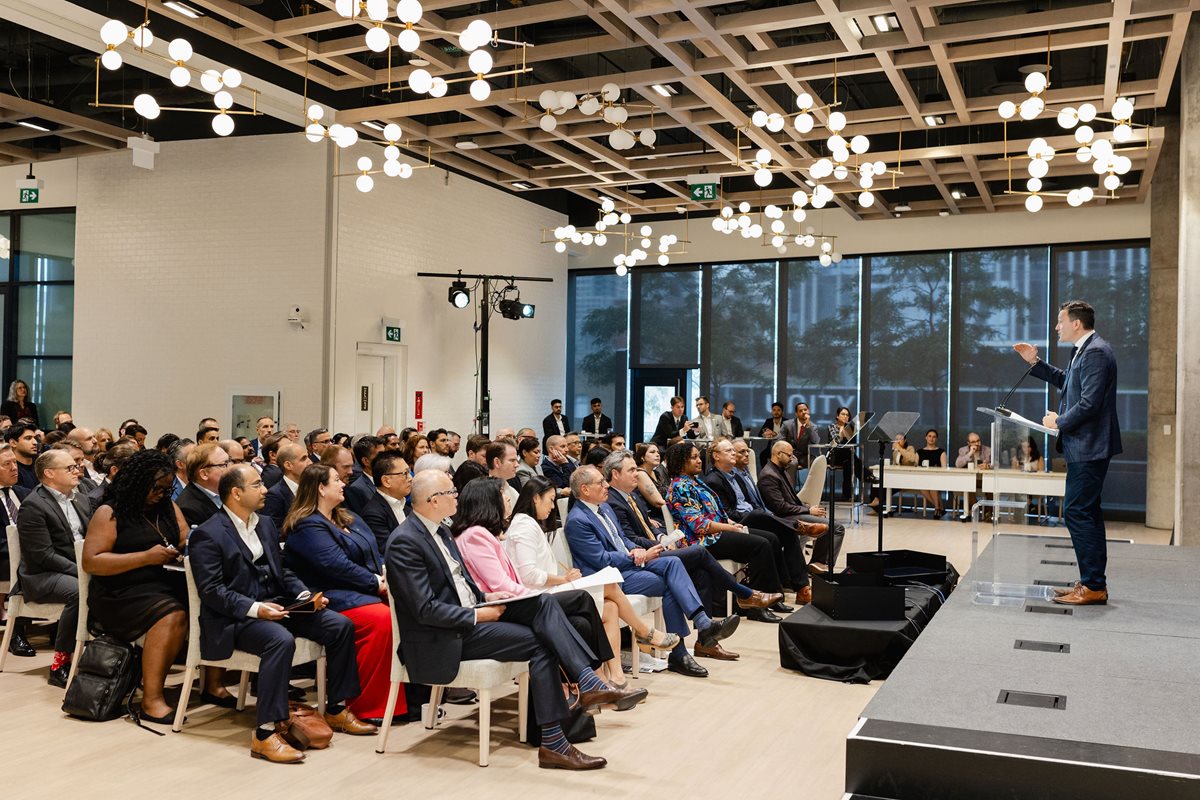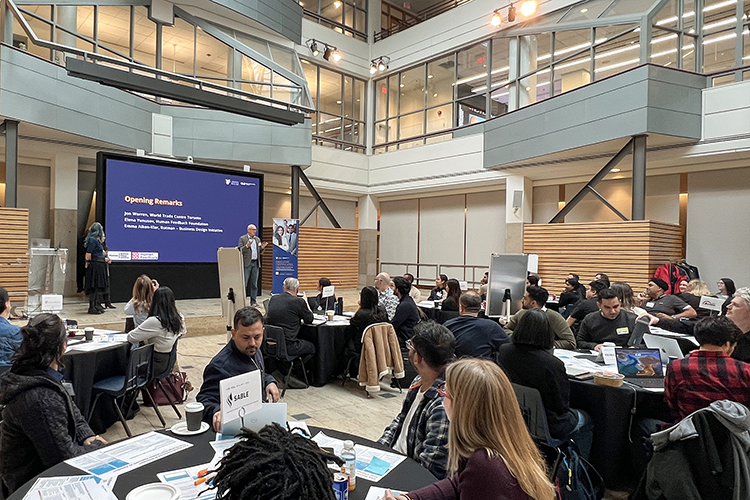
Opening remarks at the first-ever Human-Centered AI Buildathon, held April 21 at the Rotman School of Management.
Most small businesses have made a start with AI. A chatbot, a generative tool, a few experiments. But surface-level adoption only goes so far, and for many, the nagging feeling is less "we haven't started" and more "we should probably be doing something more with this."
Built around the idea that AI adoption stalls when tools aren't designed around how people actually work and make decisions, the first-ever Human-Centered AI Buildathon, held April 21 at the Rotman School of Management, was created to show there's a better way.
The format brought together an unlikely mix: business owners who understood their problems deeply, designers trained to map human friction, and builders who used AI to turn those insights into working agentic workflows the same night.
"We thought, why don't we do this collaboratively and prototype together," said Elena Yunusov, Executive Director of the Human Feedback Foundation. "To better understand where everyone's role really lands."
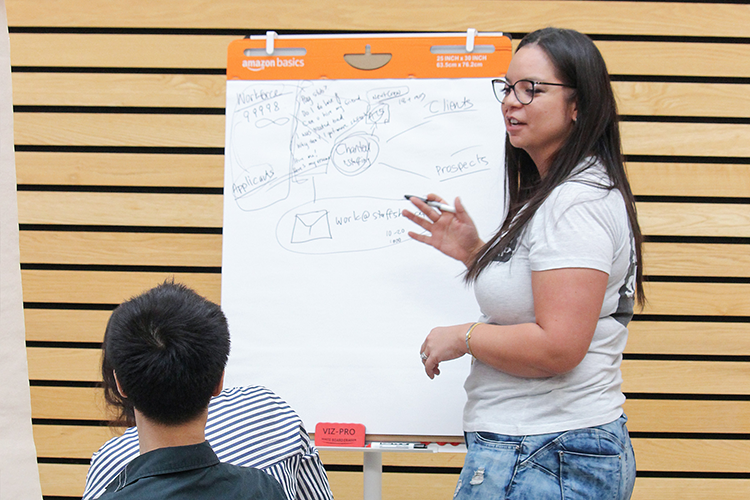
Ali Hernandez, COO of Staff Shop, maps her company's workflow during the problem framing phase.
The event was a partnership between Toronto Region Board of Trade's World Trade Centre Toronto, the Rotman Business Design Initiative, and the Human Feedback Foundation. For the first time, the map of a real operational problem was handed directly to a team to build a working proof of concept on the spot.
A business owner walks in with a problem, and four hours later there is something on a screen that didn't exist before.
The nine companies in the room came with real operational bottlenecks. At one table, Staff Shop, a Toronto-based staffing agency, came in with a problem that was equal parts operational and existential: email volume was slowing the business down, but the company's competitive advantage — the reason clients stayed loyal — was that people felt heard. Lose that human touch in the name of efficiency, and you've solved the wrong problem.
"Our business is built on people and relationships," said Ali Hernandez, COO of Staff Shop. "That was never something to automate away. The whole point is to give the people who build those relationships more space to do exactly that."
For Hernandez, that tension doesn't have to be a contradiction.
"Tonight was a great reminder that AI can actually be what enables more meaningful human connection. You just have to be intentional about what matters, right from the beginning."
The same tension was visible to Tara Caldwell, Product Design Lead at Loblaw Digital, who served as designer at the table.
"Their huge value prop is that people feel heard," she said. "We really want to be careful not to lose that."
Nick Yang, a team lead at PDI Technologies, volunteered as the group's 'vibe coder', using AI tools to build working software quickly. For him, the chance to work on a real problem with a real business owner was the whole point.
"These are real businesses with revenue and real-world problems," he said. "It's wonderful to hear directly from the executives running the company about what they're faced with day-to-day."
By the end of the evening, the team had built a prototype email triage system that classified incoming messages — a first step toward solving Staff Shop's volume problem without sacrificing what makes the company worth calling in the first place.
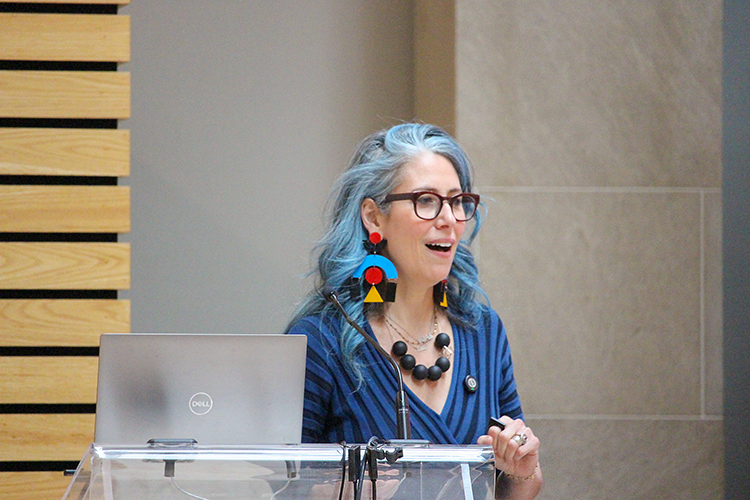
Emma Aiken-Klar, Academic Director of the Rotman Business Design Initiative, addresses the room.
Emma Aiken-Klar, Academic Director of the Rotman Business Design Initiative, says nothing since the printing press has had the transformative impact that AI is having — and that the speed at which AI is moving makes it even more important to put the human question before the technology question.
"If we solve for the technological problems, we are often creating bigger human problems if we're not paying attention. And the reason we care about this isn't just a moral issue — it's actually better for business."
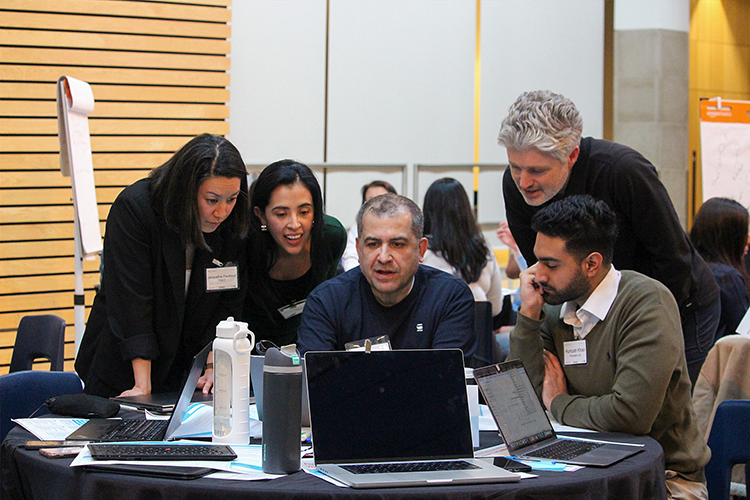
Participants work through the live build phase of the Buildathon.
It's an argument that resonates especially for smaller organizations. Without the resources of larger players, they can't afford to get it wrong. However, they have something enterprise companies often don't: leadership close enough to the front lines to drive adoption through the organization without losing the thread.
"They can deploy and learn much faster because they sit so much closer to the customers," said Yunusov.
"And I love seeing their ambition — because I think Canada needs more small businesses to succeed."