Exporters are feeling the squeeze. Few understand that better than Peter Hawkins, who's spent his career on the front lines of cross-border trade — watching shipments move, get stuck, and move again, often for reasons that have nothing to do with the goods themselves.
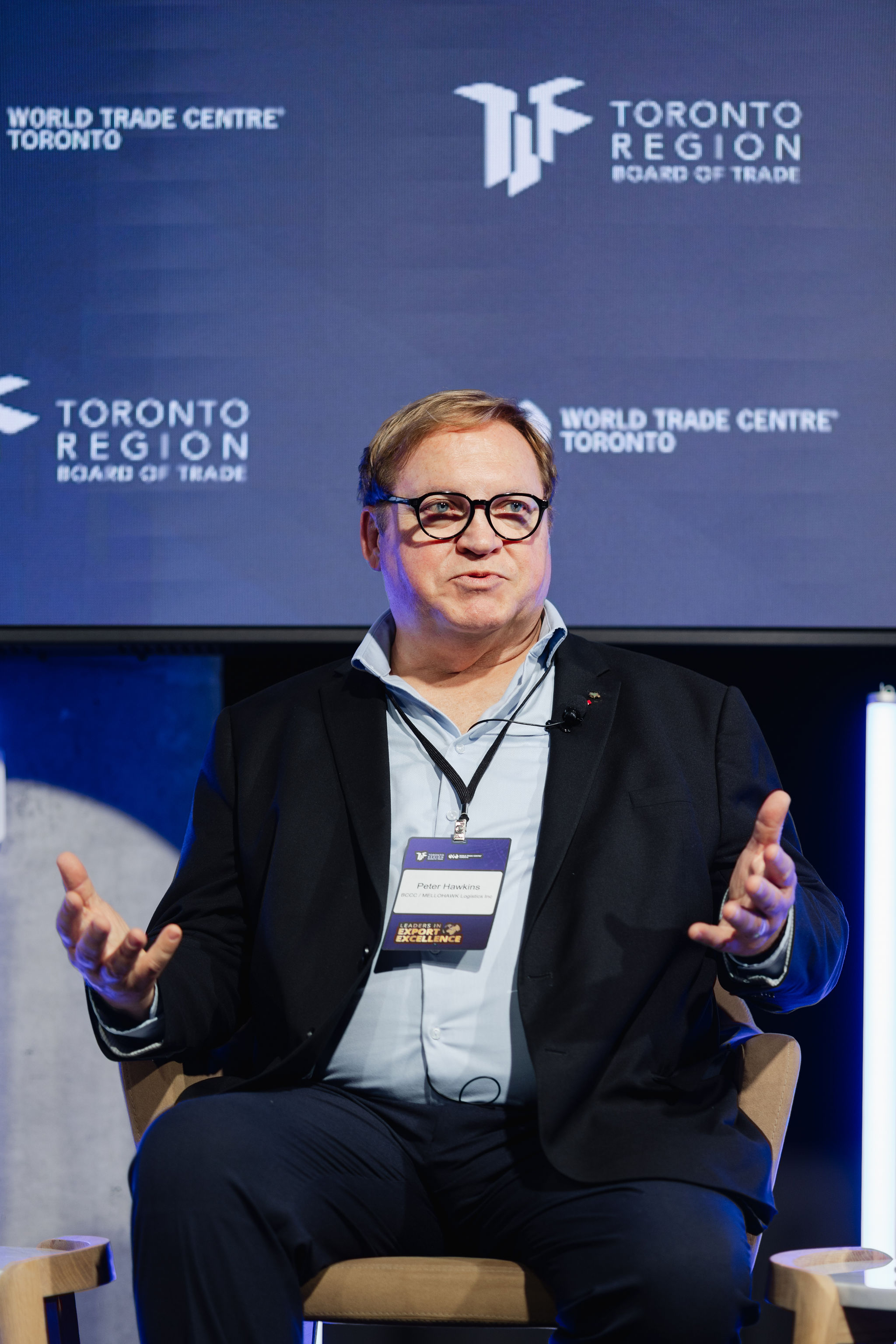
Hawkins runs the kind of business that works best when borders work efficiently. As Senior Vice President & Controller at MELLOHAWK Logistics, a Toronto-based freight forwarder, he spends his days moving cargo across that border — everything from industrial machinery to fine art. He's also a Trade Accelerator Program advisor with World Trade Centre Toronto, which gives him a front-row seat to how other exporters are navigating these problems.
He's watched plenty of disruption before. But the last few years have been different — shaped both by CUSMA itself and by a string of U.S. policy shifts that have little to do with the agreement's text.
"Something that used to take a week now takes a month," he says.
Some of the new friction is tied to CUSMA's own requirements, even if the rules themselves aren't entirely new: documentation proving rules-of-origin compliance has always been part of qualifying for preferential treatment under the agreement. What's changed, Hawkins says, is how rigorously that paperwork is now being checked. The Trump administration has placed a new emphasis on compliance enforcement that wasn't there before, and at minimum, Hawkins estimates the volume of paperwork involved has doubled as a result. Assembling and processing it now takes real time, a hurdle that wasn't nearly as costly before.
Other pressures are coming from outside the agreement entirely. The Trump administration has also changed what goods qualify for light-touch treatment in the first place, suspending a longstanding U.S. exemption that once let smaller shipments cross with minimal paperwork — a separate policy shift that has nothing to do with CUSMA itself.
"There was a de minimis rule that you could actually move $800 worth of stuff across the border with very minimal paperwork, and now that is gone," Hawkins says.
The result, according to Hawkins, is shippers confused about rules they previously never had to follow. Scrutiny that used to apply only to larger shipments now applies to nearly everything that crosses the border.
That confusion comes at a cost for exporters: consulting fees are climbing as exporters lean on Hawkins more than ever — one more expense layered on top of higher tariffs and slower business, a double whammy for companies already stretched thin.
"Before, I would spend 10, 15 minutes with somebody," he says, "but now, since I'm spending an hour, two hours, or three hours with someone, then we're charging for that time."
Part of what exporters are paying for is help making sense of a process that can shift without warning.
"Not having things grandfathered, having a decision made at midnight that is applied the next morning, and with something in mid-transit that suddenly jumps in price — that can be very frustrating for people."
Some of the friction isn't about policy at all, but rather the humans involved in the process.
"A lot of decisions are made by one individual receiving paperwork somewhere along the chain in government," Hawkins says. "It could be somebody deciding that document is not correct and then holding up the shipment."
He's careful to note it's not a bureaucrat trying to be difficult, but rather the result of heightened scrutiny applied one document at a time.

Hawkins's advice to exporters trying to navigate all of this is direct: move quickly, before it's too late.
"Wait and see is wait and die," Hawkins says.
His specifics:
- Learn your paperwork. Don't assume someone else will catch a mistake before it costs you time.
- Take a Trade Accelerator Program. Not just for what you learn, but for who you meet.
- Stay in close contact with your customers. Questions are bound to come up given the volume and complexity of the paperwork now required — better to be the one answering them than to let confusion sit.
- Diversify beyond the U.S. Mexico, Europe, Asia — logistically, they're all the same lift. The only thing standing between exporters and new markets is the decision to go.