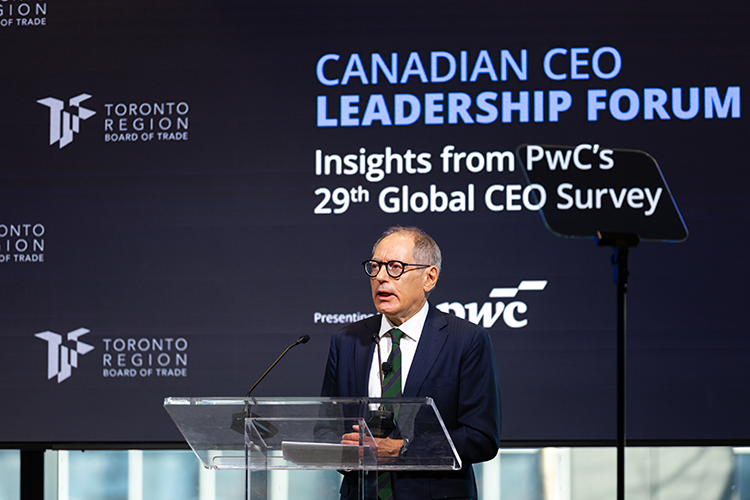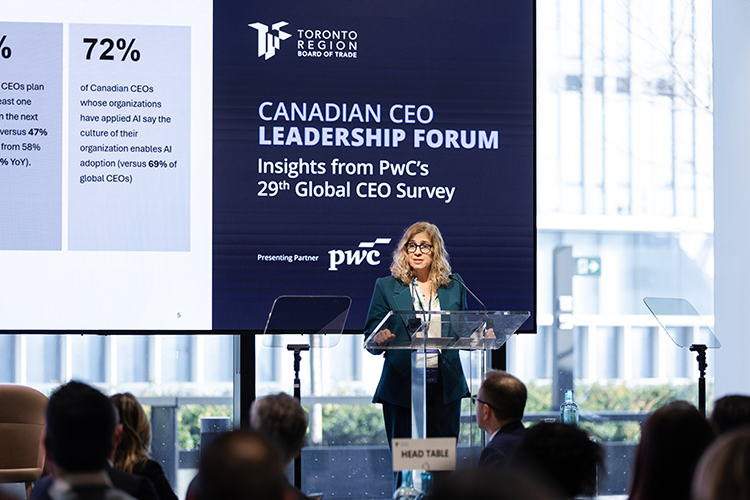
Canada is a country with enormous potential that keeps undermining itself. Our capital flows south and our talent follows. While the rest of the world accelerates, Canada is stuck debating how to move forward. Senior executives gathered at the Board's Canadian CEO Leadership Forum to confront that reality head on.
The forum was built around PwC's 29th Global CEO Survey, which captures the views of 4,500 CEOs worldwide including more than 130 in Canada. Lana Paton, Vice-Chair and Managing Partner for PwC Canada's Greater Toronto Area and Southwestern Ontario region, told those gathered: "Canada's position as a destination for global investment has really slipped, moving from 12th to 16th among G7 countries."
The fixes are not a mystery, but they require additional political leadership. Our President and CEO Giles Gherson was direct: "What we really need to see is structural reform of our regulatory apparatus, not bits and pieces and ad hocery." The event’s conversation kept coming back to one question: will Canada move past the talking, stop running small experiments that never scale, and actually execute?

Canada's overexposure to a single market is no longer manageable
Seventy-seven percent of Canada's exports go to one country, the U.S. The disruption of the past several years has exposed this as a serious vulnerability. The federal government has responded by opening bilateral trade discussions with 17 countries. The direction is right. Whether execution follows is the open question.
The AI gap is a strategy problem, not a technology problem
Ninety-four percent of Canadian CEOs have used AI in some form. Only 29% have deployed it at scale, compared to 43% of global peers. Too many organizations are just dipping their toe in the water instead of taking the plunge. The organizations seeing real results are starting with the biggest pain point in the business, get the C-suite to agree on it, and then bring in the technology people. As Nicolas Marcoux, CEO and Senior Partner of PwC Canada, put it: "It's a business conversation. Then you bring the tech people in."
Getting AI right means the whole C-suite has to own it
Every company needs to operate more like a technology company. That means using data, automation, and digital tools to fundamentally change how the business runs, not just adopting new software. It means identifying where the biggest opportunities lie and putting the right people in charge of pursuing them. It also means getting the CFO in the room early, because in industries with concentrated competition and reliable returns, profit expectations will grind innovation back toward the existing model every time. The organizations getting real returns are the ones that build the AI muscle gradually, commit to it, and stay patient.
Global investors want in. Red tape is keeping them out.
Global investors are actively looking for alternatives to the U.S., and sovereign wealth funds have said directly that they see Canada as a business-friendly environment. The opportunity is real. Canada doesn't need thousands of investors to show up. It needs a few with serious capital, aligned with Canada's pension funds and pointed at sectors where the country has real strengths: defense manufacturing, energy infrastructure, critical minerals, and data centres. Land those investors, and others follow.
Build the case. Don't ask for the favour.
Billions won't be deployed simply because people like Canada or feel a sense of obligation to it. Investors need a return. Canada's job is to build the conditions that make that return obvious. Jana Mosley, President and CEO of Toronto Hydro, put it plainly: Ontario is still one of the hardest places in the world to get a project to development stage, and that cannot coexist with the infrastructure ambitions the country is trying to pursue. The entire panel called for structural regulatory reform alongside significant tax reform.
27%
The share of Canadian CEOs confident in the Canadian economy's prospects over the next year, down 15% from last year's survey.
37%
Canadian CEOs with a clearly defined roadmap for AI initiatives, compared to 51% of global CEOs.
53%
Canadian CEOs who cited U.S. trade policy and tariffs as a concern for their business.
56%
Canadian CEOs whose companies have moved into new sectors in the past five years, compared to 42% globally.
16th
Canada's ranking as an investment destination among G7 countries at the time of the survey, down from 12th in the prior year.
“AI was born here, in this city — and somehow, we’re lagging the planet. The real question is: how do we move forward and adopt AI at scale? AI is the single best lever we have to close Canada’s productivity gap: doing more with fewer people, across every industry. This is our moment. We need to take it.” — Nicolas Marcoux, CEO and Senior Partner, PwC Canada
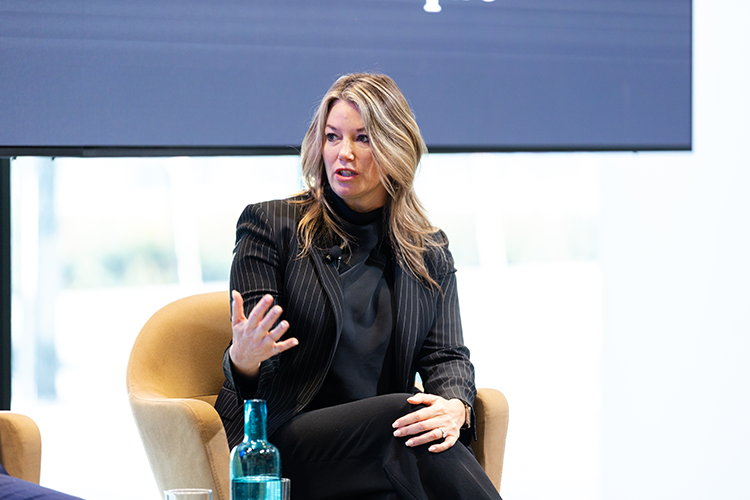
"We do way too much talking, hide behind pilots, play it safe. We need to really break that mold. That is what Canadians, and I think what the markets, are concerned about. Will Canada execute? Can Prime Minister Carney actually execute? Because it's not just about how many talented and experienced people he can bring in to work with him. As CEOs there's a big machine underneath us. It is the culture, the ways of working, and the process of unleashing people's ability to get things done that will be the difference maker." — Jana Mosley, President and CEO, Toronto Hydro
"It's April of 2026. I feel like there's a window of roughly two and a half years before global investment will no longer see the U.S. as chaotic. The infrastructure, the setup in Canada is very conducive, except for tax and regulations. If we can get money flowing into infrastructure, into the big check sizes, I think we'll land some of the sovereign funds. But that window will shut." — Brian Rosen, President, U.S. Northeast Region Brokerage, and CEO, Colliers Canada
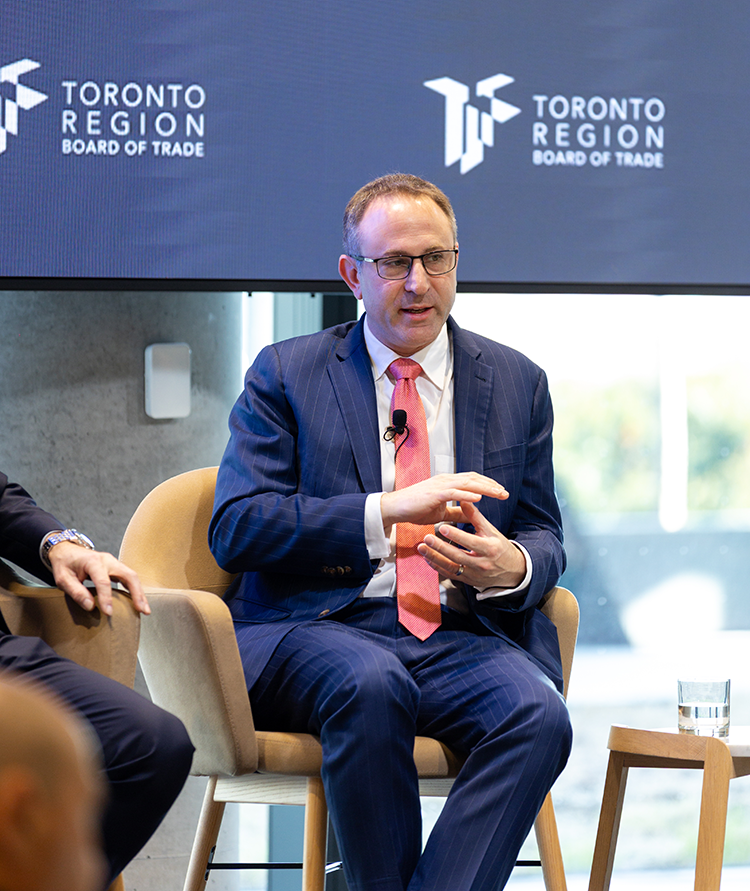
"We've seen massive capital outflow from Canada over the last decade and a half. Who's making America great again? Canadian capital. Those are dollars that could be deployed here and could have been making Canada great again, but they're not. [...] In relative terms, our taxes are much higher than the US, our nearest neighbour, and our regulations are much heavier. The relativity actually matters." — Giles Gherson, President and CEO, Toronto Region Board of Trade