Event Recap

From Discovery to Growth: The Push to Keep Canadian Innovation at Home

Presenting Partner:

speaker at podium

The University of Toronto has helped create more than 1,800 venture-backed companies, attracting over $27 billion in investment and generating thousands of jobs. But as the institution approaches its 200th anniversary, President Melanie Woodin is asking how the university can do even more.

At Meeting the Moment for Canada: Building Solutions for a Rapidly Changing World, Woodin outlined three presidential commitments: preparing future-ready graduates, advancing responsible AI adoption at scale, and mobilizing knowledge for social and economic impact. 

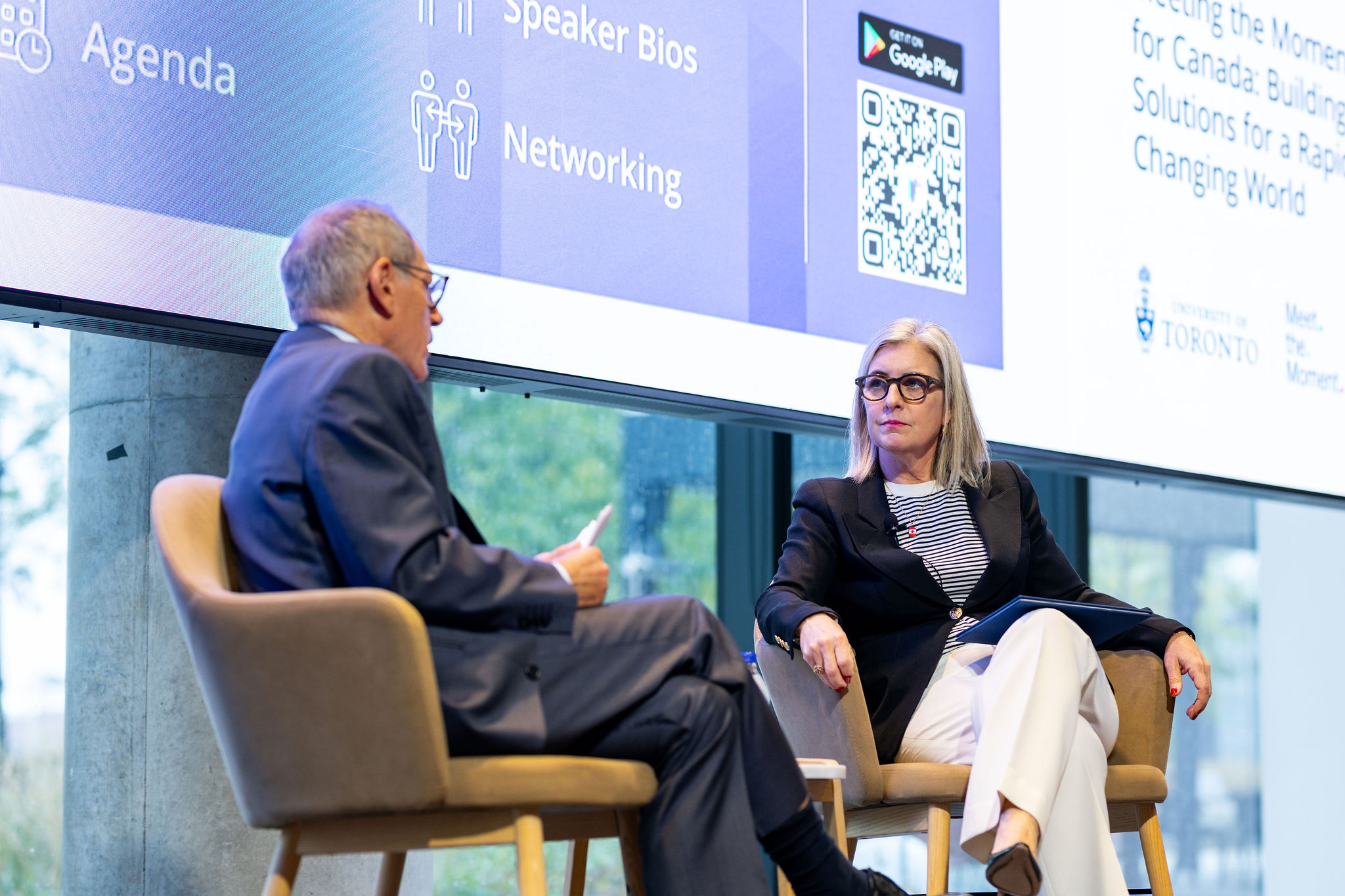
In conversation with the Board's President and CEO Giles Gherson, Woodin explored how universities can work more closely with industry to achieve those goals. Leaders from RBC, Cohere, Genesys Capital, OMERS and TELUS brought practical perspectives on how the University of Toronto can continue to foster entrepreneurship, technology adoption, investment and the policies needed to strengthen Canada's competitiveness. As Gherson put it:

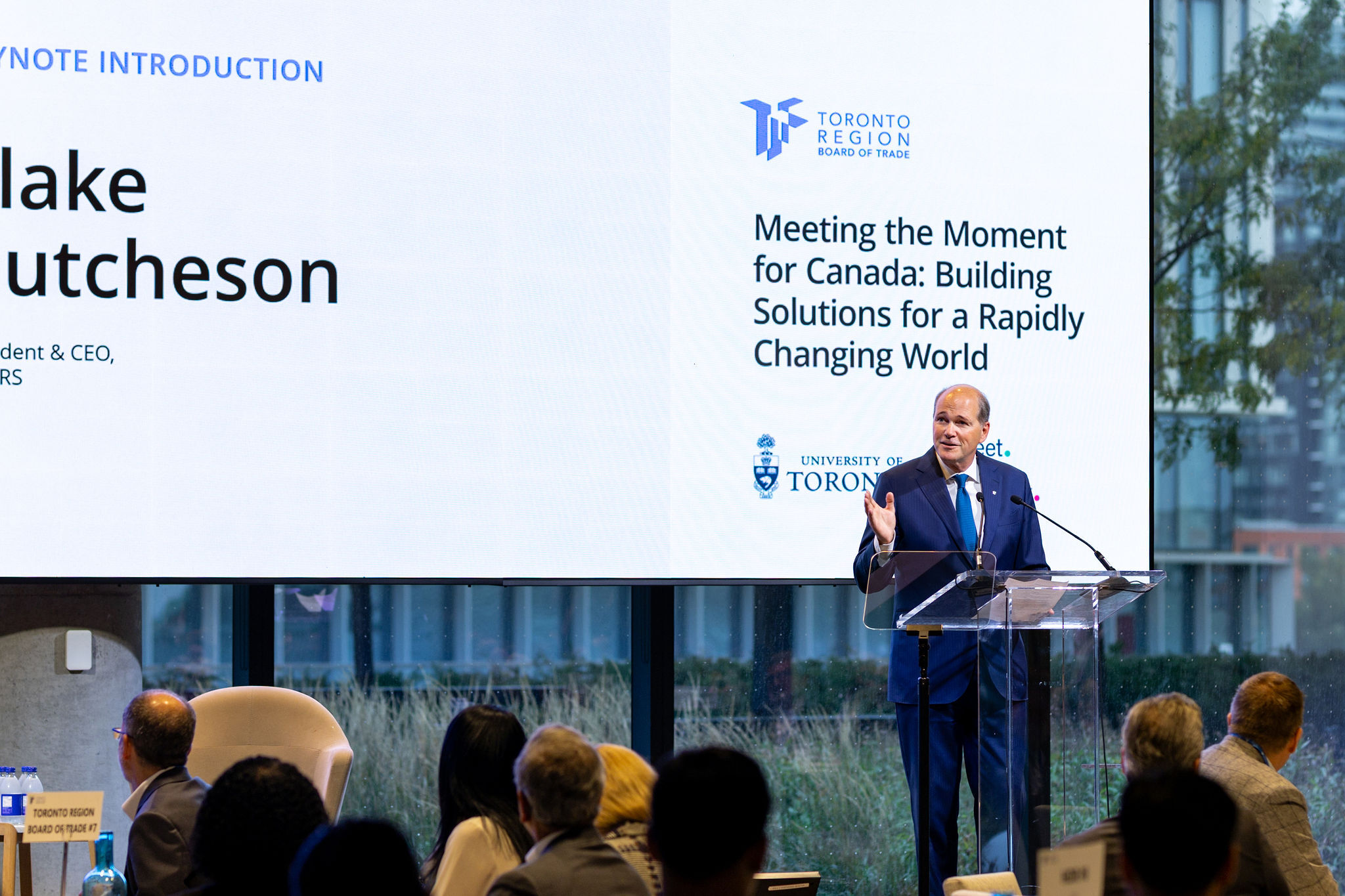
“At every corner of our economy, U of T’s fingerprints can be found. U of T punches so far above its weight in so many sectors: it’s where talent meets excellence across disciplines. And at a time when our economy is under siege from U.S. tariffs and a disrupted global economic order, the talent and skills emanating from U of T are exactly what we’re going to need to propel our country forward.”


speaker at podium

KEY TAKEAWAYS

Don't settle for third place.

Woodin challenged U of T to look beyond its standing as North America's third-ranked public university and ask why it shouldn't be number one. RBC's John Stackhouse and Cohere's Michael Pelosi echoed her call for greater ambition, arguing that Canada must move faster, think bigger and compete at a global scale. With geopolitical relationships shifting and countries seeking new economic partners, Canada has an opportunity to build on its strengths in research, talent and innovation. The country has already demonstrated it can produce world-leading ideas and discoveries. Now, the ambition must extend to attracting and retaining the world's brightest minds, building globally competitive Canadian companies and establishing Canada as a destination for investment and innovation. 

speaker

Turn Canada's talent and research into successful businesses

Canada needs to do more than produce talented graduates and groundbreaking research. It needs to turn both into successful businesses. Woodin called for expanded experiential learning and more opportunities for students to work alongside leading researchers, while emphasizing the need to simplify intellectual property agreements and connect researchers with the business expertise needed to turn promising discoveries into successful companies. RBC's John Stackhouse highlighted declining entrepreneurship among young Canadians, arguing that universities must do more to prepare students to start and grow companies. The Genesys University Seed Fund offers a practical example, connecting early-stage life sciences discoveries with capital and commercial expertise. 

speaker

Canada's AI leadership depends on responsible adoption

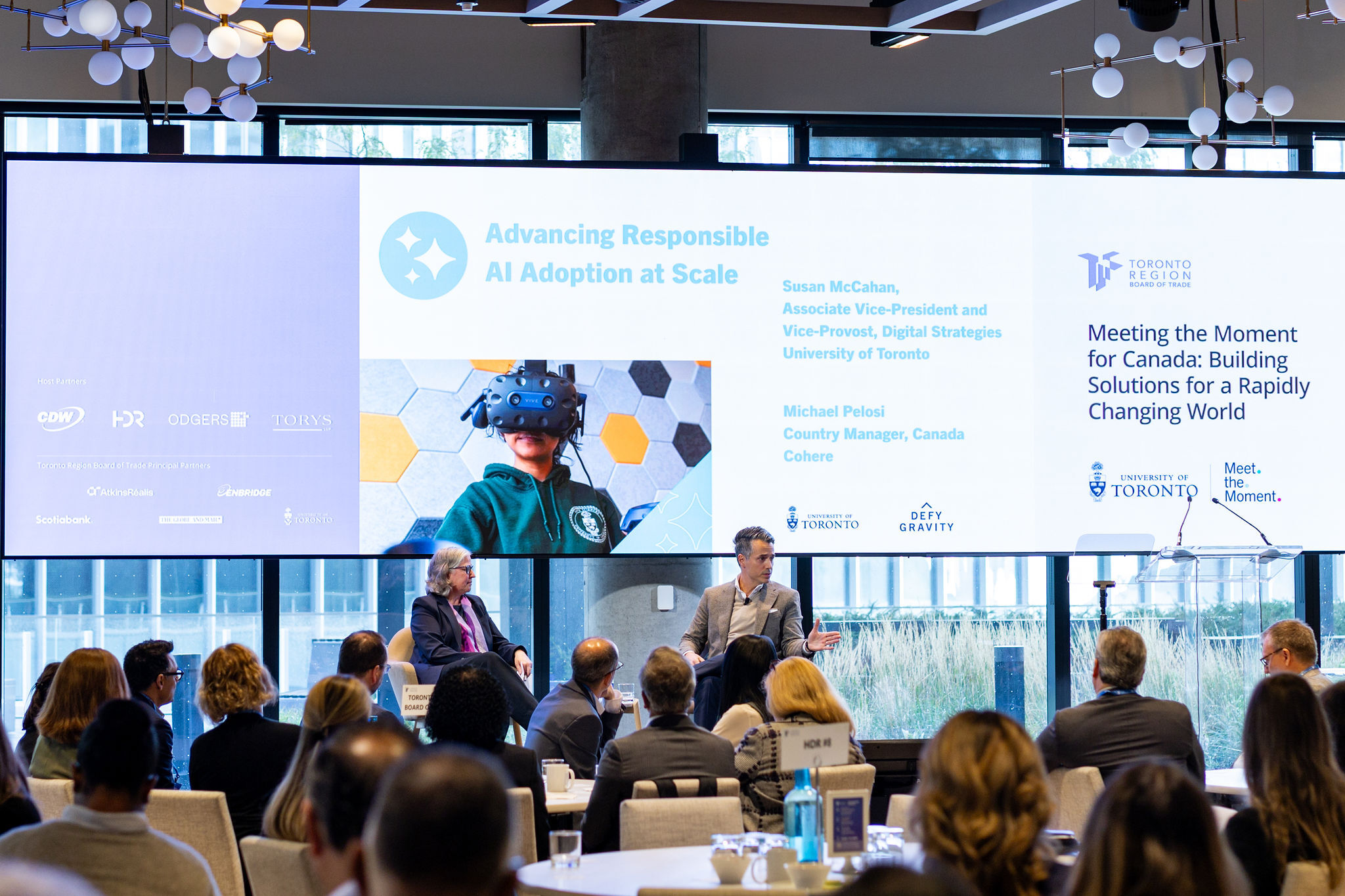
Having helped pioneer modern artificial intelligence, Canada now faces the challenge of putting the technology to work. Through a partnership with Cohere, U of T is developing an AI Kitchen to test applications across teaching, research and operations. The University’s Associate Vice-President and Vice-Provost, Digital Strategies, Susan McCahan emphasized that widespread adoption requires more than technological capability. Trust, data sovereignty, institutional control and human judgment will determine how effectively organizations use AI.

Growing new businesses requires strengthening the ones we have

As speakers called for more Canadian entrepreneurs and greater success commercializing homegrown research, TELUS President and CEO Victor Dodig offered an important reminder: supporting startups shouldn't mean overlooking the contributions of established Canadian companies. He pointed to the importance of Canada's banking, telecommunications and grocery sectors, emphasizing the essential services and infrastructure they provide. Dodig also called for stronger collaboration between universities and the private sector, arguing that isolated successes will not be enough to meet Canada's economic challenges. 

KEY NUMBERS

1,800+ companies

Venture-backed companies created by U of T faculty, students and alumni over the past decade, collectively raising more than $27 billion and creating approximately 28,000 jobs.

100,000+ students

Enrolled across the University of Toronto's three campuses, supported by a global network of more than 720,000 alumni.

$100 million

Investment in U of T's new Presidents' Impact Scholarship Program, supporting interdisciplinary doctoral research with annual scholarships of $80,000 over four years. The first cohort of 12 to 13 students will begin in September 2027. 

Fewer than 2%

The proportion of Canadians aged 20 to 39 who employ others, according to RBC research cited by John Stackhouse. That figure has declined by approximately 50% over the past two decades. 

$40 million

Target size of the Genesys University Seed Fund, designed to bring early-stage capital to life sciences innovations. The fund's second close, announced October 13, welcomed University Health Network and Sunnybrook as new partners. 

IN THEIR OWN WORDS

“The Times Higher Education ranks U of T as the third top public university in North America, only behind UCLA and Berkeley. And whenever I share this headline, you have to know I am deeply conflicted, because I know number three is impressive. But I am simultaneously asking myself, why aren't we number one? By every estimation, we have all the ingredients we need to rise in the ranks.”
— Melanie Woodin, President, University of Toronto

“U of T is one of the world's leading institutions and one of Canada's most important institutions. For generations, it’s educated our leaders, advanced groundbreaking research, and helped shape the economic, scientific, and social fabric of this nation. And we don't have enough of them, but U of T is one of the great competitive advantages in this great nation.”
— Blake Hutcheson, President and CEO, OMERS

Blake Hutcherson

“We regard U of T as Canada's university. Really, we see ourselves, for all the reasons that have been described, as the flagship for Canada, and so we feel a real genuine sense of responsibility about producing the graduates, and indeed the talent, that we feel that the country needs, especially right now.”
— Nicholas Rule, Vice-Provost, Academic Programs, University of Toronto

“We have a challenge in this country. And we'll come out with some research this week on youth entrepreneurship, which is in serious decline in our country. Not enough people, now in their 20s, are going out and starting their own businesses. There's a lot of people in the gig economy self-employed, but not starting their own businesses. And we've just done a massive grind with StatsCan data that shows that fewer than 2% of Canadians between the age of 20 and 39 employ others.”
— John Stackhouse, Senior Vice-President, Office of the CEO, RBC

“We considered thoughtfully what an institution dedicated to the development of human potential should look like five, 10 years from now, in the adoption of AI. We want to adopt it. We don't want it to adopt us.”
— Susan McCahan, Associate Vice-President and Vice-Provost, Digital Strategies, University of Toronto

“There is a real sense of pride and excitement around not settling and wanting to be the best. Melanie mentioned it, John mentioned it. This idea of why shouldn't we be number one? When we watch a hockey game in the Olympics, I don't think we're cheering for silver. […] A lot of the AI that you see globally was not only born in Canada, was born right here at University of Toronto.”
— Michael Pelosi, Country Manager, Canada, Cohere

“We all recognize there's also some very significant challenges with regards to commercializing IP, generating economic value in Canada and scaling. That was another theme that we heard a lot about: we've got a great foundation of excellence, but how do we build this at scale to meet the moment?”
— Leah Cowen, Vice-President, Research and Innovation, and Strategic Initiatives, University of Toronto

261013_Indigo_Events_0302-2

“It's easy to go out and say, hey, we're going to raise a pool of capital and we're going to spend it in your institution. It's a whole other thing to get those institutions to agree to be investors in the fund. To have a stake in it. And it changes the mindset completely of how I think this gets approached. It's no longer a buyer and a seller. It's a partnership.”
— Damian Lamb, Co-Founder and Managing Partner, Genesys Capital

Related Content

News

A quantum computer, courtesy Xanadu / The Logic.
Quantum Leap: Why Toronto is Leading the Computing Revolution

Discover how Toronto is leading the quantum computing revolution as Xanadu CEO Christian Weedbrook explores groundbreaking innovations, industry applications, and the city's growing role as a global quantum technology hub.

JAN 2025

News

girl giving presentation
A Case for Employer Competitions in the Classroom

Work-integrated learning (WIL), such as internships and co-ops, is the unsung hero of education policy.

MAY 2026