Event Recap

Canada's AI Future: Scaling AI for Business Growth

speaker at podium

Nine in ten Ontario manufacturers believe advanced technologies like AI can transform their businesses, yet only 15% have adopted them extensively. For Canadian companies struggling to grow, that gap between potential and practice is becoming increasingly difficult to ignore.

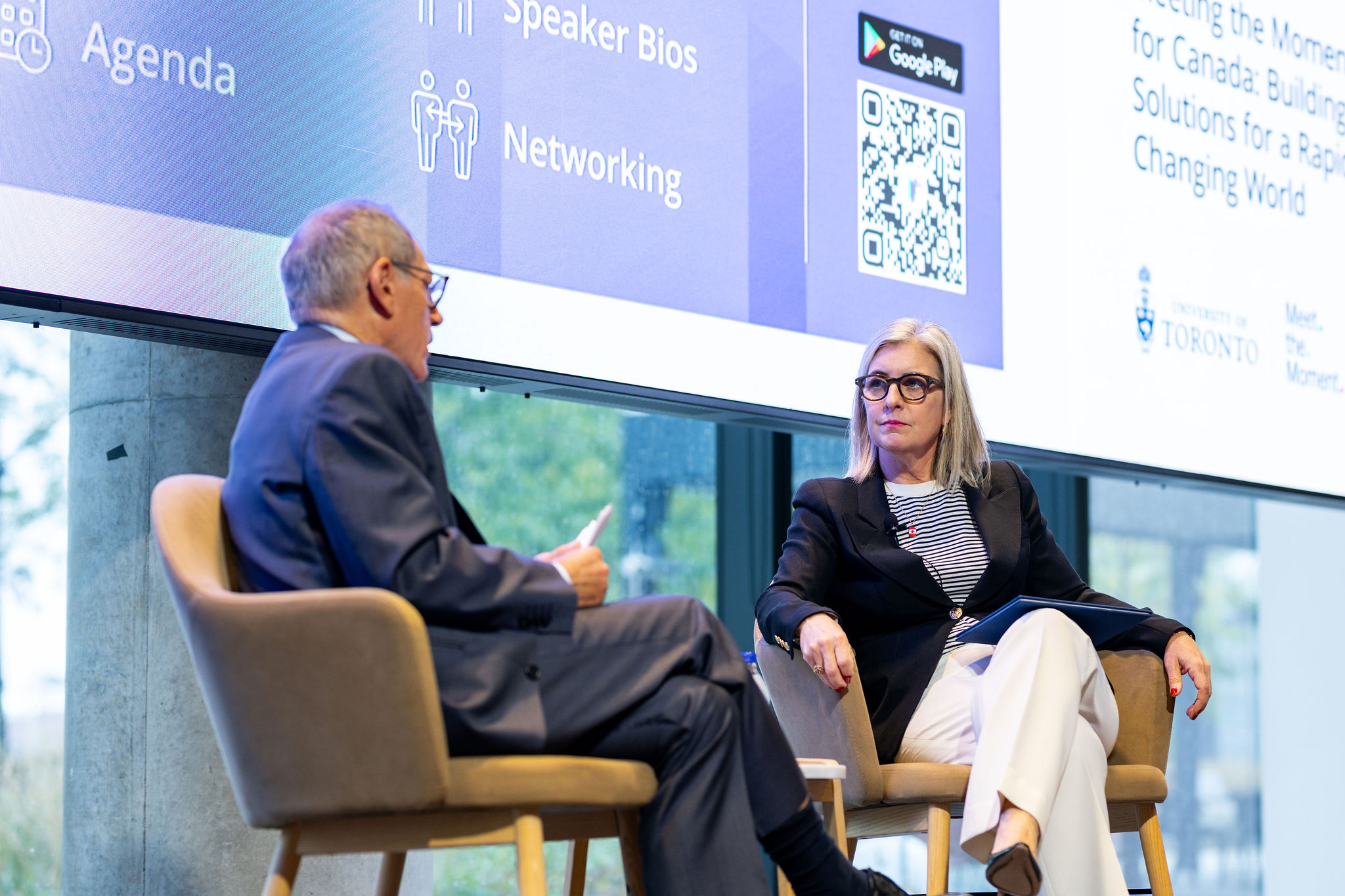
At Canada's AI Future: Scaling AI for Business Growth, HP Canada President and Managing Director Michelle Biase explored how businesses can turn AI into measurable results. From AI-enabled devices and services to employee training and cost management, Biase outlined how HP is helping organizations put the technology to work.

“AI adoption is table stakes. We know this, but adoption is not simple. Canada's next advantage will come from how effectively businesses can put AI to work. The role of Canadian businesses is to turn our AI leadership into broader economic progress by adopting AI in ways that improve productivity, strengthen competitiveness, and create value across our economy.”

In conversation with the Board's President & CEO Giles Gherson, Biase examined how AI could help smaller Canadian businesses overcome longstanding barriers to growth. Gherson pointed to what he called Canada's subscale firm syndrome, arguing that AI could help level the playing field,

“It's no surprise that SMEs, with their lack of scale and capacity, generally have a hard time competing with larger enterprises. But small scale shouldn't be a vortex that traps firms, a vicious cycle. That's precisely where AI-enabled technologies can be the great equalizer, but only if they can access these tools.”


speaker at podium

KEY TAKEAWAYS

AI can help Canadian businesses break the cycle of staying small

Canada's small and medium-sized businesses face a persistent challenge: limited resources make it difficult to invest in technology, expand into new markets and compete with larger enterprises. While AI offers an opportunity to change that equation, barriers to adoption remain significant, from limited capital and technical expertise to outdated systems and insufficient training. HP Canada is helping address these challenges by integrating AI into familiar workplace tools, offering AI training through its HP LIFE platform and working with technology partners to make industry-specific applications more accessible. Smaller businesses can develop the capacity to grow and compete without the resources of a much larger enterprise.

Start with the business problem, not the technology

Deploying AI is relatively straightforward. Making it deliver measurable results is considerably harder. Too many organizations are investing in AI without clearly defining what they want to achieve, leaving them struggling to justify rising costs. Successful adoption requires business and technology leaders to establish shared objectives, identify practical applications and measure the returns. Where AI operates also matters. HP's work with businesses demonstrates how combining cloud computing with AI running directly on devices or local infrastructure can improve performance, strengthen data security and reduce costs. From AI-enabled printing and document management to real-time decision-making in remote industrial settings, the opportunity lies in matching technology to the problems businesses need to solve.

Prepare people for the future of work

AI's potential to improve productivity depends on employees having the skills and confidence to use it effectively. Simply providing access to new tools is not enough. Businesses must invest in AI literacy, communicate clearly about how technology will change existing roles and help employees move away from repetitive tasks toward higher-value work. This transition also raises questions about the future of entry-level employment, as AI increasingly takes on responsibilities traditionally assigned to younger workers. HP is already rethinking how its internship programs can provide greater exposure to strategic decision-making and business operations. Universities, colleges, employers and governments all have a role in preparing workers for an economy where AI will be increasingly embedded in everyday work.

speaker

KEY NUMBERS

44th out of 47 countries

Canada's ranking for AI training and literacy. Canada also ranked 42nd out of 47 countries for trust in AI systems, highlighting significant challenges for widespread adoption.

24%

Of Canadians have received any AI training. Fewer than four in ten Canadians report having moderate or high knowledge of AI, suggesting a substantial gap between the technology's potential and people's ability to use it effectively.

47%

Of workers use employer-provided AI daily or weekly, up 12 percentage points from the previous year, according to Canadian findings from HP's Work Relationship Index. Meanwhile, 26% report not using AI at all.

33%

Of knowledge workers say their organizations clearly communicate how AI could affect their roles, compared with 52% of business leaders, according to HP's Work Relationship Index findings. The gap underscores the importance of transparency and employee engagement as businesses introduce new technologies.

49%

Of leaders have already scaled back their use of AI agents because of rising costs. As businesses deploy more sophisticated AI systems, controlling computing expenses while demonstrating measurable returns is becoming increasingly important.

150 technology partners

The approximate number of independent software vendors HP is working with globally to integrate AI applications into its technology ecosystem. These partnerships are part of HP's efforts to make AI more accessible through the tools businesses already use.